


























Views
Plays
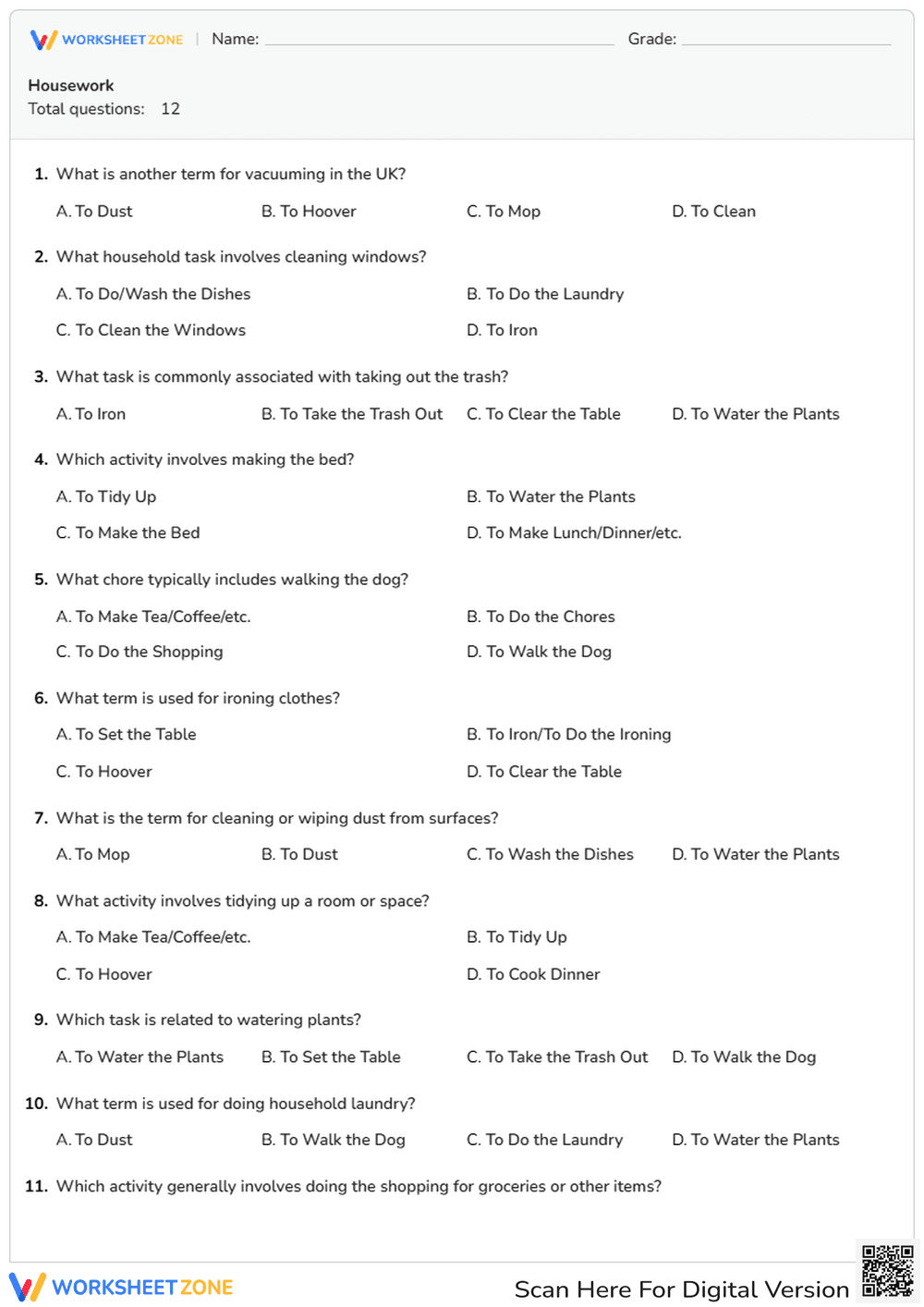


Grade 1 Housework Vocabulary — Printable No-Prep Worksheet
Paste this activity's link or code into your existing LMS (Google Classroom, Canvas, Teams, Schoology, Moodle, etc.).
Students can open and work on the activity right away, with no student login required.
You'll still be able to track student progress and results from your teacher account.
This ready-to-use vocabulary worksheet helps early elementary students identify and understand common household chores. By matching descriptive phrases to the correct terminology, learners build functional language skills and expand their everyday vocabulary. The straightforward multiple-choice format ensures students can demonstrate comprehension independently.
At a Glance
- Grade: 1 · Subject: ELA
- Standard:
CCSS.ELA-LITERACY.L.1.6— Use acquired words and phrases in context- Skill Focus: Housework Vocabulary
- Format: 2 pages · 12 problems · PDF
- Best For: Independent practice or assessment
- Time: 10–15 minutes
This two-page resource features 12 multiple-choice questions focused on daily household tasks. Students read a brief description, such as "cleaning windows" or "taking out the trash," and select the matching vocabulary term from four options. The clear layout and familiar subject matter make it highly accessible for young readers and English language learners alike.
- Print (1 min): Simply download the PDF and print double-sided for a quick, single-sheet activity.
- Distribute (1 min): Hand out to students as a morning work assignment or quick vocabulary check.
- Review (3 mins): Go over the 12 questions together as a class to reinforce pronunciation and meaning.
With under two minutes of total teacher prep time, this worksheet is an excellent addition to any emergency sub plan or last-minute lesson adjustment.
Aligned to CCSS.ELA-LITERACY.L.1.6, this activity requires students to use words and phrases acquired through conversations and reading. It supports foundational language development by connecting everyday actions to specific terminology. Both standard codes can be copied directly into lesson plans, IEP goals, or district curriculum mapping tools.
Deploy this worksheet after a class discussion about responsibilities at home or community helpers. It serves as an effective independent practice activity while the teacher works with small groups. For a quick formative assessment, observe which students struggle with regional terms versus standard terms, adjusting future vocabulary instruction accordingly. Expected completion time is 10 to 15 minutes.
This resource is ideal for Kindergarten through 2nd-grade students, as well as beginner ESL/ELL learners building functional life skills vocabulary. The multiple-choice format provides built-in scaffolding for students who need visual structure. Pair this worksheet with a picture book about helping at home or a classroom chore chart to reinforce the concepts in a real-world context.
Integrating functional vocabulary into early elementary education is essential for developing comprehensive communication skills and fostering independence. According to Fisher & Frey (2014), explicit vocabulary instruction that connects directly to students' daily lives and routines significantly improves both reading comprehension and expressive language capabilities. This targeted worksheet aligns with CCSS.ELA-LITERACY.L.1.6 by having students use acquired words and phrases in context, specifically focusing on practical housework vocabulary. By practicing these everyday terms through structured multiple-choice questions, young learners solidify their understanding of common household concepts and actions. Regular, repeated exposure to domain-specific words in highly familiar contexts allows early readers to build a robust mental lexicon. This foundational language development is a critical predictor of future academic success across all subject areas, ensuring students can confidently articulate their experiences and responsibilities.


