


























Views
Downloads

Printable House Vocabulary Worksheet | Grade 5 ELA
Paste this activity's link or code into your existing LMS (Google Classroom, Canvas, Teams, Schoology, Moodle, etc.).
Students can open and work on the activity right away, with no student login required.
You'll still be able to track student progress and results from your teacher account.
This comprehensive vocabulary worksheet helps students master domain-specific architectural and housing terms while practicing their creative writing skills. By engaging with a themed word search, matching definitions, and a descriptive writing prompt, learners actively expand their working vocabulary and apply new words in context.
At a Glance
- Grade: 5 · Subject: ELA
- Standard:
CCSS.ELA-LITERACY.L.5.6— Acquire and use domain-specific words accurately- Skill Focus: Vocabulary Acquisition
- Format: 3 pages · 4 activities · Answer key included · PDF
- Best For: Independent practice and sub plans
- Time: 30–45 minutes
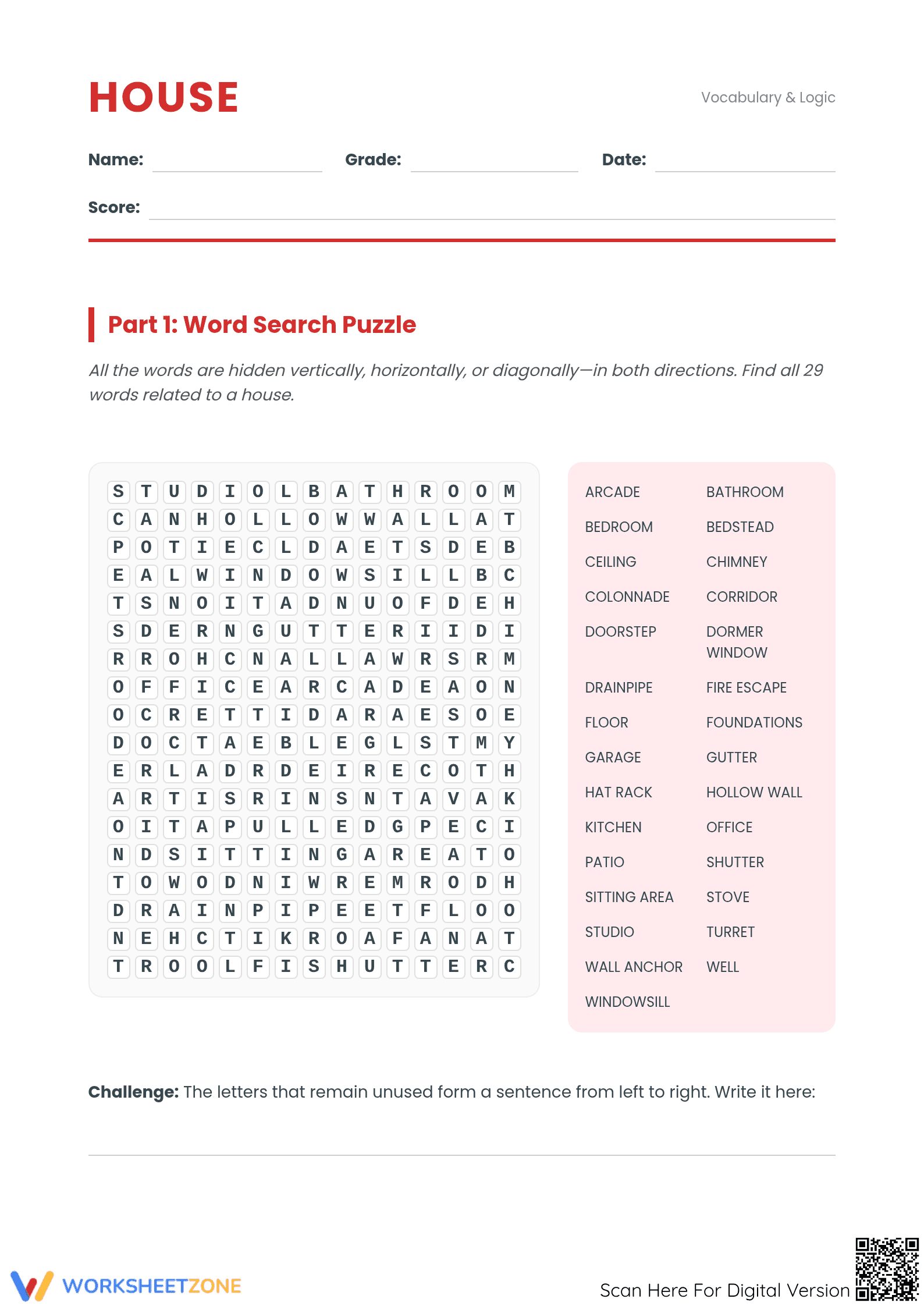
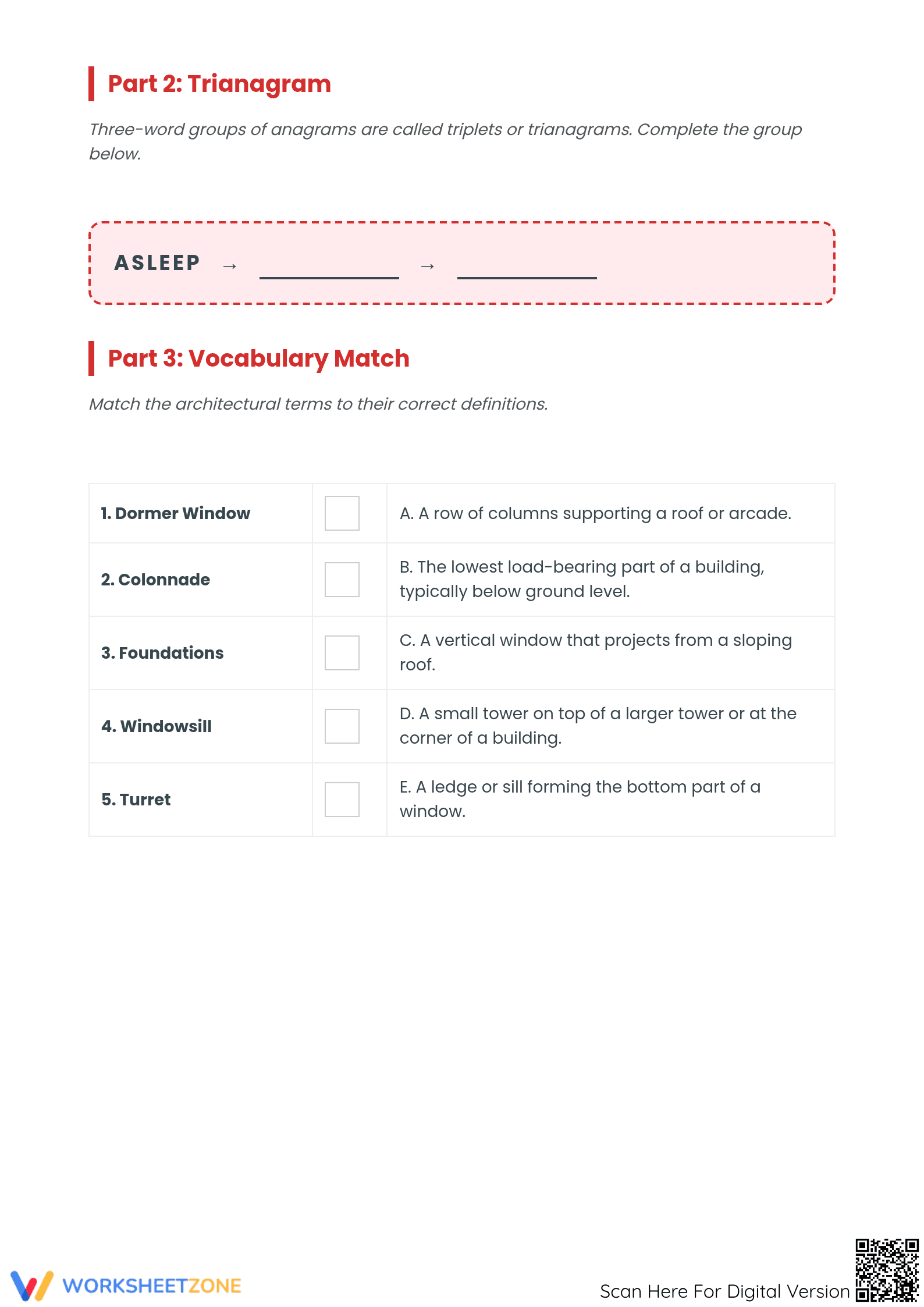
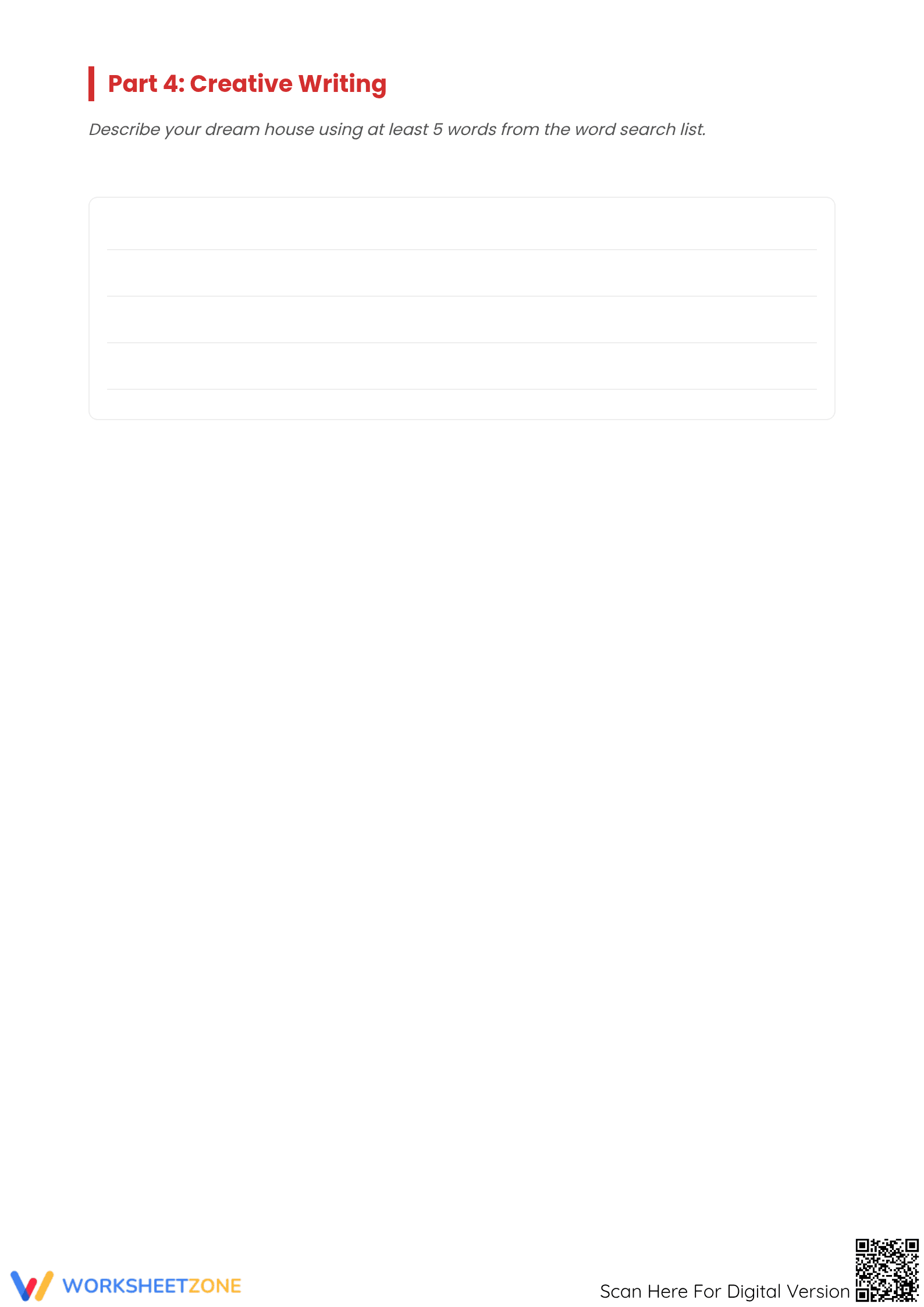
This three-page packet features four activities to reinforce spelling and meaning. Students complete a 29-word search puzzle with a hidden sentence challenge, solve a trianagram, and match architectural terms like "colonnade." Finally, a creative writing prompt asks students to describe a dream house using five new vocabulary words. An answer key is provided.
- Print (1 minute): Simply print the three-page PDF packet and the accompanying answer key. No special materials or prior setup are required.
- Distribute (1 minute): Hand out the packets to students for immediate engagement. The clear instructions make it entirely self-explanatory.
- Review (3 minutes): Use the provided answer key to quickly check the puzzle and matching sections, leaving only the short creative writing paragraph for individual review.
With under five minutes of total teacher prep time, this resource is an ideal, stress-free option for emergency sub plans or quiet independent work stations.
Aligned to primary standard CCSS.ELA-LITERACY.L.5.6, this resource ensures students acquire and use accurately grade-appropriate general academic and domain-specific words and phrases. The creative writing component also supports descriptive writing standards by requiring students to integrate new vocabulary into original sentences. Both standard codes can be copied directly into lesson plans, IEP goals, or district curriculum mapping tools.
This packet works beautifully as an independent vocabulary center. Students work through the puzzles at their own pace before tackling the writing prompt. Alternatively, it serves as an effective emergency substitute activity, keeping students quietly engaged. Teachers can use the writing section as a formative assessment to observe how well students grasp the new terms. Expected completion time is 30 to 45 minutes.
This resource is primarily designed for fifth-grade students, though it is highly adaptable for upper elementary and middle school learners who need vocabulary enrichment. The word search provides a low-barrier entry point for students who benefit from visual scanning exercises, while the creative writing task offers a natural extension for advanced learners. It pairs perfectly with a reading passage about architecture, historical homes, or community buildings.
Integrating domain-specific vocabulary practice into daily literacy routines significantly improves reading comprehension and descriptive writing abilities. According to Fisher & Frey (2014), explicit vocabulary instruction combined with multiple exposures to new words in varied contexts is essential for long-term retention. This worksheet directly supports CCSS.ELA-LITERACY.L.5.6 by requiring students to acquire and use domain-specific words accurately. By transitioning learners from simple word recognition in a puzzle format to definition matching and finally to applied creative writing, the activities ensure deep cognitive processing of the new terms. Students do not just memorize definitions; they actively construct meaning and apply their knowledge to describe a dream house. This multi-modal approach to vocabulary acquisition builds stronger foundational language skills, equipping students with the precise terminology needed to articulate complex ideas and succeed in cross-curricular academic tasks.


