


























Views
Downloads

Printable Homophones Worksheet | Grade 1 ELA Essential
Paste this activity's link or code into your existing LMS (Google Classroom, Canvas, Teams, Schoology, Moodle, etc.).
Students can open and work on the activity right away, with no student login required.
You'll still be able to track student progress and results from your teacher account.
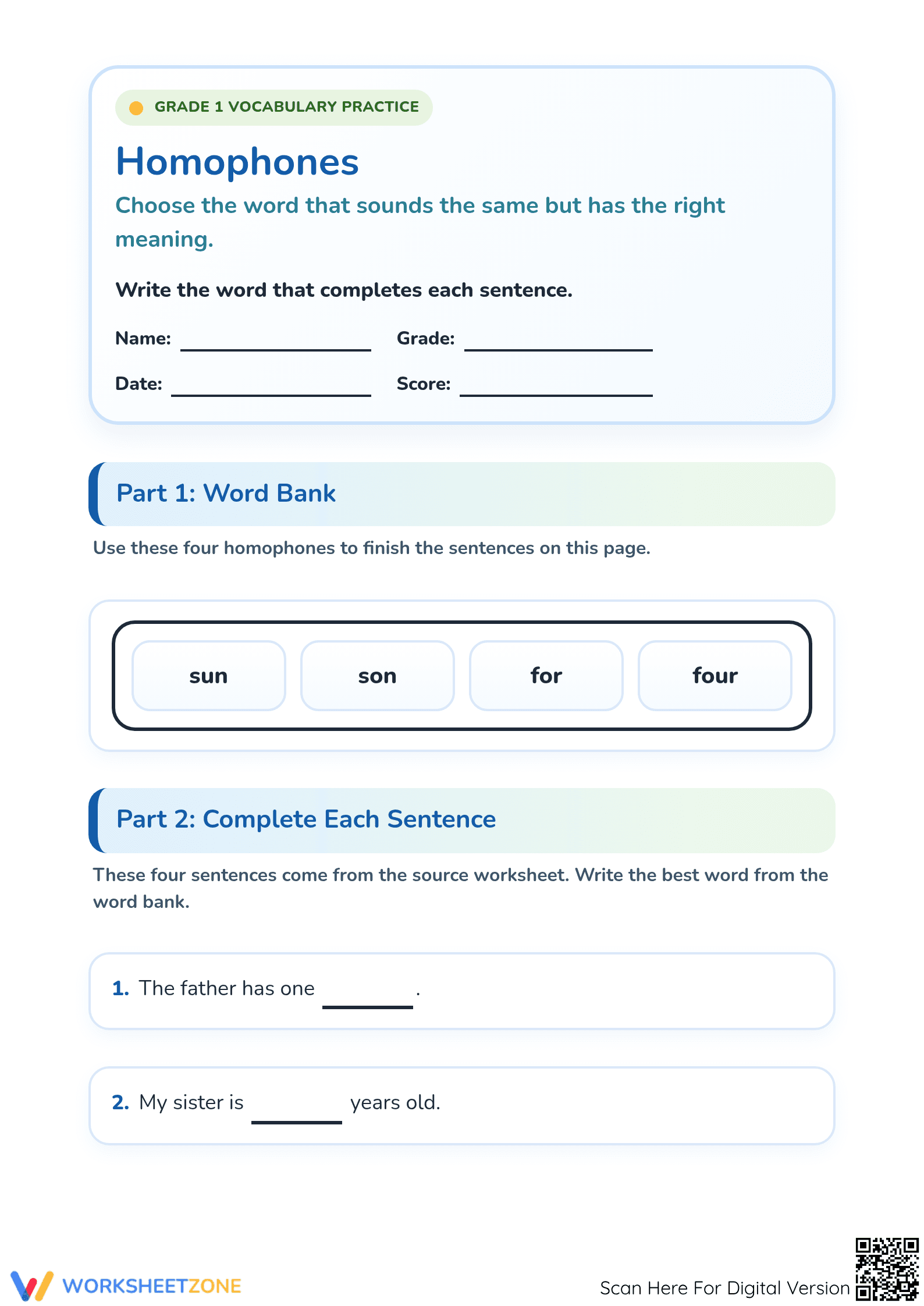
This Grade 1 homophones worksheet provides essential practice for young learners to distinguish between words that sound alike but have different meanings. Students focus on the high-frequency pairs "sun/son" and "for/four" through contextual sentence completion. By engaging with these specific lexical challenges, first graders build the foundational spelling and vocabulary skills necessary for reading fluency.
At a Glance
- Grade: 1 · Subject: English Language Arts (ELA)
- Standard:
CCSS.ELA-LITERACY.L.1.4— Use sentence-level context as a clue to the meaning of a word- Skill Focus: Homophone Differentiation (sun/son, for/four)
- Format: 3 pages · 12 problems · Answer key included · PDF
- Best For: Independent practice and small group literacy centers
- Time: 15–20 minutes
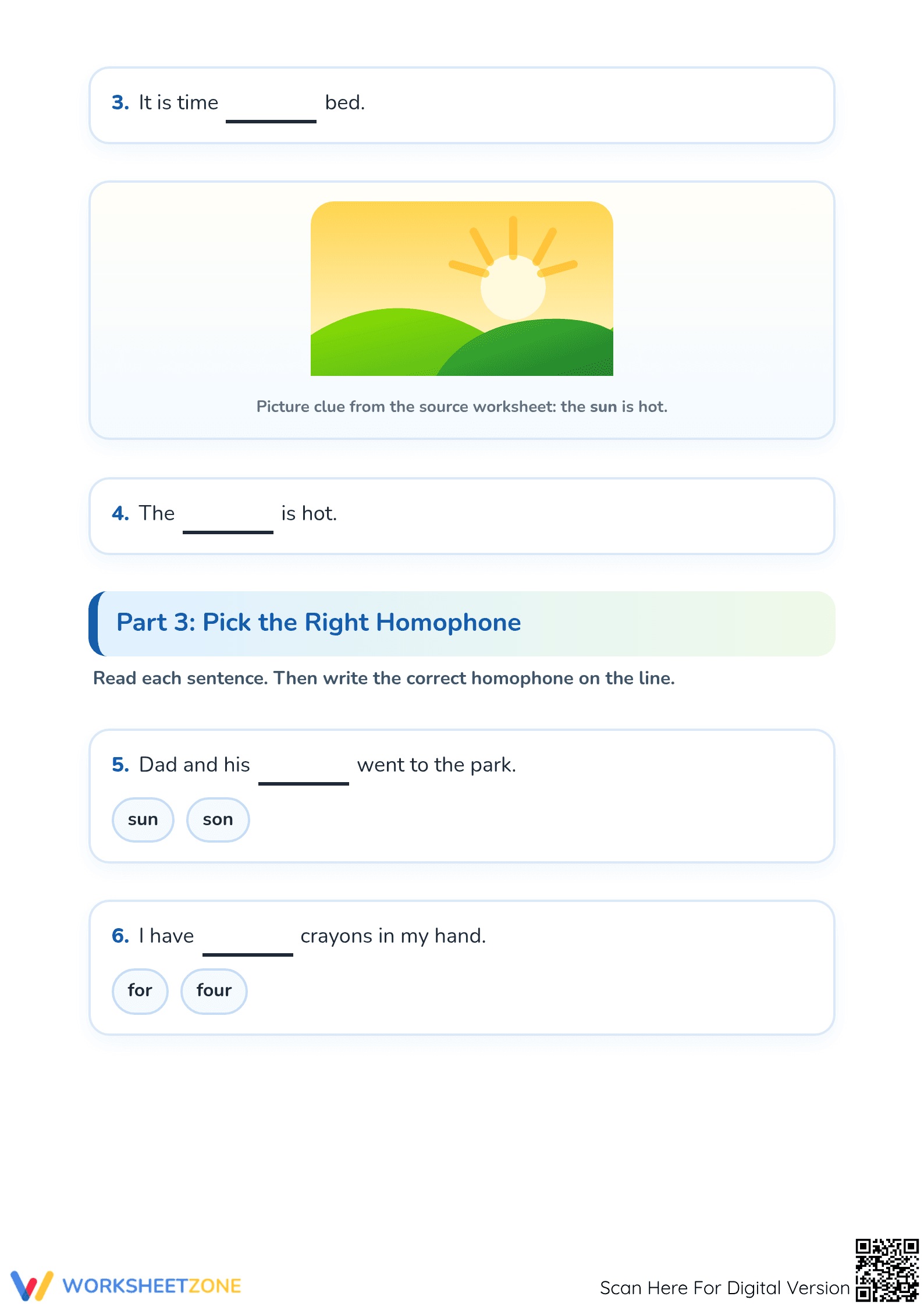
The resource is structured across three pages to ensure student success through scaffolded support. It begins with a clear word bank and visual clues, such as a helpful illustration of the sun, to ground learners in literal meanings. The 12-task set progresses from multiple-choice selections to independent writing, supported by a full answer key that simplifies the grading process for busy educators.
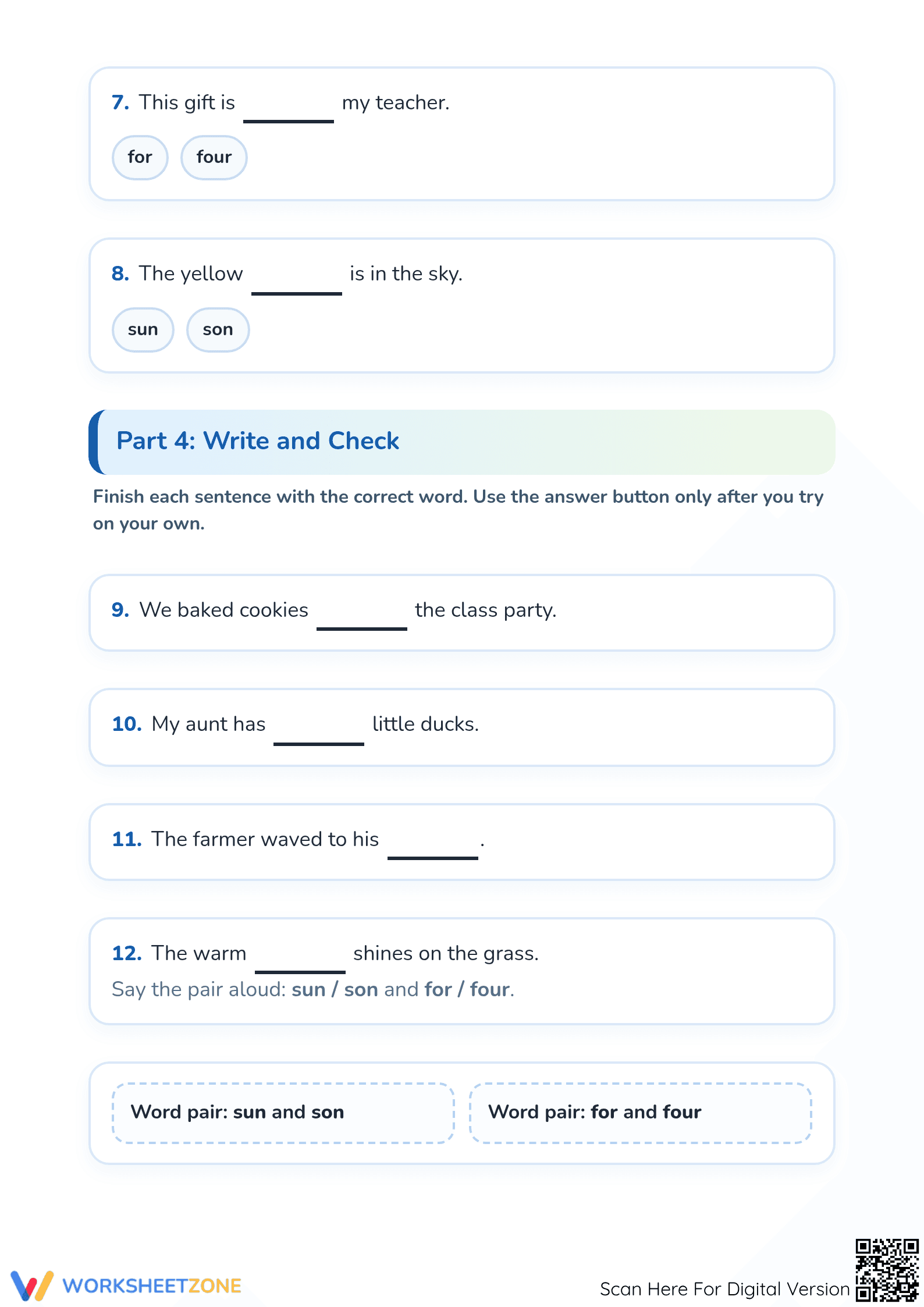
The zero-prep workflow is designed for maximum efficiency in the modern classroom. Teachers can print the three-page PDF in under 30 seconds and distribute it immediately to students without any additional cutting or assembly. The intuitive layout allows for quick distribution during a literacy block, and the "write and check" section facilitates a 5-minute peer-review or teacher-led feedback session at the end of the lesson.
This worksheet is aligned to CCSS.ELA-LITERACY.L.1.4, which requires students to determine or clarify the meaning of unknown and multiple-meaning words. Specifically, it supports the sub-standard of using sentence-level context clues. Both standard codes can be copied directly into lesson plans, IEP goals, or district curriculum mapping tools to ensure instructional compliance and tracking.
To maximize impact, use this as a post-instructional check after a direct lesson on multiple-meaning words. It works effectively as a formative assessment during literacy centers where students can say the word pairs aloud to reinforce phonemic awareness. Educators should observe if students rely on the visual clues in Part 2 before attempting the independent selections in Part 3.
This activity is ideal for first-grade students and serves as an excellent intervention for second graders who struggle with these specific high-frequency homophones. It pairs naturally with a homophone anchor chart or a short reading passage that features these target words. The clear font and spacious lines provide necessary support for students still developing their fine motor writing skills.
The acquisition of homophones is a critical milestone in early literacy, as these "lexical twins" can often cause confusion in both reading comprehension and spelling. Research from Fisher & Frey (2014) emphasizes that gradual release models—moving from word banks to independent application—are the most effective way to solidify vocabulary mastery in primary grades. This worksheet implements that research-based strategy by providing 12 targeted opportunities to apply contextual clues. By focusing on the CCSS.ELA-LITERACY.L.1.4 standard, the resource ensures that students are not just memorizing spellings but are actively engaging in the cognitive process of meaning-making. Mastery of these specific word pairs, such as "for" and "four," reduces cognitive load during later complex writing tasks. Educators can confidently integrate this tool into their curriculum, knowing it aligns with NAEP standards for vocabulary development and provides the structured repetition required for long-term retention of irregular spelling patterns.


