


























Views
Downloads

Whose or Who's Homophones Worksheet | Grade 4 Essential
Paste this activity's link or code into your existing LMS (Google Classroom, Canvas, Teams, Schoology, Moodle, etc.).
Students can open and work on the activity right away, with no student login required.
You'll still be able to track student progress and results from your teacher account.
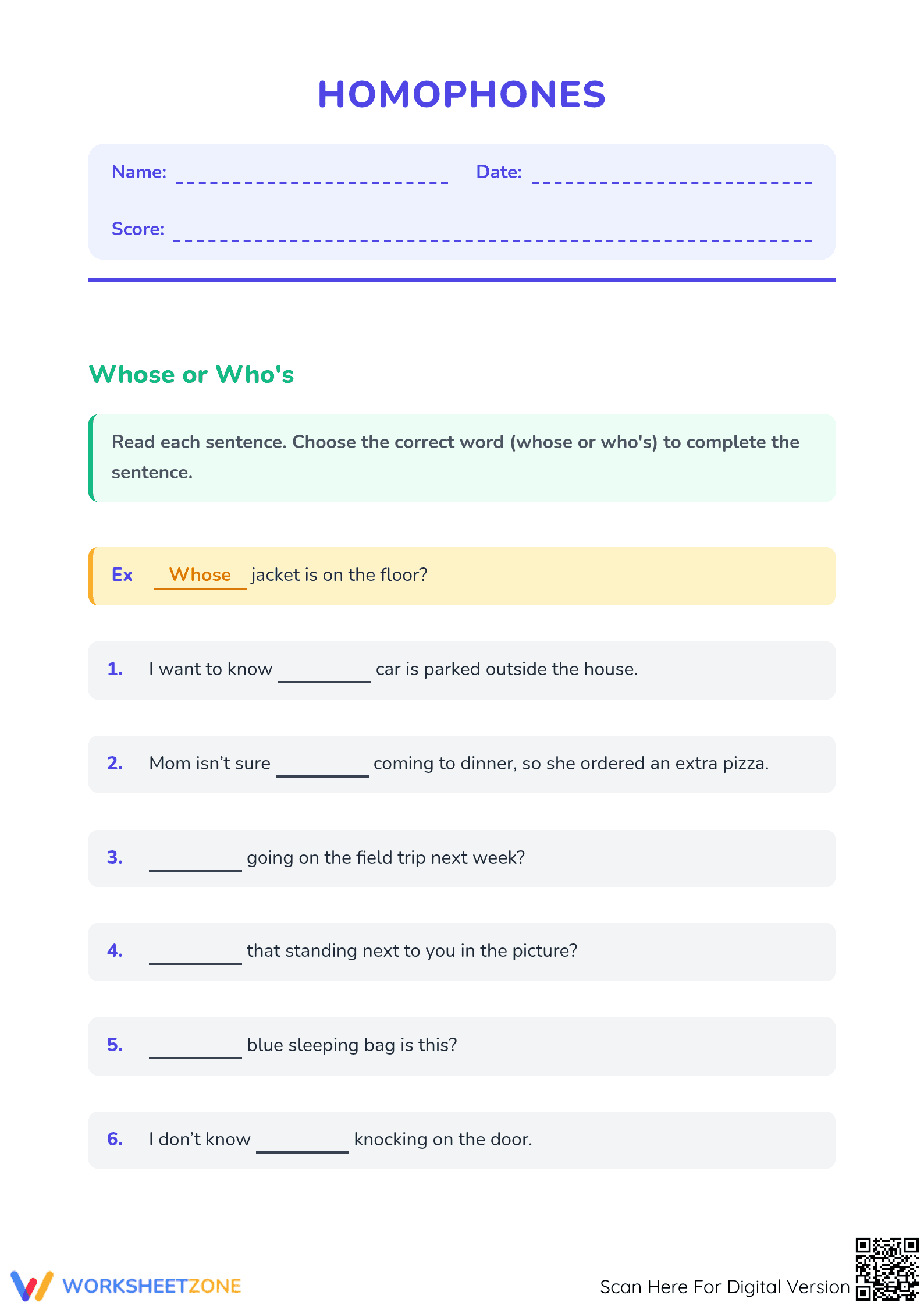
This Grade 4 homophones worksheet helps students master the specific distinction between the possessive "whose" and the contraction "who's." By engaging with contextual sentences, learners develop the linguistic precision necessary for clear writing and formal communication. This resource ensures students can identify the correct usage in various sentence structures to improve overall writing mechanics.
At a Glance
- Grade: 4 · Subject: ELA
- Standard:
CCSS.ELA-LITERACY.L.4.1.G— Correctly use frequently confused words like homophones in writing- Skill Focus: Whose vs. Who's distinction
- Format: 2 pages · 10 problems · Answer key included · PDF
- Best For: Grammar reinforcement and formative assessment
- Time: 15–20 minutes
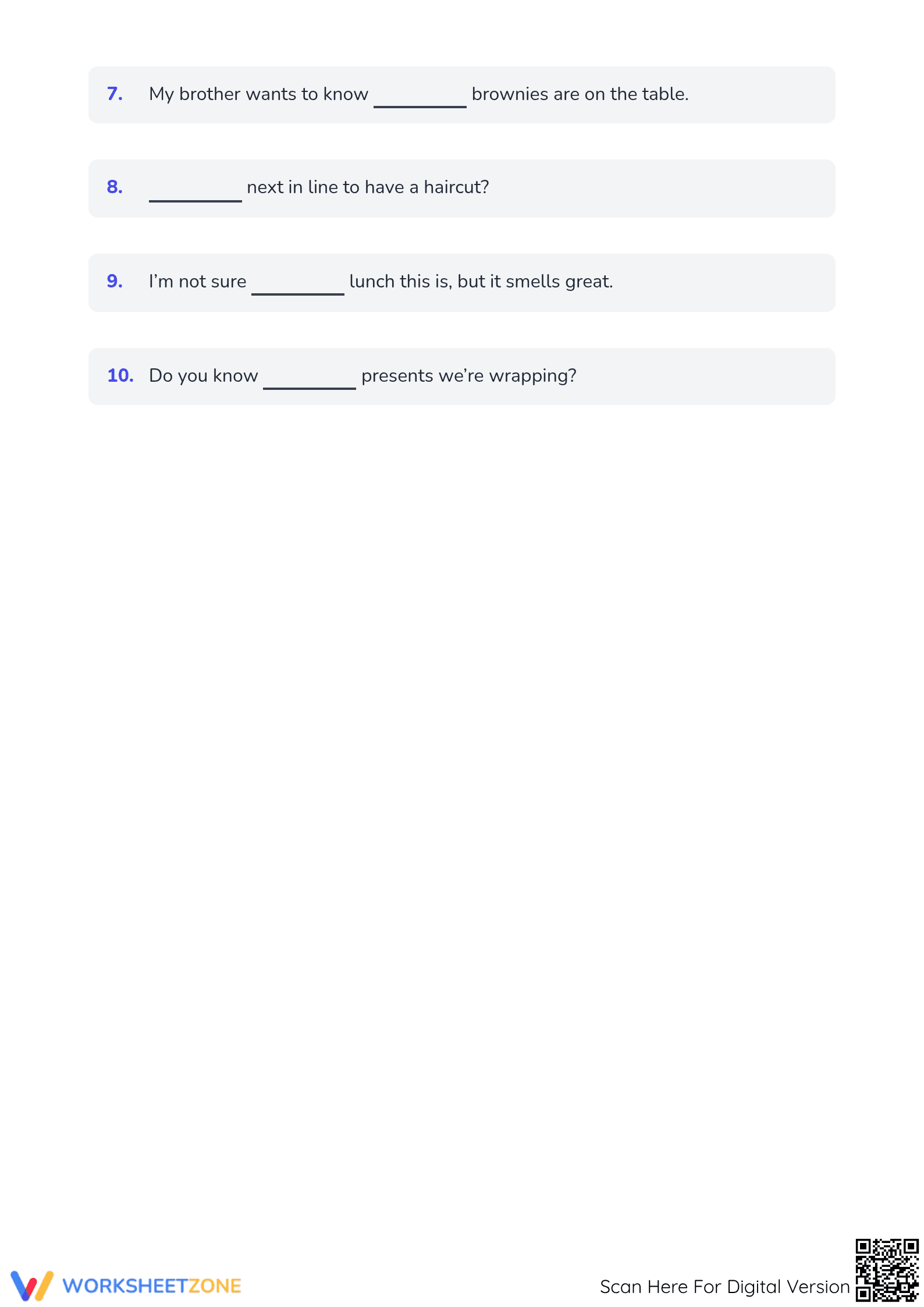
The worksheet contains 10 targeted fill-in-the-blank problems spread across two printable pages. It begins with a clear instructional header and a worked example to establish the pattern. Each task presents a complete sentence with a missing word, requiring students to analyze the grammatical function—possessive or contraction—before selecting the correct homophone. A comprehensive answer key is provided for quick grading and immediate feedback.
The practice follows a logical progression to ensure student success. First, the Guided practice starts with a clear example ("Whose jacket is on the floor?") to model the thought process. Next, Supported practice involves items 1 through 5, which use common classroom and home scenarios to build confidence. Finally, Independent practice in items 6 through 10 introduces slightly more complex sentence structures where the homophone appears in different positions. This gradual-release model moves students from recognition to application.
This resource is specifically aligned to `CCSS.ELA-LITERACY.L.4.1.G`, which requires students to correctly use frequently confused words. By focusing exclusively on the "whose/who's" pair, it provides the intensive repetition needed to overcome this common error. This standard code can be copied directly into lesson plans, IEP goals, or district curriculum mapping tools.
Use this worksheet during the "You Do" phase of a grammar lesson after introducing the "apostrophe-as-is" rule for contractions. It serves as an excellent formative assessment tool; teachers should observe if students are checking for the "who is" substitution to verify their choice. Completion typically takes 15 to 20 minutes, making it ideal for a morning work activity or a quick exit ticket to gauge student understanding before moving to more complex homophones.
This worksheet is designed for Grade 4 students but is also highly effective for Grade 5 review or English Language Learners (ELL) who struggle with English contractions. It pairs naturally with a homophone anchor chart or a short reading passage where students must highlight possessive pronouns. The clean layout supports students with executive functioning challenges by minimizing visual distractions and providing clear, numbered tasks.
Mastery of homophones like "whose" and "who's" is a critical component of linguistic fluency. According to the RAND AIRS 2024 report, targeted practice on high-frequency confused words significantly reduces mechanical errors in student compositions. This worksheet addresses CCSS.ELA-LITERACY.L.4.1.G by providing 10 specific opportunities for students to apply grammatical rules in context. Research from Fisher & Frey (2014) emphasizes that the gradual release of responsibility—moving from a worked example to independent sentence completion—is the most effective way to ensure long-term retention of grammar skills. By isolating this specific homophone pair, the resource prevents cognitive overload and allows for focused mastery. Educators can use the results of this 2-page assessment to identify students needing tier-2 intervention or to document progress toward specific language conventions goals in elementary ELA curricula.


