


























Views
Downloads

Printable Homophones Worksheet | Grade 4 ELA
Paste this activity's link or code into your existing LMS (Google Classroom, Canvas, Teams, Schoology, Moodle, etc.).
Students can open and work on the activity right away, with no student login required.
You'll still be able to track student progress and results from your teacher account.
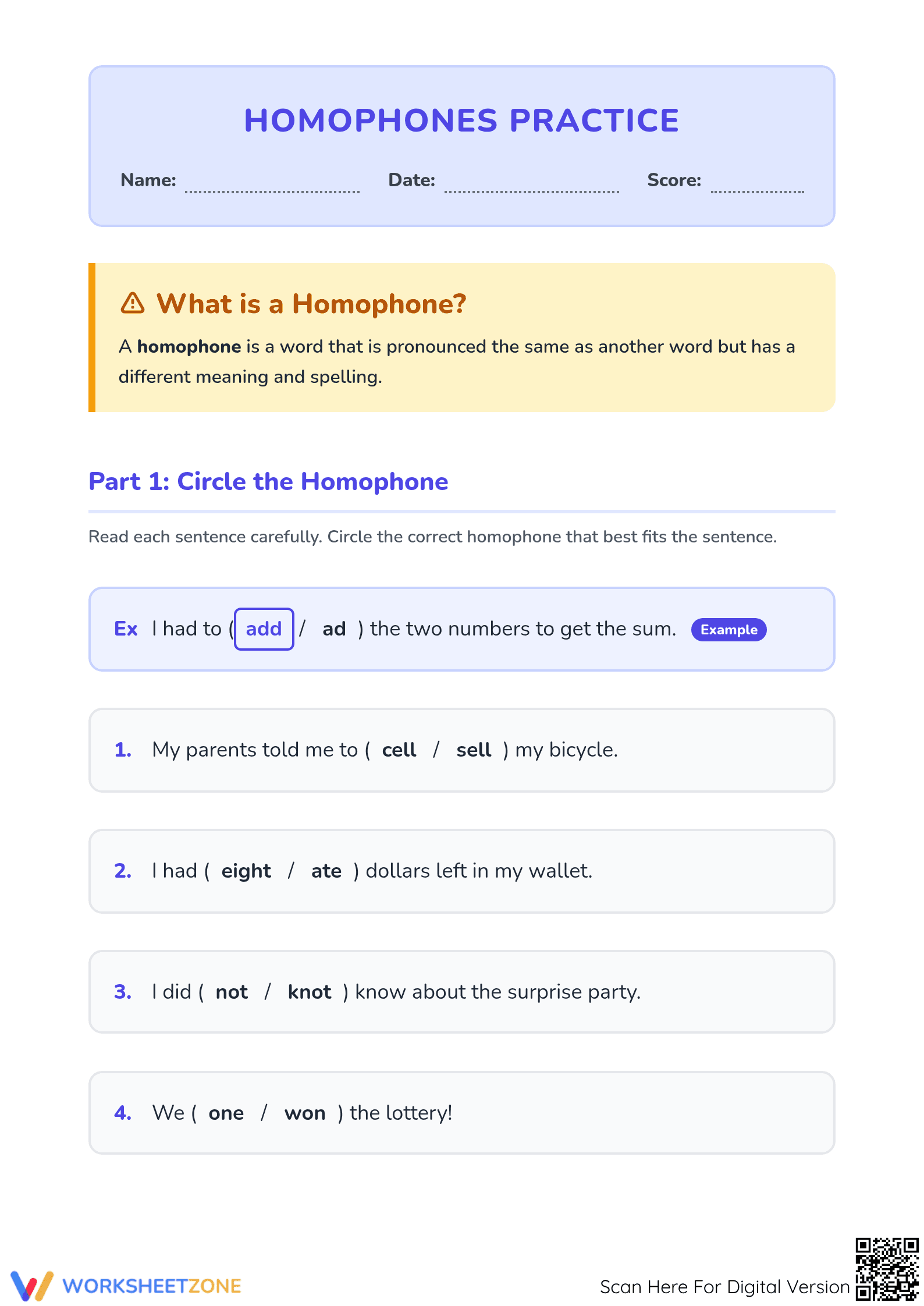
This printable Grade 4 ELA worksheet helps students master homophones by identifying and applying frequently confused words in context. By transitioning from simple sentence completion to independent sentence writing, learners build essential vocabulary and spelling skills required for clear, effective communication in their daily writing.
At a Glance
- Grade: 4 · Subject: ELA
- Standard:
CCSS.ELA-LITERACY.L.4.1.G— Correctly use frequently confused words.- Skill Focus: Homophones
- Format: 3 pages · 15 problems · Answer key included · PDF
- Best For: Independent practice and vocabulary building
- Time: 15–20 minutes
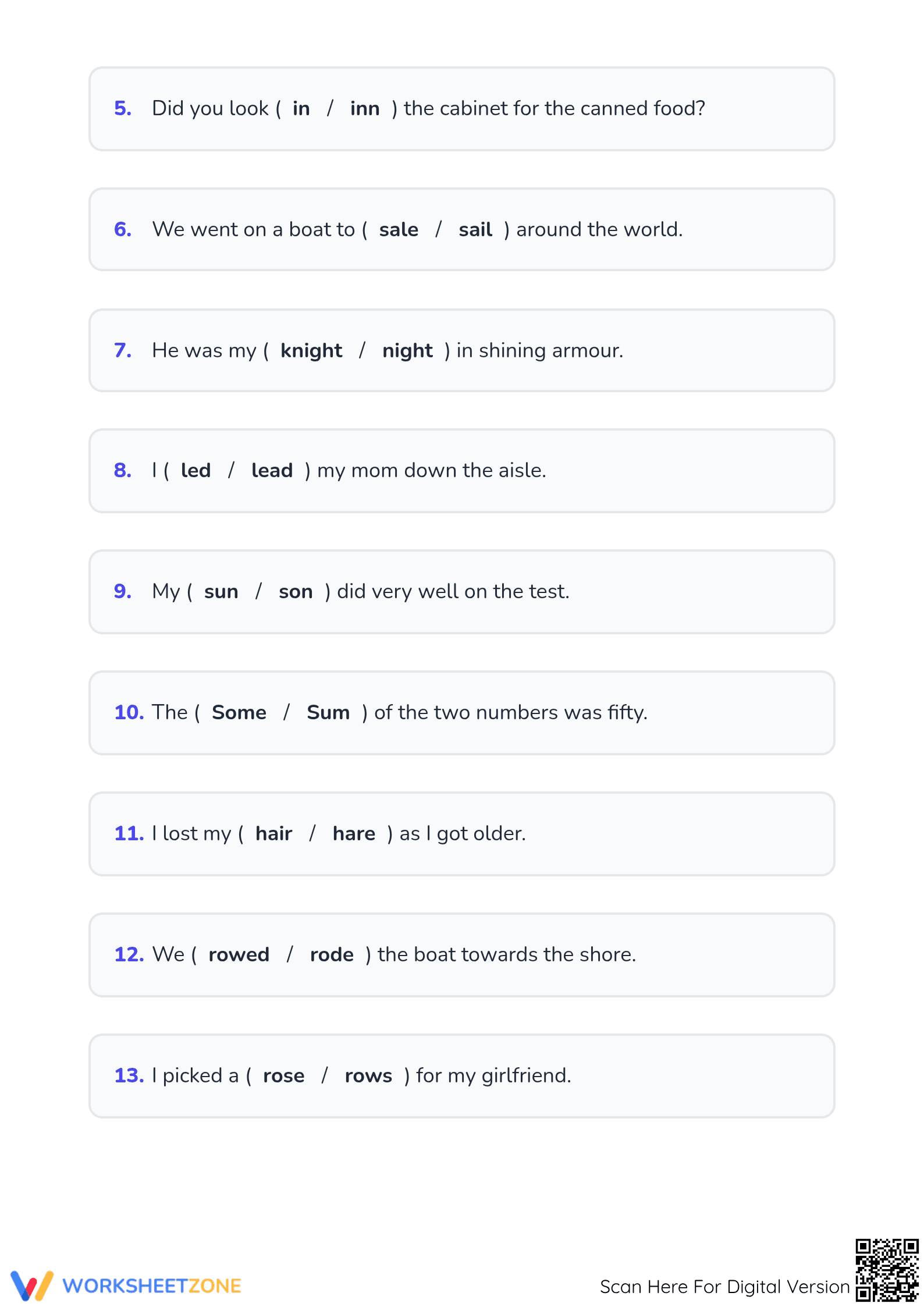
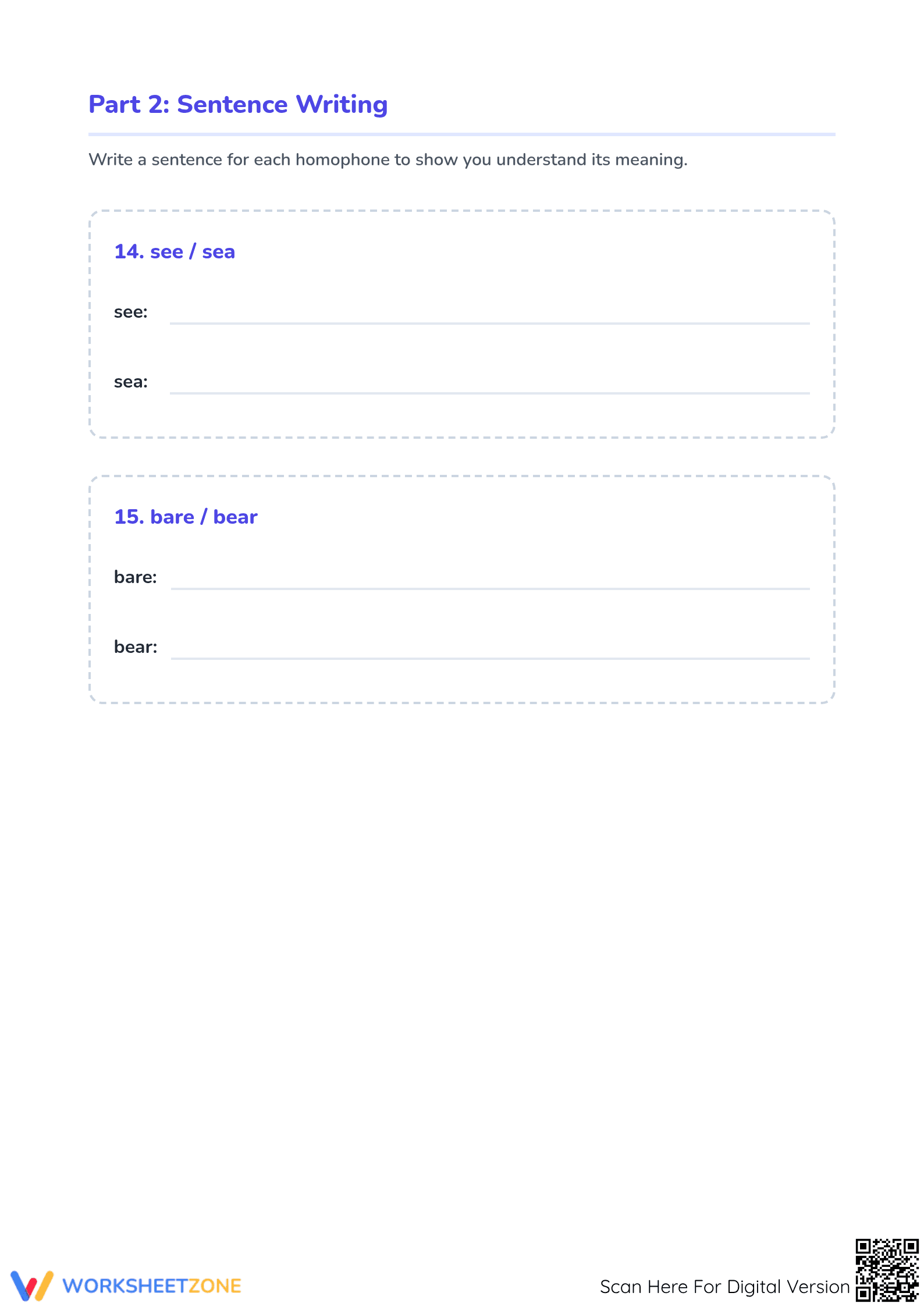
This comprehensive three-page resource features a clear definition of homophones at the top to anchor student understanding. The packet includes 13 sentence-level multiple-choice questions where students circle the correct word, followed by a sentence-writing section requiring them to generate original context for two homophone pairs. A complete answer key is provided for quick grading.
Skill Progression
- Guided practice: The worksheet opens with a clear definition and a worked example, ensuring students understand the concept before beginning.
- Supported practice: Part 1 features 13 targeted sentences where students select the correct homophone (e.g., cell/sell, knight/night) using context clues.
- Independent practice: Part 2 challenges learners to write their own original sentences for specific homophone pairs (see/sea, bare/bear), demonstrating full comprehension.
This gradual-release approach moves students from recognition to application, perfectly mirroring the I Do, We Do, You Do instructional model.
Standards Alignment
This resource is directly aligned to CCSS.ELA-LITERACY.L.4.1.G, which requires students to correctly use frequently confused words (e.g., to, too, two; there, their, they're). By requiring both identification and original writing, the worksheet ensures students grasp the nuanced spelling and meaning differences of auditory twins. Both standard codes can be copied directly into lesson plans, IEP goals, or district curriculum mapping tools.
How to Use It
Integrate this worksheet into your literacy block after a mini-lesson on commonly confused words. It serves as an excellent independent practice activity while the teacher pulls small groups for targeted reading instruction. As a formative assessment tip, review the sentences generated in Part 2 to quickly gauge if students truly understand the distinct definitions of each homophone pair. Most students will complete the full three-page packet in 15 to 20 minutes.
Who It's For
This activity is designed for fourth-grade students developing their foundational language and spelling skills. It is also highly effective for upper-elementary English Language Learners (ELLs) who often need explicit instruction on words that sound identical but carry different meanings. Pair this worksheet with a visual anchor chart displaying common homophone pairs to provide additional scaffolding for struggling writers.
Mastering vocabulary nuances is a critical component of elementary literacy development. According to Fisher & Frey (2014), explicit vocabulary instruction that requires students to interact with words in multiple contexts significantly improves reading comprehension and writing clarity. This worksheet directly supports CCSS.ELA-LITERACY.L.4.1.G by asking students to correctly use frequently confused words. By requiring learners to first identify the correct spelling based on sentence context and then generate their own original sentences, the activity moves beyond rote memorization into authentic application. Understanding homophones prevents common spelling errors that can obscure meaning in student writing. Providing structured, gradual-release practice ensures that learners internalize these distinctions, ultimately fostering more confident and precise communicators in the classroom and beyond. This targeted practice builds the exact foundational language skills necessary for advanced reading and writing tasks.


