


























Views
Downloads



Essential Homophones Practice Worksheet | Grade 4 Ready
Paste this activity's link or code into your existing LMS (Google Classroom, Canvas, Teams, Schoology, Moodle, etc.).
Students can open and work on the activity right away, with no student login required.
You'll still be able to track student progress and results from your teacher account.
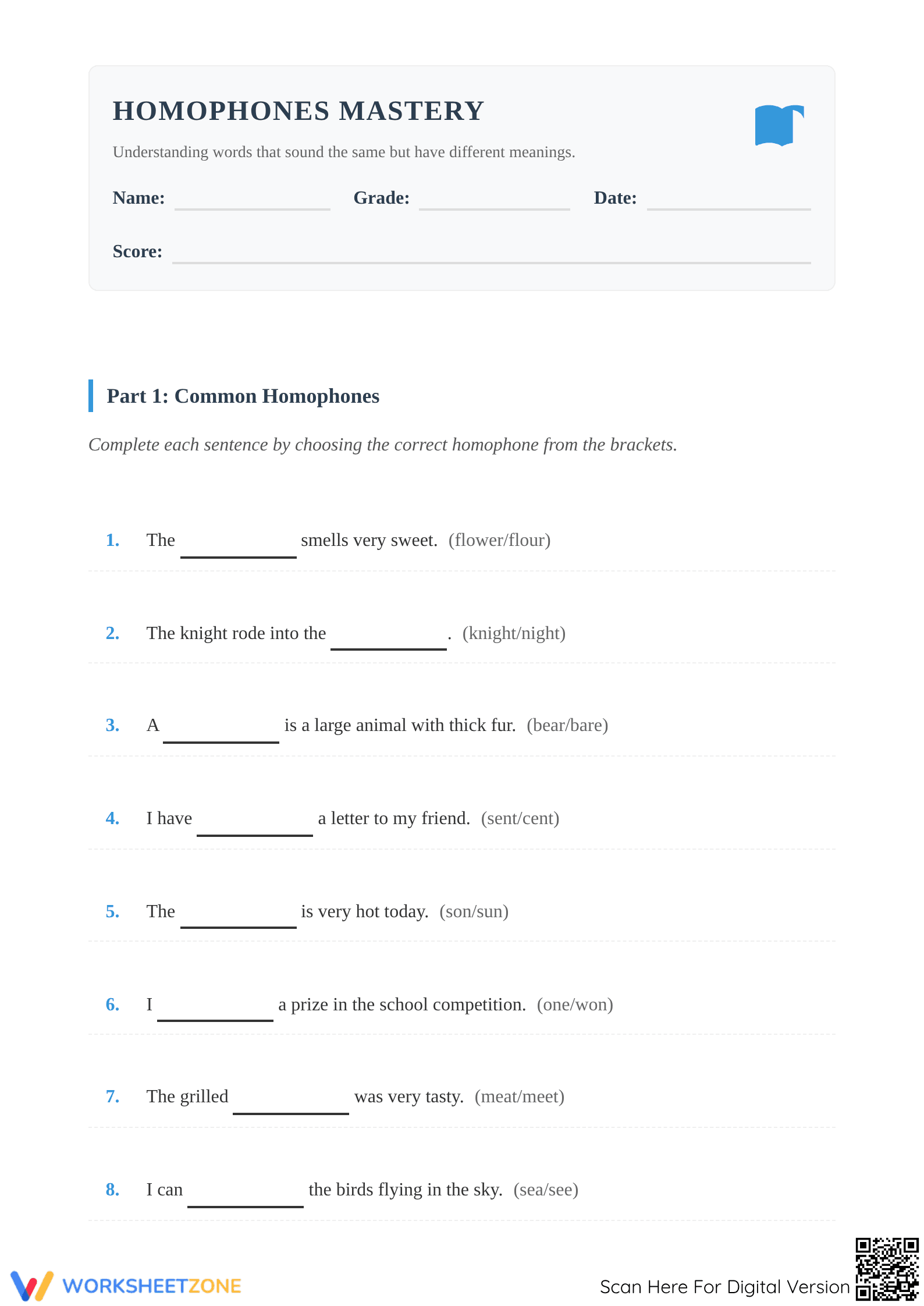
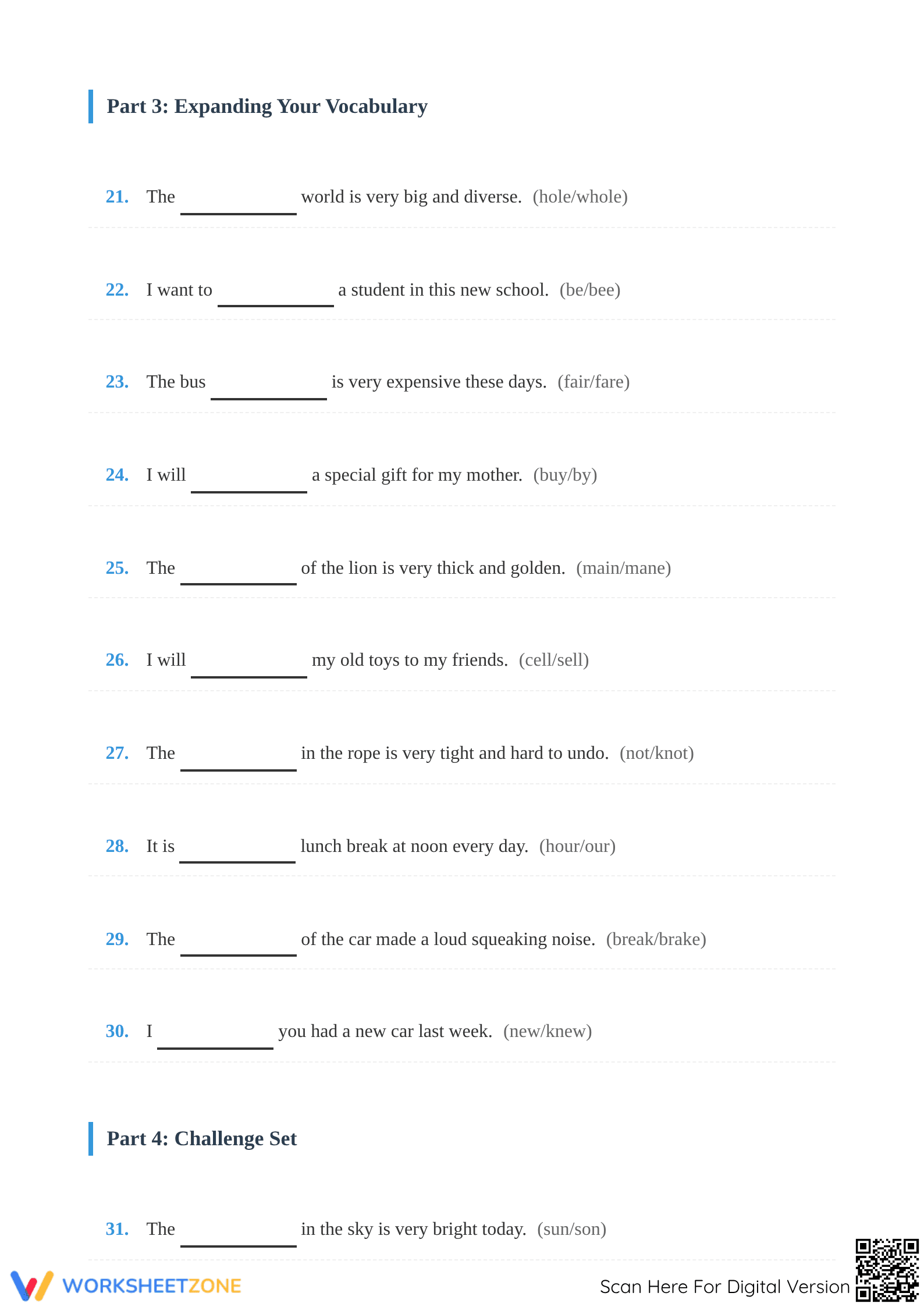
This comprehensive homophones practice resource helps students distinguish between words that sound the same but have different meanings and spellings. By working through 40 unique sentence-based problems, learners develop the linguistic precision necessary for clear writing and accurate reading. The structured format ensures students apply context clues to select the correct word for every scenario.
At a Glance
- Grade: 4 · Subject: ELA
- Standard:
CCSS.ELA-LITERACY.L.4.1.G— Correctly use frequently confused words such as homophones in writing- Skill Focus: Homophone discrimination and context clues
- Format: 4 pages · 40 problems · Answer key included · PDF
- Best For: Independent practice and literacy centers
- Time: 20–30 minutes
The worksheet is organized into four distinct parts: Common Homophones, Homophones in Action, Expanding Your Vocabulary, and a Challenge Set. Across 4 pages, students encounter 40 fill-in-the-blank sentences where they must choose between two bracketed options, such as flower/flour or knight/night. A complete 4-page answer key is provided, mirroring the worksheet layout for rapid grading and immediate feedback.
Zero-Prep Workflow
- Print: Select the four-page PDF and print enough copies for your class in under 60 seconds.
- Distribute: Hand out the sheets as a quiet morning starter or a focused literacy center activity.
- Review: Use the included answer key to grade all 40 items in less than 5 minutes.
This streamlined process makes the resource ideal for emergency sub plans or supplemental homework assignments.
This resource is specifically aligned with CCSS.ELA-LITERACY.L.4.1.G, which requires students to correctly use frequently confused words. It also supports CCSS.ELA-LITERACY.L.3.2.F by reinforcing spelling patterns and generalizations. Both standard codes can be copied directly into lesson plans, IEP goals, or district curriculum mapping tools to ensure instructional compliance and tracking.
Use this worksheet during the independent practice phase of a grammar lesson on homonyms and homophones. It works exceptionally well as a formative assessment after direct instruction to identify which specific word pairs, like scent/cent or peak/peek, require further clarification. Expect students to spend approximately 25 minutes completing the full 40-item set, or assign one page per day for a week of consistent reinforcement.
This practice set is designed for Grade 4 students but is highly effective for Grade 3 enrichment or Grade 5 review. It is an excellent resource for English Language Learners (ELL) who often struggle with the phonetic overlaps of the English language. Pair this worksheet with a homophone anchor chart or a vocabulary word wall to provide visual support during the independent working session.
Homophones represent a significant hurdle in English orthography due to the lack of one-to-one correspondence between phonemes and graphemes. According to Fisher & Frey (2014), explicit instruction in frequently confused words through contextualized sentence practice is vital for developing writing fluency. This worksheet addresses CCSS.ELA-LITERACY.L.4.1.G by providing 40 targeted opportunities for students to discriminate between lexical items that sound identical but differ in meaning and spelling. Research from the NAEP indicates that mastery of these linguistic nuances correlates strongly with overall reading comprehension and written clarity in the upper elementary grades. By isolating the skill of word selection within controlled syntactic environments, educators can effectively bridge the gap between phonological awareness and formal spelling accuracy. This resource serves as a high-utility tool for formative assessment.


