


























Views
Downloads

Grade 4 Homophones — Printable No-Prep Worksheet
Paste this activity's link or code into your existing LMS (Google Classroom, Canvas, Teams, Schoology, Moodle, etc.).
Students can open and work on the activity right away, with no student login required.
You'll still be able to track student progress and results from your teacher account.
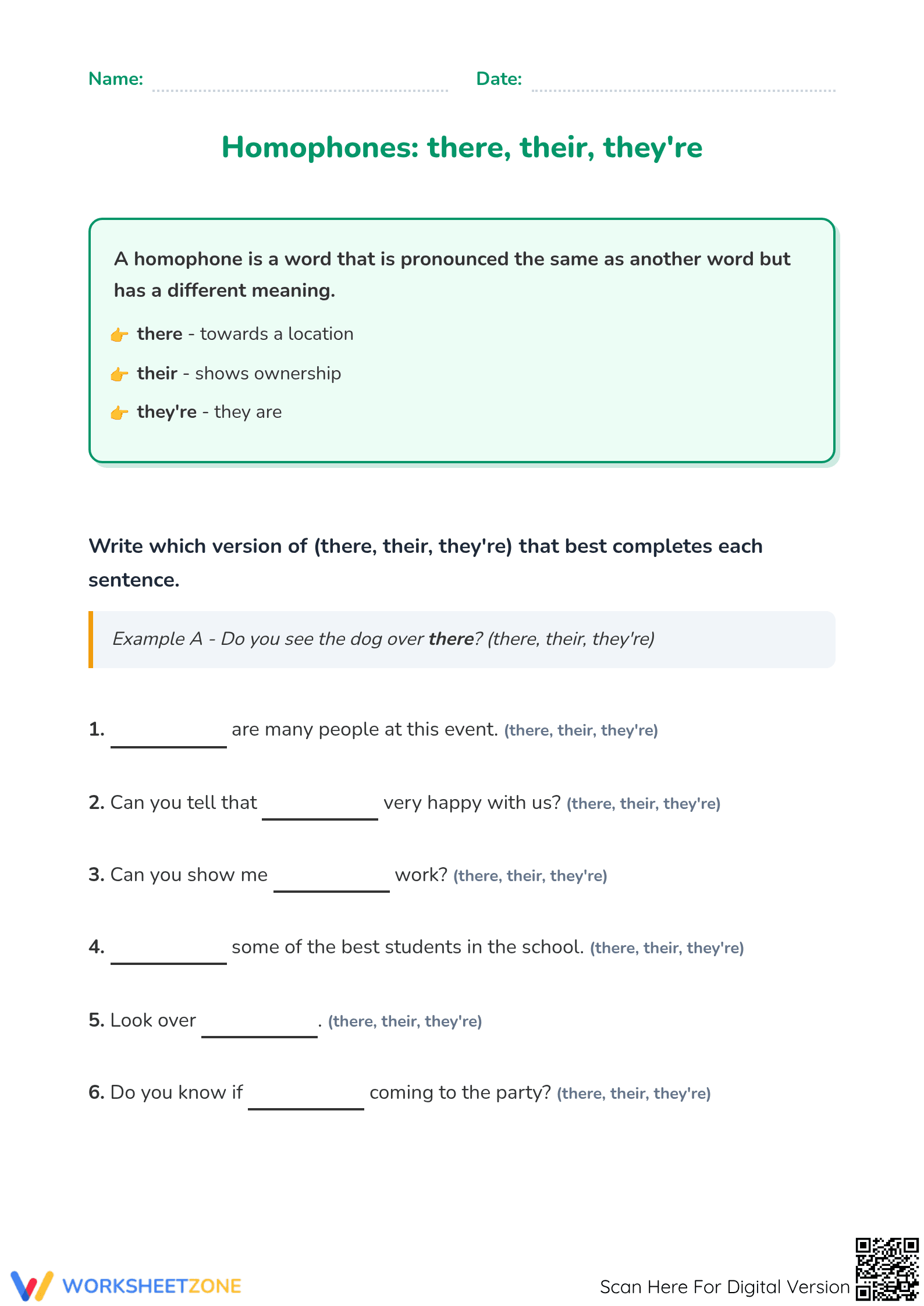
This Grade 4 grammar worksheet helps students master the frequently confused homophones "there," "their," and "they're." By providing clear definitions and contextual sentence practice, this resource ensures learners can accurately identify and apply the correct spelling based on meaning, strengthening their overall writing clarity and vocabulary skills.
At a Glance
- Grade: 4 · Subject: ELA
- Standard:
CCSS.ELA-LITERACY.L.4.1.G— Correctly use frequently confused words- Skill Focus: Homophones (there, their, they're)
- Format: 2 pages · 10 problems · Answer key included · PDF
- Best For: Independent practice and sub plans
- Time: 10–15 minutes
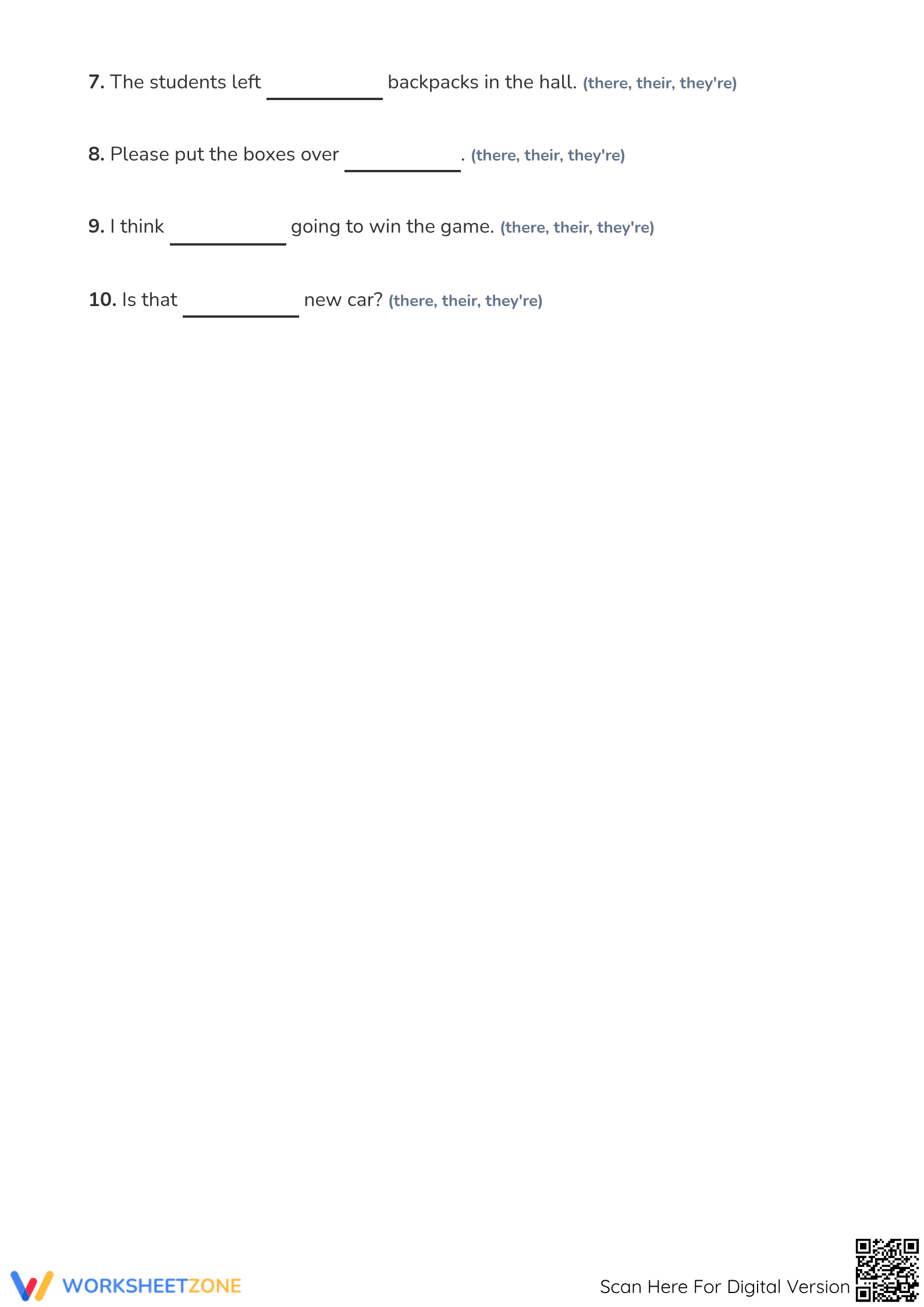
This resource features a helpful reference box at the top of the first page, clearly defining each version of the target homophones alongside simple examples. Following the instructional guide, students will complete 10 fill-in-the-blank sentences that require them to use context clues to select the appropriate word. The two-page layout provides ample space for writing, and a complete answer key is included for quick grading.
Designed for maximum efficiency, this worksheet requires absolutely no teacher preparation.
- Print (1 minute): Simply download the PDF and print the two-page student handout.
- Distribute (1 minute): Hand out the assignment. The built-in reference box means students can begin immediately without a mini-lesson.
- Review (3 minutes): Use the provided answer key to quickly check student work or facilitate peer grading.
With a total prep time of under two minutes, this activity is an ideal addition to emergency sub plans or morning work routines.
This worksheet is directly aligned to primary standard CCSS.ELA-LITERACY.L.4.1.G, which requires students to correctly use frequently confused words. By isolating these three specific homophones, the activity provides targeted repetition to build mastery. Both standard codes can be copied directly into lesson plans, IEP goals, or district curriculum mapping tools.
This activity works perfectly as an independent practice assignment immediately following direct instruction on homophones. Teachers can also use it as a formative assessment during literacy centers to check for understanding. As a quick observation tip, watch to see if students refer back to the definition box when stuck; this indicates strong self-monitoring skills. Expected completion time is 10 to 15 minutes.
This worksheet is designed for fourth-grade students developing their foundational grammar and spelling skills. It is also highly effective for older students needing targeted intervention or English Language Learners who benefit from explicit vocabulary instruction. Pair this activity with a short reading passage and challenge students to highlight every instance of "there," "their," and "they're" they can find.
Mastering frequently confused words is a critical component of developing proficient written communication. According to Fisher & Frey (2014), explicit vocabulary instruction combined with immediate, contextual practice significantly improves student retention of complex language rules. This worksheet targets CCSS.ELA-LITERACY.L.4.1.G, requiring students to correctly use frequently confused words. By focusing specifically on "there," "their," and "they're," the activity reduces cognitive load and allows learners to internalize the distinct meaning and spelling of each variation. The inclusion of a reference guide directly on the page supports independent problem-solving and builds student confidence. Providing structured opportunities to apply these grammar rules in context ensures that students move beyond rote memorization and develop the deep syntactic awareness necessary for clear, effective writing across all academic subjects.


