


























Views
Downloads

Essential Homophones Worksheet: To, Two, Too | Grade 4
Paste this activity's link or code into your existing LMS (Google Classroom, Canvas, Teams, Schoology, Moodle, etc.).
Students can open and work on the activity right away, with no student login required.
You'll still be able to track student progress and results from your teacher account.
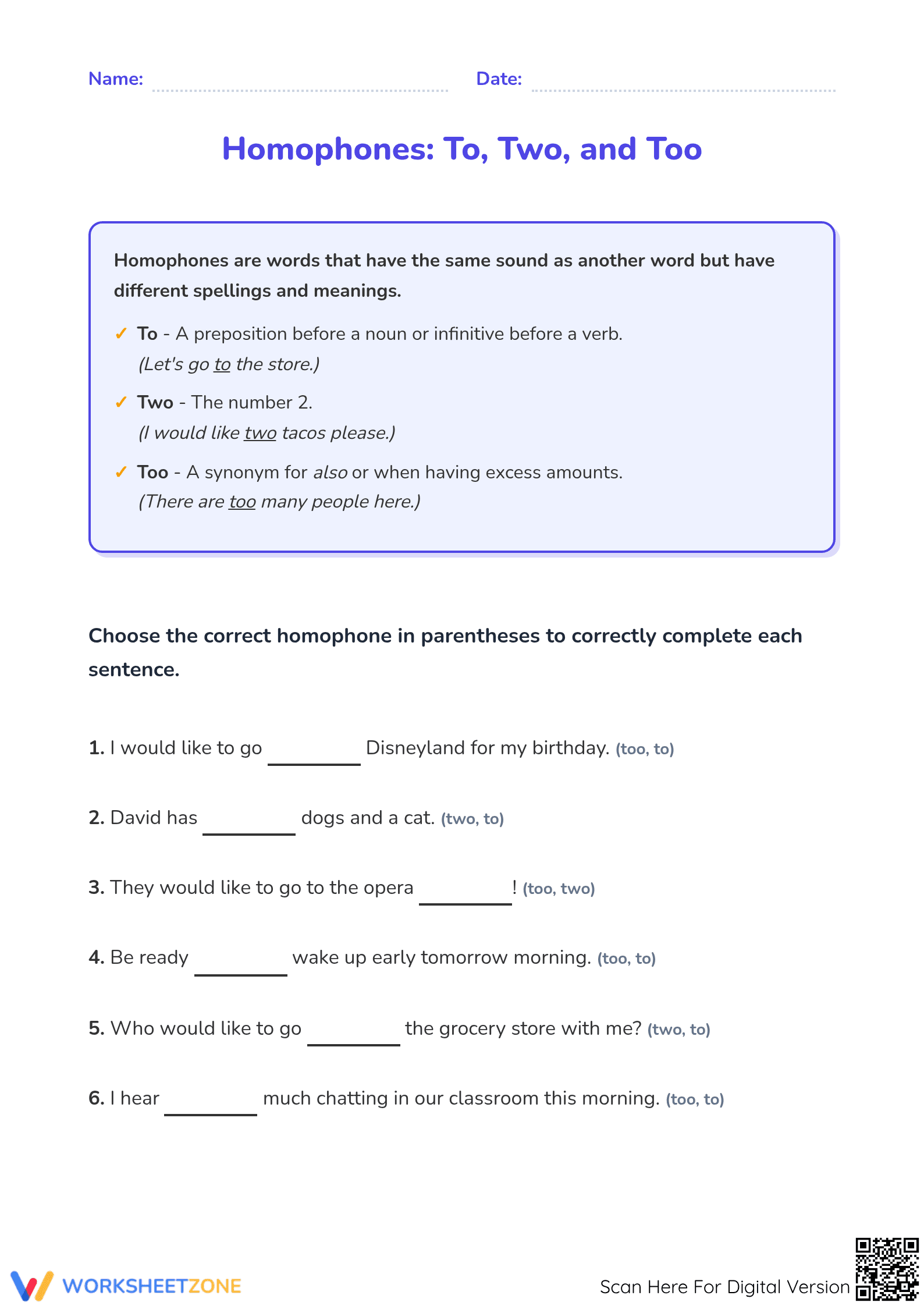
This Grade 4 homophones worksheet provides targeted practice for the frequently confused words to, two, and too. Students learn to distinguish between prepositions, numbers, and adverbs through contextual sentence completion. By applying specific definitions to real-world examples, learners build the linguistic precision necessary for clear written communication and grammatical mastery in elementary ELA.
At a Glance
- Grade: 4 · Subject: ELA
- Standard:
CCSS.ELA-LITERACY.L.4.1.G— Correctly use frequently confused words such as to, two, and too- Skill Focus: Homophone Differentiation
- Format: 2 pages · 10 problems · Answer key included · PDF
- Best For: Independent practice or quick formative assessment
- Time: 10–15 minutes
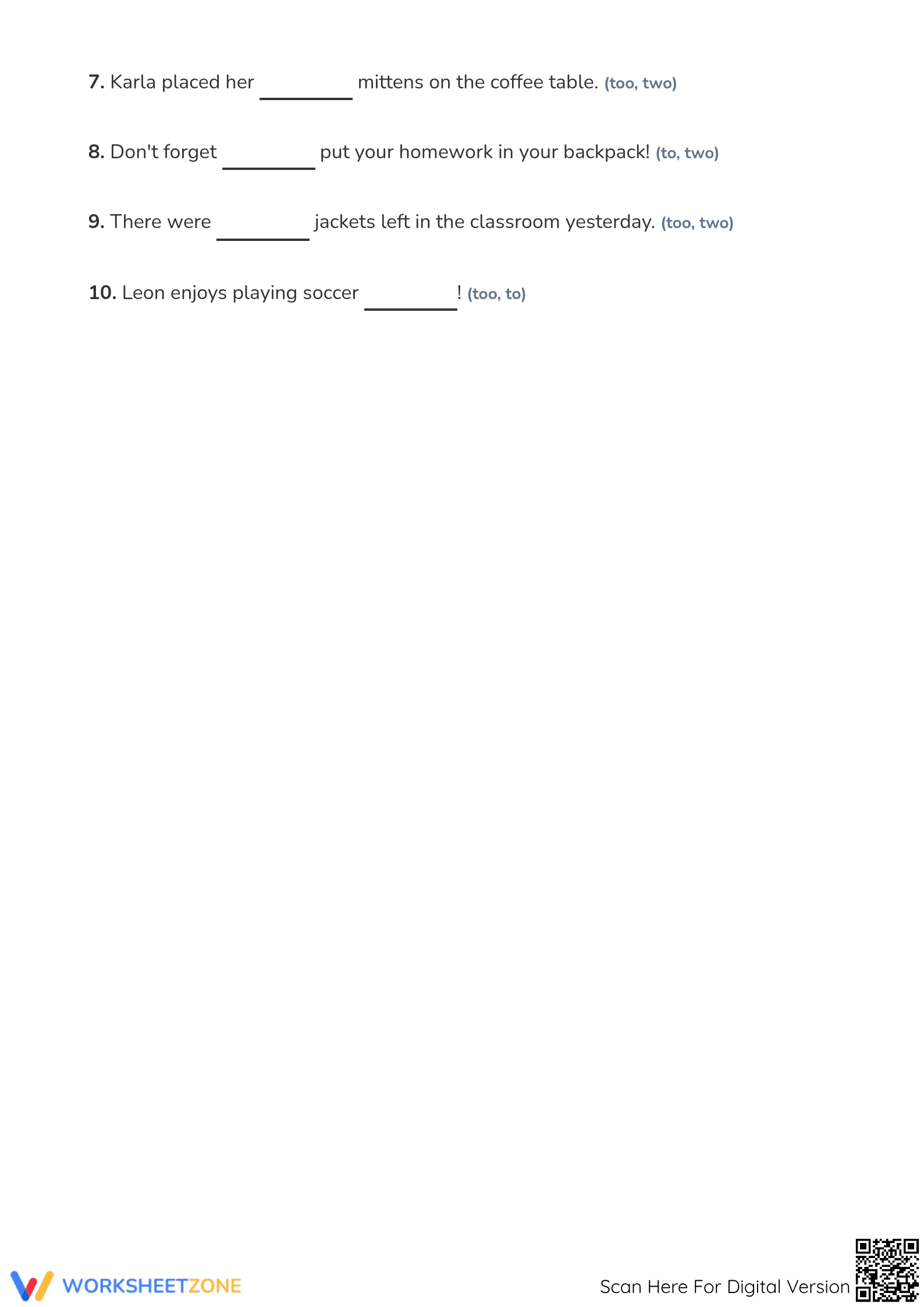
The resource features a prominent instructional header that defines each homophone with clear examples. "To" is identified as a preposition or infinitive marker, "Two" as the numerical value, and "Too" as a synonym for "also" or "excess." Following this guide are 10 fill-in-the-blank sentences spread across two pages, ensuring students have ample space to write. A comprehensive answer key is included for rapid grading.
This worksheet is designed for a zero-prep classroom workflow. Teachers can print the PDF in under 30 seconds. Distribution takes less than a minute, as the built-in definition box eliminates the need for a separate lecture or anchor chart. Reviewing the 10 answers as a whole class requires only 5 minutes, making this an ideal solution for busy mornings or unexpected substitute teacher plans.
This activity aligns directly with `CCSS.ELA-LITERACY.L.4.1.G`, which requires students to demonstrate command of the conventions of standard English grammar by correctly using frequently confused words. It also supports `CCSS.ELA-LITERACY.L.3.1`, focusing on general grammar proficiency. Both standard codes can be copied directly into lesson plans, IEP goals, or district curriculum mapping tools.
Use this worksheet as a "bell-ringer" activity to settle the class at the start of a literacy block. Alternatively, assign it as a formative assessment after a mini-lesson on homophones to gauge individual student understanding. Teachers should observe if students refer back to the definition box; those who do not may need additional scaffolding to internalize the spelling-to-meaning relationship. Completion typically takes 12 minutes.
This resource is tailored for Grade 4 students but is highly effective for Grade 3 enrichment or Grade 5 review. It is particularly helpful for English Language Learners (ELLs) who struggle with the phonetic similarities of English vocabulary. Pair this worksheet with a homophone anchor chart or a short reading passage to reinforce the skill in a broader literary context.
According to the RAND AIRS 2024 report on elementary literacy, targeted practice with high-frequency homophones like to, two, and too is essential for reducing cognitive load during the drafting phase of the writing process. When students master these distinctions through structured exercises, they can focus more energy on complex composition tasks rather than basic mechanics. This worksheet addresses CCSS.ELA-LITERACY.L.4.1.G by providing 10 specific opportunities for students to apply grammatical rules in context. Research from Fisher & Frey (2014) emphasizes the importance of gradual release models, where the definition box serves as the initial scaffold before students move toward independent application. By isolating these three specific words, the resource prevents the confusion often caused by over-crowded vocabulary lists. This focused approach ensures that the 10 tasks lead to measurable improvement in spelling accuracy and sentence-level clarity for Grade 4 learners.


