


























Views
Downloads


Printable Homophones Worksheet | Grade 1 Essential ELA
Paste this activity's link or code into your existing LMS (Google Classroom, Canvas, Teams, Schoology, Moodle, etc.).
Students can open and work on the activity right away, with no student login required.
You'll still be able to track student progress and results from your teacher account.
Overview
This printable Grade 1 homophones worksheet provides targeted practice for early learners to distinguish between words that sound identical but have different meanings and spellings. By completing these 12 focused exercises, students build essential vocabulary and reading fluency while mastering common sound-alike word pairs like tale/tail and see/sea.
At a Glance
- Grade: 1 · Subject: English Language Arts
- Standard:
CCSS.ELA-LITERACY.L.1.4— Identify and use common homophones correctly in simple sentence contexts to build early literacy- Skill Focus: Foundational homophone identification and vocabulary development
- Format: 3 pages · 12 problems · Answer key included · Printable PDF
- Best For: Literacy centers and independent vocabulary practice
- Time: 15–20 minutes
What's Inside
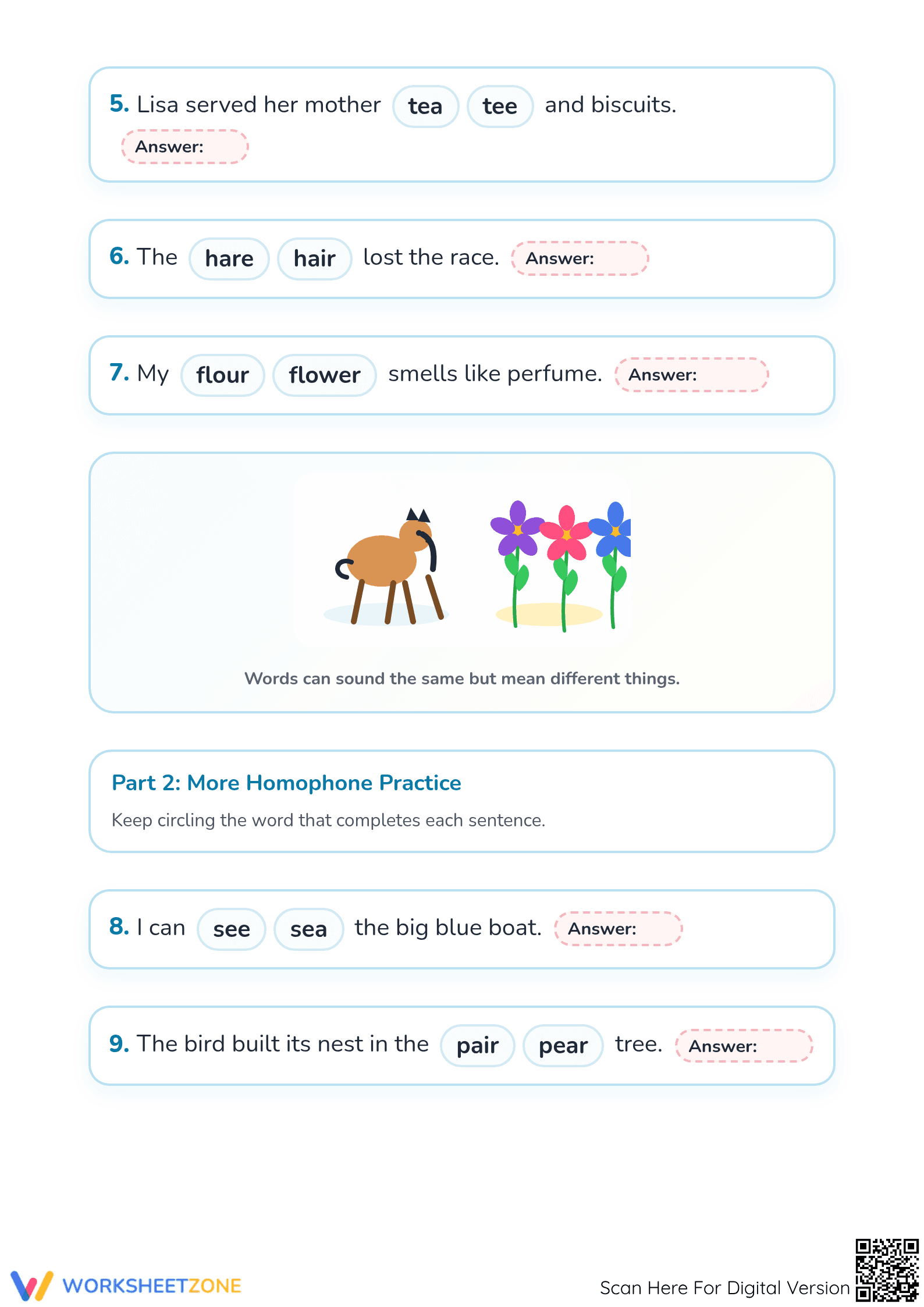
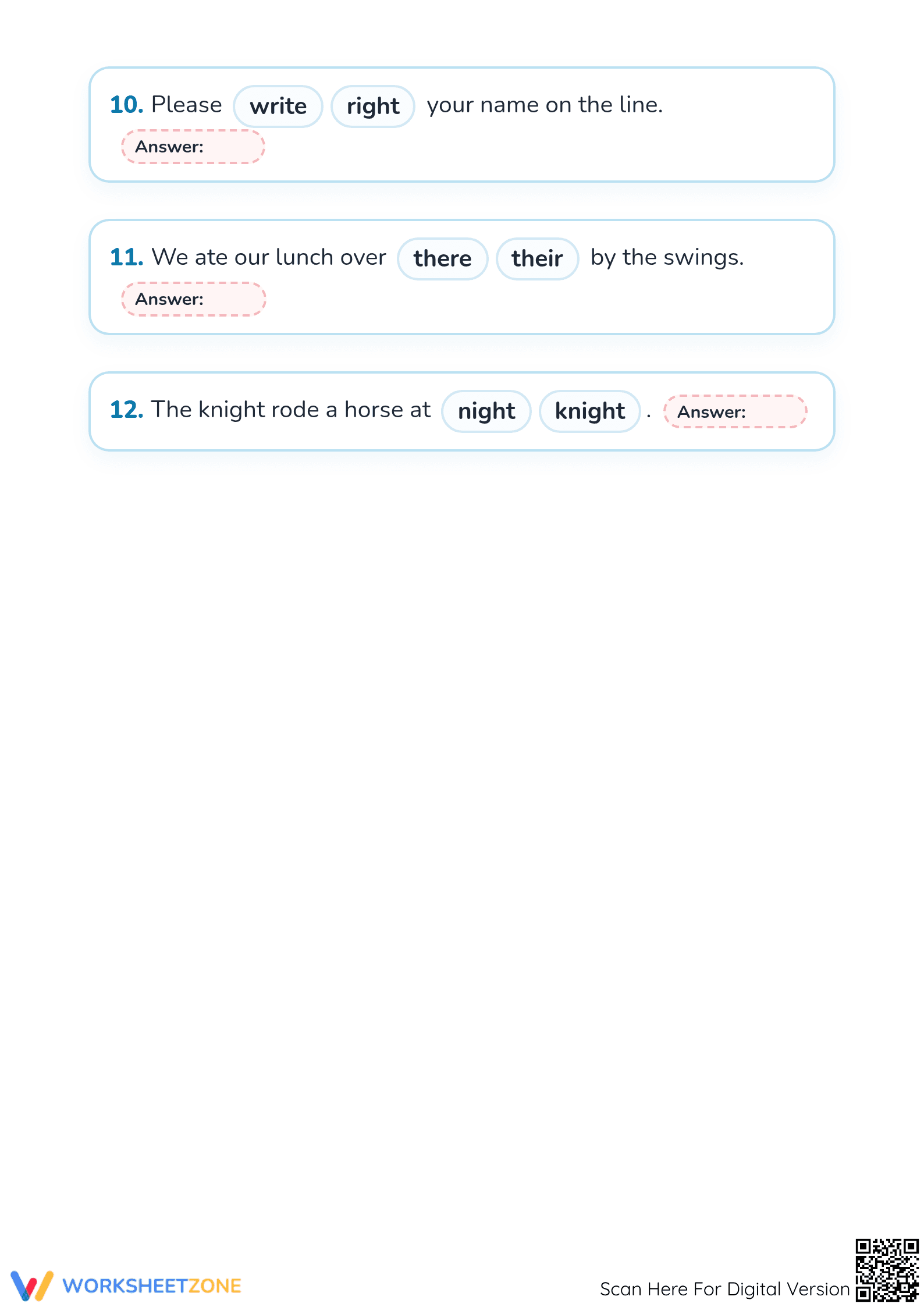
This comprehensive 3-page PDF contains twelve carefully structured sentences, each presenting a choice between two common homophones. The worksheet features clear, large-print text designed for first-grade readers, visual cues for comprehension, and a dedicated "Answer" box for each item. A full answer key is provided to facilitate rapid grading or student self-correction.
Zero-Prep Workflow
The "Print-and-Go" design ensures this resource is ready for immediate classroom use. Teachers can download and print the file in under 60 seconds. Distribution takes less than a minute, and with the included answer key, reviewing student work can be completed during a quick transition period. Total preparation time is approximately two minutes.
Standards Alignment
The primary focus is `CCSS.ELA-LITERACY.L.1.4`, which requires students to determine or clarify the meaning of unknown and multiple-meaning words and phrases. This activity specifically addresses the lexical challenge of homophones by requiring students to use context clues to select the correct spelling. This standard code can be copied directly into lesson plans, IEP goals, or district curriculum mapping tools.
How to Use It
Use this worksheet during a small-group literacy rotation after a direct instruction lesson on "sound-alike" words. It also serves as an effective formative assessment tool; observe if students read the entire sentence for context before circling their choice. The expected completion time for most Grade 1 students is 15 to 20 minutes.
Who It's For
This resource is designed for first-grade students but is also appropriate for Kindergarteners ready for extension or second-graders needing remedial vocabulary support. It pairs naturally with a homophone anchor chart or a read-aloud session featuring "Dear Deer" or similar word-play literature.
Effective vocabulary instruction for early readers necessitates repeated exposure to multiple-meaning words and sound-alike pairs within meaningful contexts. According to research from RAND AIRS 2024, the systematic identification of homophones significantly improves orthographic mapping and reading comprehension in Grade 1 students. By requiring learners to distinguish between phonetically identical but semantically distinct words like "write" and "right," this worksheet fosters the metalinguistic awareness needed for advanced spelling and syntax. Fisher & Frey (2014) emphasize that such focused practice, when integrated into a gradual release of responsibility model, allows students to internalize lexical nuances that are often missed during casual reading. This 12-task sequence, aligned to `CCSS.ELA-LITERACY.L.1.4`, provides the rigorous yet accessible scaffolding required to transition from auditory recognition to correct written usage. This resource ensures that students develop a robust lexical foundation, meeting benchmarks for vocabulary acquisition while reducing common orthographic errors in student writing.


