


























Views
Downloads

Printable Homophones Worksheet | Grade 1 ELA Practice
Paste this activity's link or code into your existing LMS (Google Classroom, Canvas, Teams, Schoology, Moodle, etc.).
Students can open and work on the activity right away, with no student login required.
You'll still be able to track student progress and results from your teacher account.
Mastering Homophones for Grade 1 Success
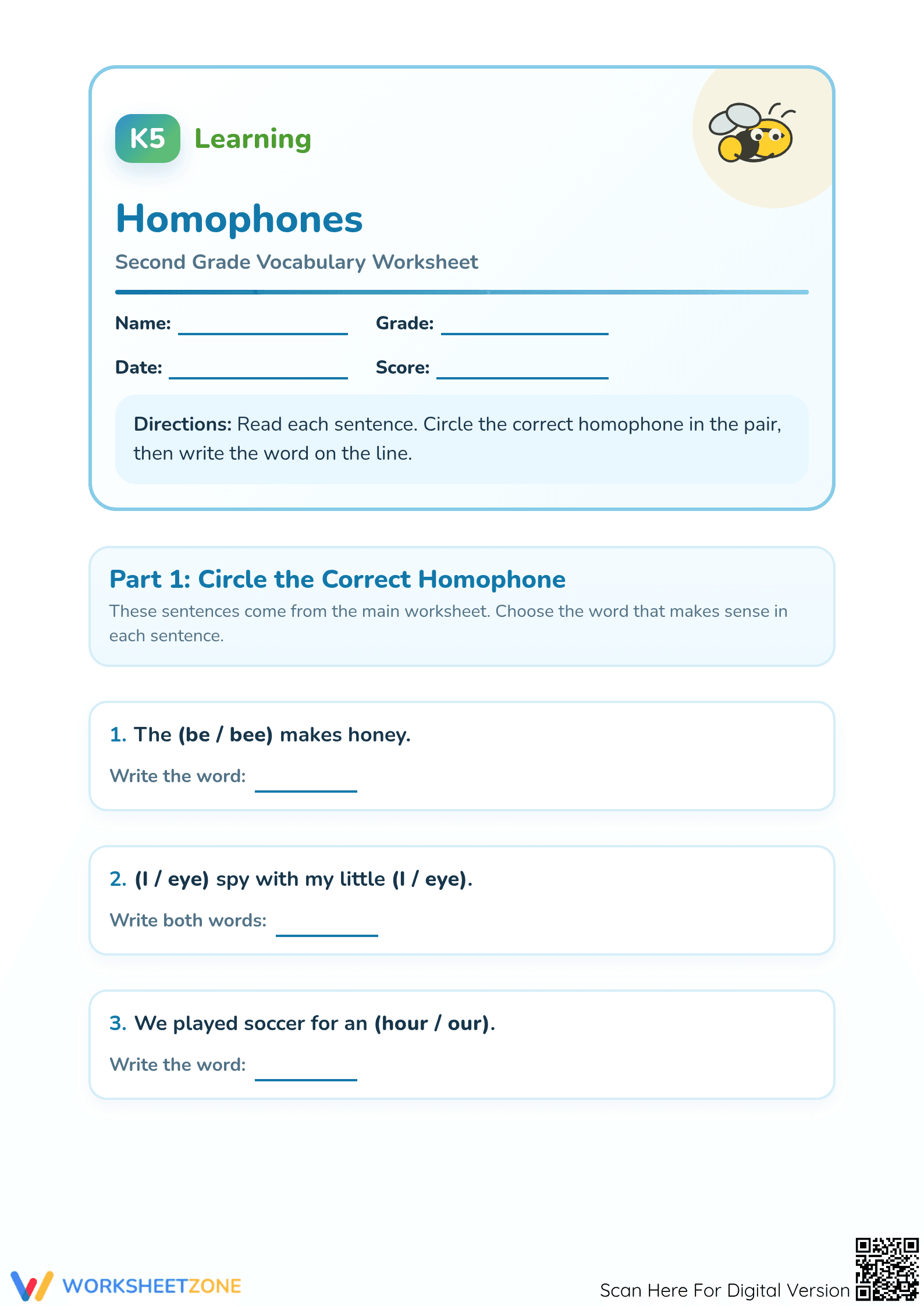
This comprehensive Homophones worksheet provides Grade 1 students with targeted practice in identifying and using words that sound the same but have different meanings and spellings. By engaging with 12 carefully crafted sentences, learners develop the essential vocabulary skills needed for reading fluency and clear writing. Students will circle the correct term and write it to reinforce mastery.
At a Glance
- Grade: 1 · Subject: English Language Arts (ELA)
- Standard:
CCSS.ELA-LITERACY.L.1.4— Determine or clarify the meaning of multiple-meaning words based on grade 1 reading- Skill Focus: Homophone identification and context clue usage
- Format: 3 pages · 12 problems · Answer key included · PDF
- Best For: Independent practice and vocabulary reinforcement
- Time: 15–20 minutes
What's Inside
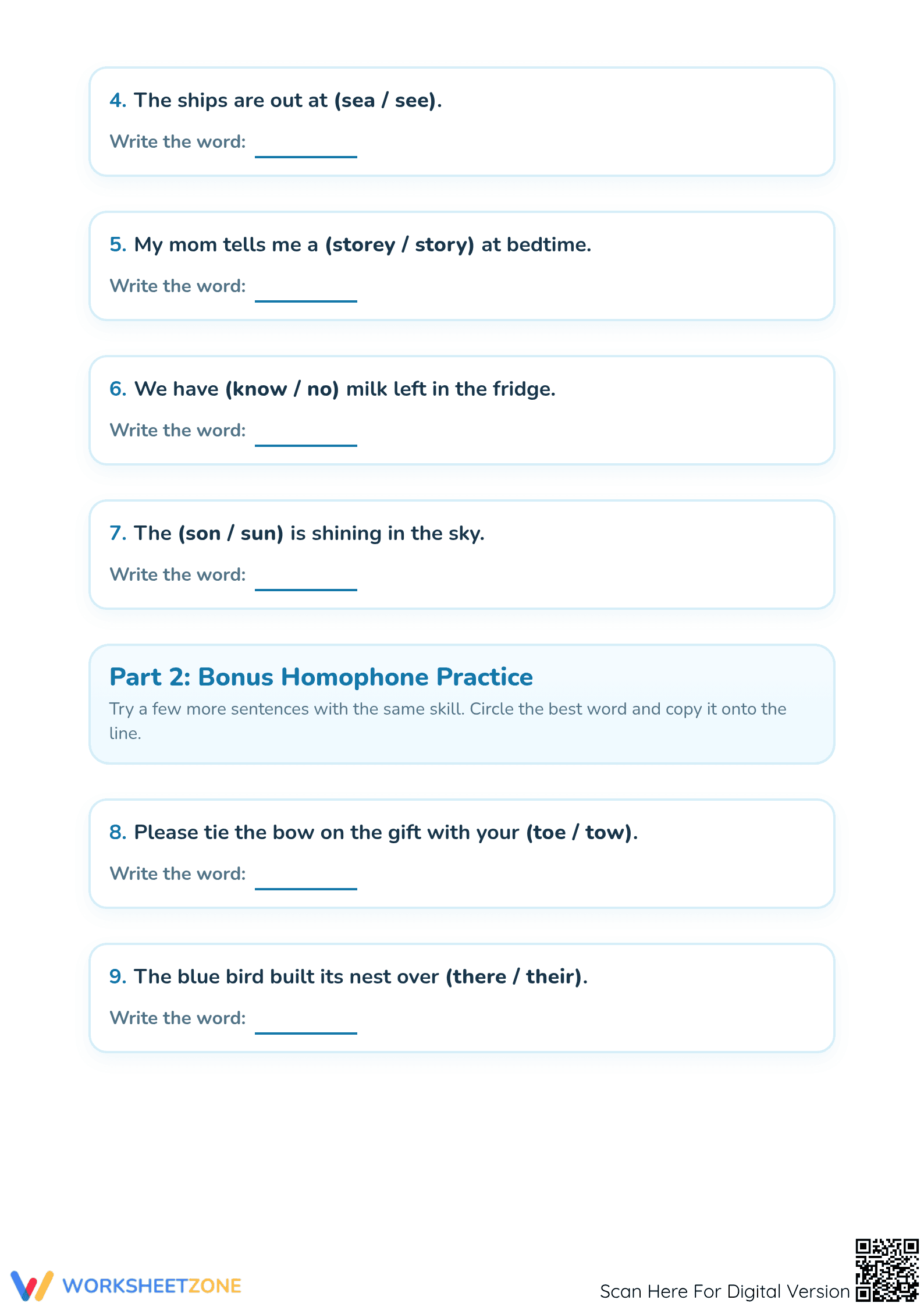
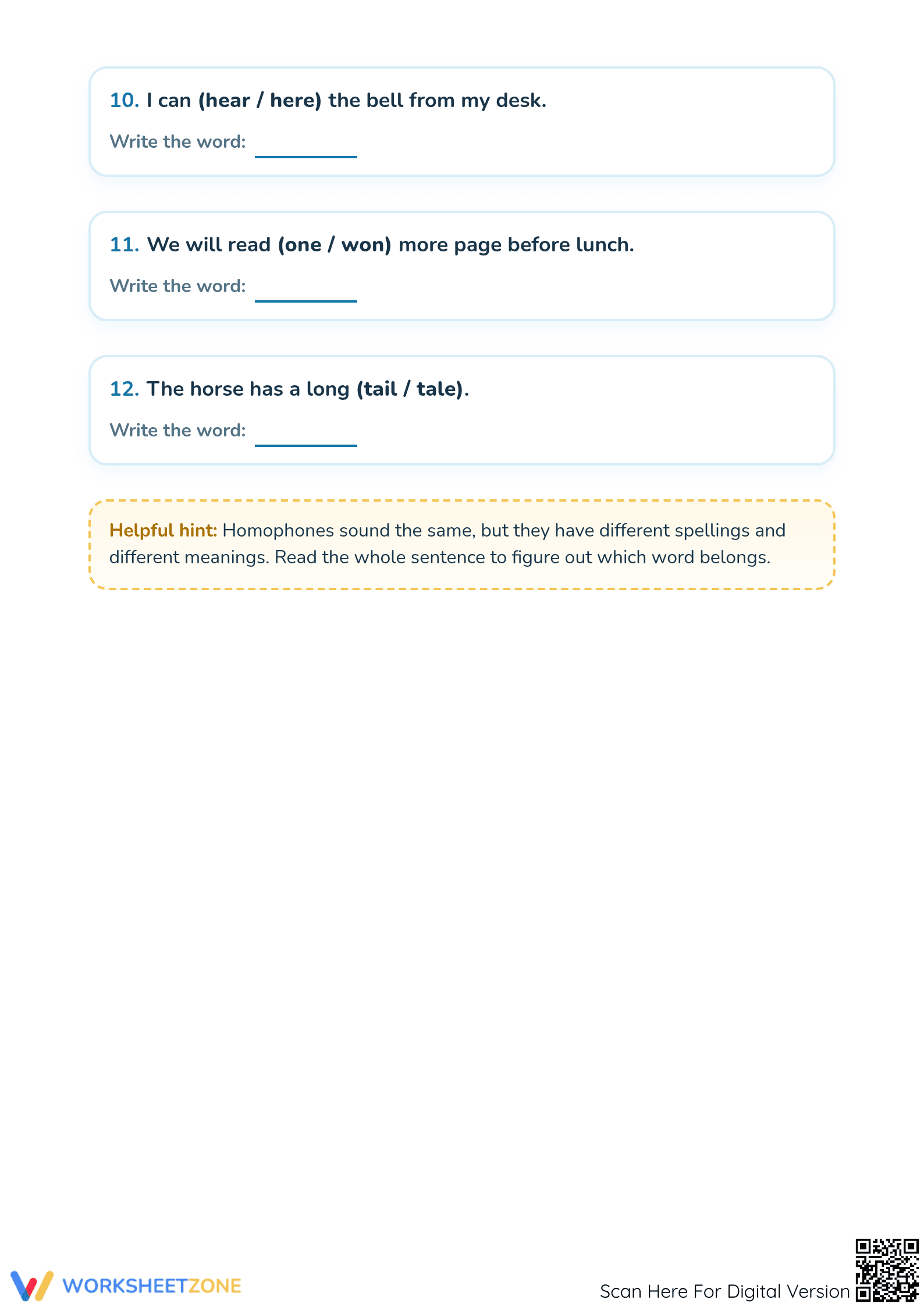
This three-page resource features a structured layout designed to maximize student focus. Each page presents a series of sentences with homophone pairs (such as bee/be, I/eye, and sun/son) enclosed in parentheses. Students are tasked with circling the word that fits the context and transcribing it onto a provided line. The worksheet includes a helpful hint box and a complete answer key for quick teacher or parent grading.
Skill Progression
- Guided Practice: The first three problems introduce highly familiar pairs like "be/bee" and "I/eye," accompanied by clear sentence structures that provide immediate context clues for successful identification.
- Supported Practice: Problems 4 through 7 increase complexity, requiring students to distinguish between more abstract homophones like "know/no" and "sea/see" within complete narrative sentences.
- Independent Practice: The bonus practice section and final tasks challenge students to apply their knowledge to less common pairs like "tail/tale" and "tow/toe," encouraging independent problem-solving without immediate scaffolds.
This gradual-release approach follows the "I Do, We Do, You Do" instructional model, moving from high-frequency foundational words to more challenging vocabulary applications.
Standards Alignment
This worksheet is primarily aligned with `CCSS.ELA-LITERACY.L.1.4`, which requires students to determine or clarify the meaning of unknown and multiple-meaning words and phrases. By focusing on homophones, the resource also supports spelling patterns for frequently occurring irregular words. Both standard codes can be copied directly into lesson plans, IEP goals, or district curriculum mapping tools.
How to Use It
This resource is best utilized during the independent practice phase of a lesson after direct instruction on sound-alike words. Teachers can distribute the worksheet as a quiet desk activity to assess whether students can distinguish between homophones using context clues. For a formative assessment observation, walk around while students complete Part 2 and note if they are reading the entire sentence before choosing a word. Most Grade 1 students will complete the 12 tasks within 15 to 20 minutes.
Who It's For
This worksheet is designed for first-grade students building their foundational reading and writing skills. It is also effective for English Language Learners (ELLs) who often struggle with the nuances of English sound-alikes. Pair this resource with a visual anchor chart displaying common homophone pairs or a short reading passage that features these specific vocabulary words to provide a richer, multi-sensory learning experience for diverse classroom populations.
This worksheet aligns with research highlighting the importance of vocabulary acquisition and scaffolded instruction. It provides 12 targeted exercises focused on `CCSS.ELA-LITERACY.L.1.4`, specifically for identifying and using homophones in context-rich sentences. By requiring students to both circle and write the correct word, the resource reinforces the connection between sounds and spellings, fostering semantic processing skills crucial for decoding and comprehension. Educators can use these tasks to gauge student mastery and build a strong foundation for reading and writing fluency.


