


























Views
Downloads

Printable Homophones Worksheet | Grade 1 ELA Essential
Paste this activity's link or code into your existing LMS (Google Classroom, Canvas, Teams, Schoology, Moodle, etc.).
Students can open and work on the activity right away, with no student login required.
You'll still be able to track student progress and results from your teacher account.
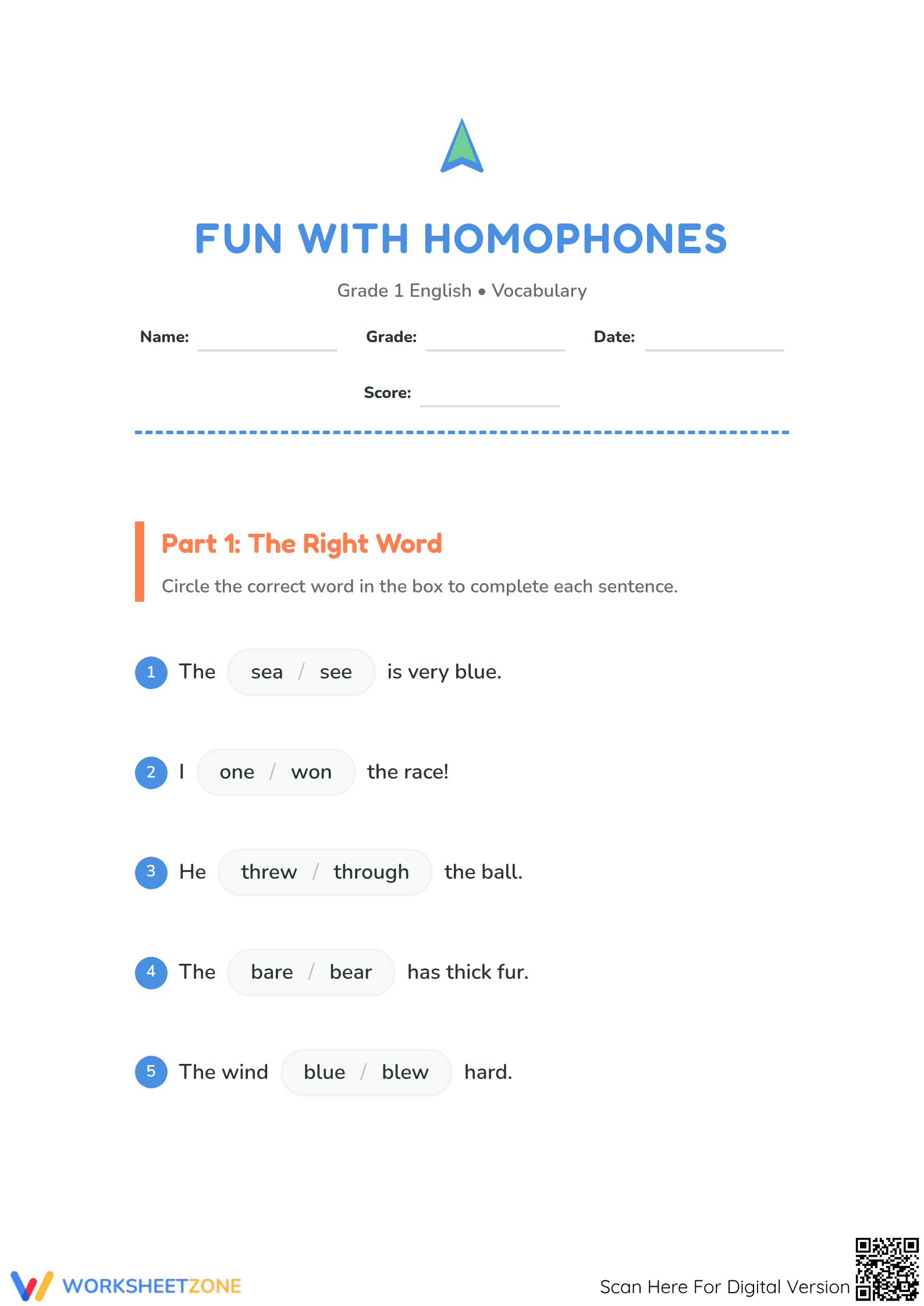
Strengthen your students' vocabulary and spelling accuracy with this focused Grade 1 ELA worksheet designed to master common homophones. This three-page resource helps learners distinguish between words that sound the same but have different meanings and spellings, ensuring they can produce clearer writing and better reading comprehension. Students will engage with 26 high-frequency homophone pairs through contextual application and matching exercises.
At a Glance
- Grade: 1 · Subject: English Language Arts (ELA)
- Standard:
CCSS.ELA-LITERACY.L.1.4— Identify and use common homophones accurately in context-rich sentences- Skill Focus: Homophone Differentiation
- Format: 3 pages · 26 problems · Answer key included · PDF
- Best For: Independent literacy centers or sub plans
- Time: 15–20 minutes
What's Inside
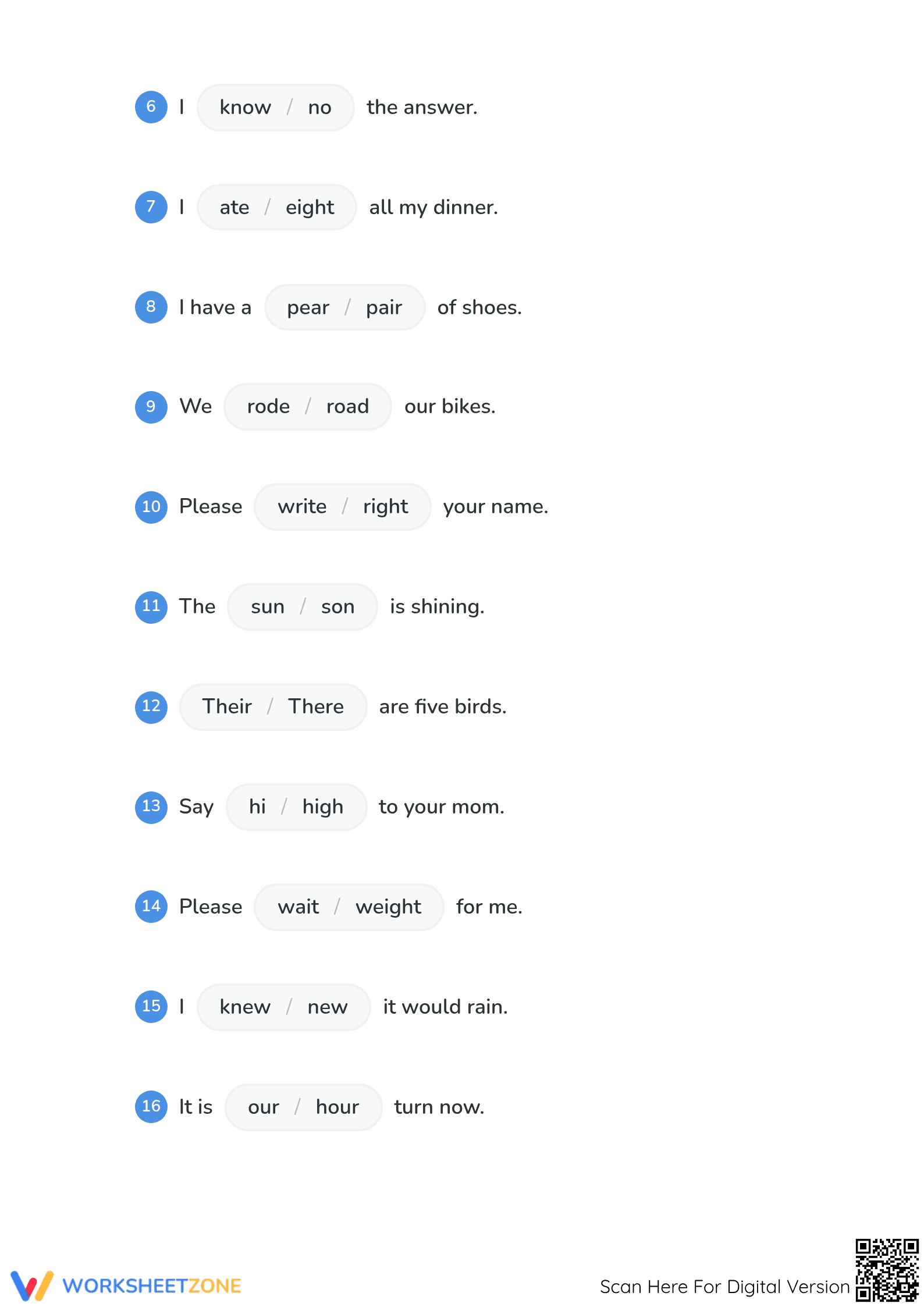
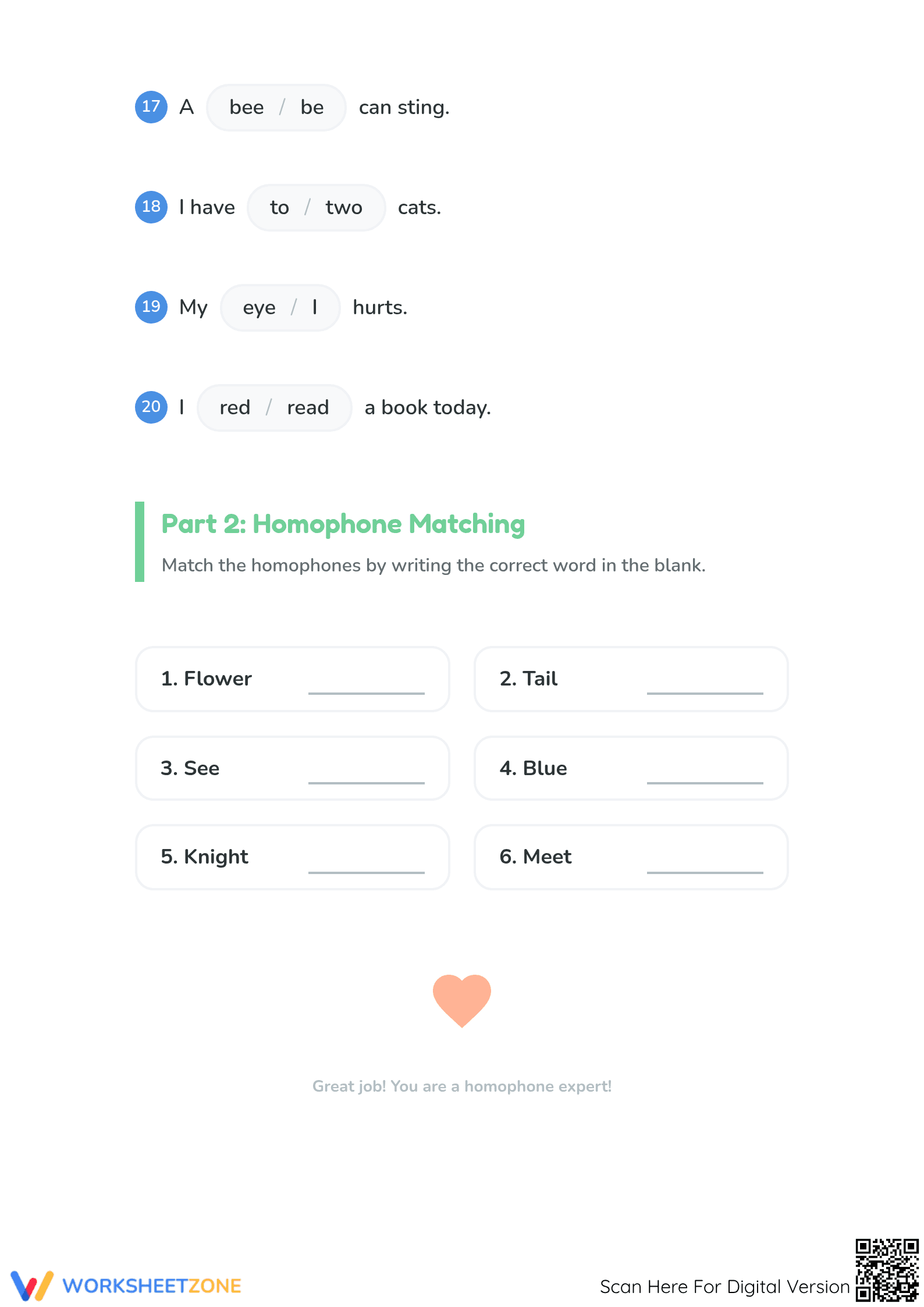
This comprehensive three-page packet features two distinct sections. Part one includes 20 multiple-choice sentences where students circle the correct homophone from a provided box. Part two offers a matching challenge with 6 additional items where students write the corresponding homophone pair for words like 'flower' and 'knight'. A full answer key is included to facilitate quick grading and immediate feedback.
Zero-Prep Instructional Workflow
This resource is engineered for immediate implementation with a total teacher preparation time of under two minutes. First, print the three-page packet (1 minute). Second, distribute the materials as an independent practice task (1 minute). Third, use the included answer key for a rapid review. The clear instructions and intuitive layout make this an ideal choice for emergency substitute plans, ensuring students remain engaged with standards-aligned content.
Standards Alignment
This resource directly supports the CCSS.ELA-LITERACY.L.1.4 standard regarding multiple-meaning words and phrases. By focusing on frequently confused lexical pairs like 'sea/see' and 'ate/eight', students build the foundational conventions necessary for Grade 1 proficiency. This standard code can be copied directly into lesson plans or IEP goals to demonstrate alignment with core literacy expectations.
How to Use It
Ideally used after direct instruction, this worksheet serves as a formative assessment tool. Teachers can observe student choices in Part One to identify which specific word pairs require further clarification. Completion typically takes 15 to 20 minutes, making it a perfect fit for a literacy rotation or a morning work assignment that reinforces previously taught vocabulary concepts.
Who It's For
This worksheet is tailored for first-grade students or English Language Learners (ELL) needing support with English orthography. For best results, pair this resource with a visual anchor chart displaying homophone pairs with illustrations. This approach helps students anchor abstract spellings to concrete meanings as they work through the practice problems.
According to Fisher & Frey (2014), the acquisition of lexical word classes like homophones requires repeated exposure within varied contexts to move from recognition to automaticity. This Grade 1 homophones packet addresses CCSS.ELA-LITERACY.L.1.4 by providing twenty-six distinct opportunities for students to differentiate between frequently confused words such as sea/see, blue/blew, and to/two. Research indicates that early mastery of these lexical distinctions prevents cognitive overload during the drafting phase of writing, as students do not have to pause to recall correct spellings. By isolating these word pairs in sentence-level context and follow-up matching tasks, the worksheet scaffolds the transition from phonological awareness to orthographic precision. This resource is optimized for educators requiring high-utility, standards-aligned materials that support both initial instruction and targeted intervention for early readers. The inclusion of a comprehensive answer key ensures that feedback can be provided immediately, reinforcing correct lexical choices before errors become habitual in student writing.


