


























Views
Downloads


Homophones Worksheet | Grade 1 ELA Printable
Paste this activity's link or code into your existing LMS (Google Classroom, Canvas, Teams, Schoology, Moodle, etc.).
Students can open and work on the activity right away, with no student login required.
You'll still be able to track student progress and results from your teacher account.
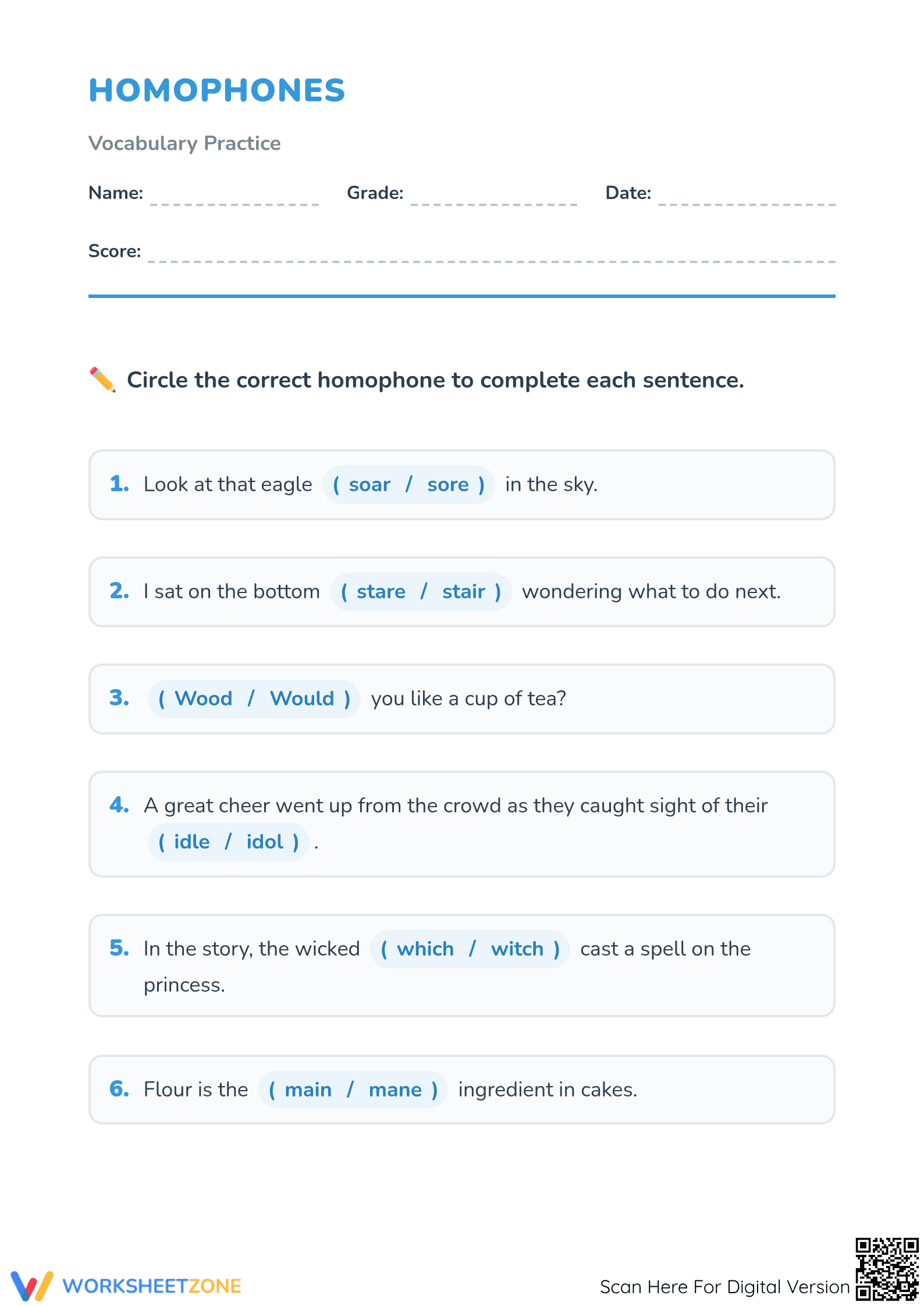
This focused worksheet helps first-grade students master homophones by selecting the correct word to complete a sentence. By practicing with frequently confused words, young learners build essential vocabulary and reading comprehension skills, ensuring they can rely on context clues to determine accurate word meanings in everyday texts.
At a Glance
- Grade: 1 · Subject: ELA
- Standard:
CCSS.ELA-LITERACY.L.1.4.A— Use sentence-level context to determine word meaning- Skill Focus: Homophones and Context Clues
- Format: 2 pages · 7 problems · Answer key included · PDF
- Best For: Independent practice or homework
- Time: 10–15 minutes
Inside this resource, educators will find a straightforward, two-page activity featuring seven distinct sentence-completion tasks. Each problem presents a sentence with a missing word and provides two homophone options in parentheses. Students must read the sentence, analyze the context, and circle the correct spelling. A complete answer key is provided to make grading quick and efficient, while the clean layout minimizes visual distractions for early readers.
This activity supports vocabulary development through a clear progression:
- Guided practice: Teachers can model the first few sentences, demonstrating how to look for context clues to choose between words like "soar" and "sore."
- Supported practice: Students work in pairs to read the remaining sentences aloud, discussing which homophone makes logical sense.
- Independent practice: Learners complete the final problems on their own, solidifying their understanding of multiple-meaning words.
This structure perfectly complements a gradual-release, I Do, We Do, You Do instructional model.
This resource is directly aligned to CCSS.ELA-LITERACY.L.1.4.A, requiring students to use sentence-level context as a clue to the meaning of a word or phrase. It also supports foundational reading skills by encouraging students to decode and differentiate between similarly pronounced words. Both standard codes can be copied directly into lesson plans, IEP goals, or district curriculum mapping tools.
This worksheet is highly versatile for the primary classroom. Use it as a quick formative assessment after a direct instruction lesson on homophones to gauge student comprehension. Alternatively, place it in a literacy center for independent reinforcement. While students work, teachers can observe whether they are actively reading the full sentence for context or simply guessing the word. The entire activity takes approximately 10 to 15 minutes to complete.
This practice sheet is ideal for first-grade students developing their vocabulary and reading comprehension skills. It serves as an excellent intervention tool for learners who struggle with spelling or frequently confused words. For differentiated instruction, pair this worksheet with a visual anchor chart displaying common homophones and their definitions to provide extra scaffolding for English Language Learners or students needing additional support.
Mastering vocabulary in context is a critical component of early literacy development and foundational reading success. According to a 2024 report by EdReports, explicit instruction in word meanings and relationships significantly improves reading comprehension outcomes in primary grades, particularly when students are taught to rely on surrounding text. This worksheet targets CCSS.ELA-LITERACY.L.1.4.A, challenging students to use sentence-level context to determine word meaning. By requiring learners to differentiate between homophones, the activity strengthens both spelling accuracy and semantic awareness. When students actively engage with context clues rather than relying on rote memorization, they build a more robust and flexible vocabulary. This targeted practice ensures that young readers can navigate complex texts with greater confidence and fluency, laying a strong, evidence-based foundation for future academic achievement across all subject areas.


