


























Views
Downloads


Homophones Worksheet: Essential Grade 1 ELA Practice
Paste this activity's link or code into your existing LMS (Google Classroom, Canvas, Teams, Schoology, Moodle, etc.).
Students can open and work on the activity right away, with no student login required.
You'll still be able to track student progress and results from your teacher account.
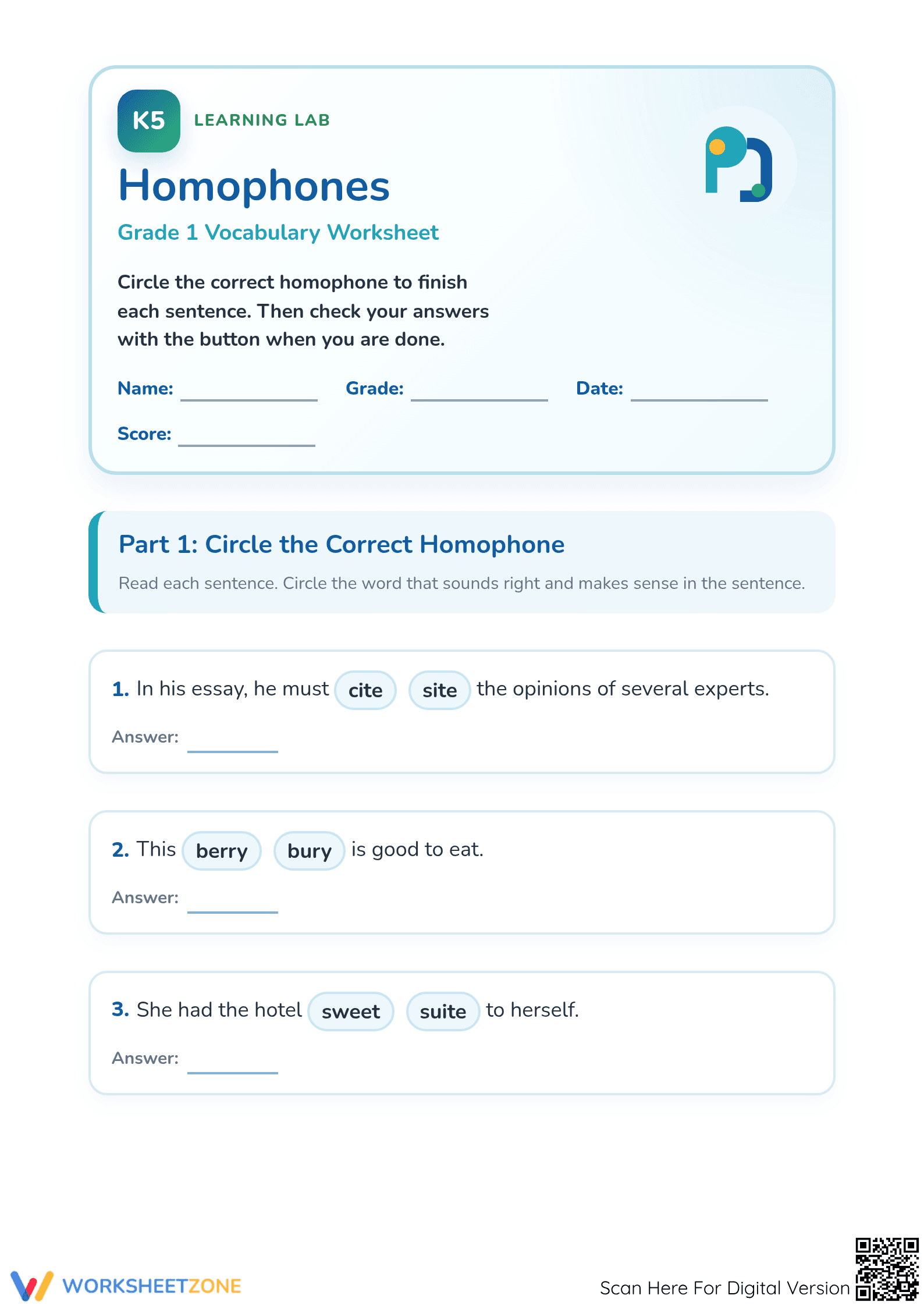
This Grade 1 homophones worksheet provides students with targeted practice identifying word pairs that sound identical but differ in meaning. By completing these context-driven exercises, learners strengthen their lexical awareness and reading fluency. This printable resource ensures students can distinguish between tricky words like "sea" and "see" or "flour" and "flower" with confidence.
At a Glance
- Grade: 1 · Subject: English Language Arts
- Standard:
CCSS.ELA-LITERACY.L.1.4— Determine word meanings using sentence context clues- Skill Focus: Homophone Differentiation
- Format: 3 pages · 12 problems · Answer key included · PDF
- Best For: Vocabulary centers and independent morning work
- Time: 15–20 minutes
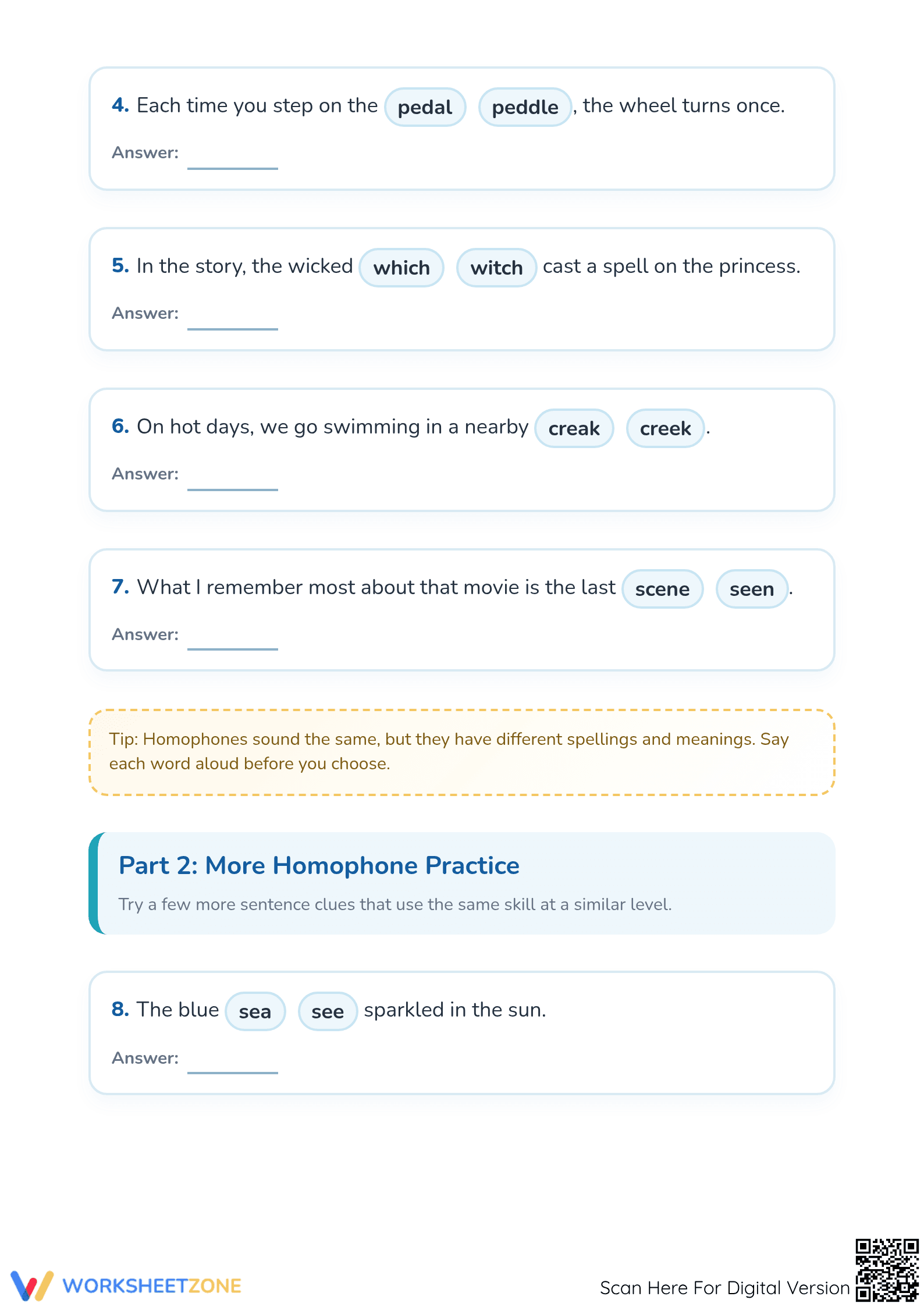
The worksheet consists of three pages featuring 12 carefully crafted sentences. Each sentence presents two homophones, requiring the student to circle the word that makes sense within the context. The layout includes clear answer lines for writing the selected word, providing a dual-modality approach. A helpful tip box reinforces definitions, while the full answer key provides immediate feedback.
Skill Progression
- Guided Practice: The first problems use concrete homophones like "berry" and "bury" to establish the pattern of checking for meaning.
- Supported Practice: Tasks introduce abstract pairs like "scene" and "seen," supported by clues defining the required part of speech.
- Independent Practice: The final page challenges students to apply knowledge to words like "hoarse" and "flour" independently.
This "I Do, We Do, You Do" approach allows teachers to model the first page before letting students work through the remaining sets independently.
Standards Alignment
The primary focus is CCSS.ELA-LITERACY.L.1.4: "Determine or clarify the meaning of unknown and multiple-meaning words and phrases based on grade 1 reading and content." This activity also supports CCSS.ELA-LITERACY.RF.1.3 regarding decoding skills. Both standard codes can be copied directly into lesson plans, IEP goals, or district curriculum mapping tools.
How to Use It
Use this worksheet during the practice phase of a vocabulary lesson. After introducing homophones with an anchor chart, distribute these pages for independent work. It serves as an excellent formative assessment; observe if students read the entire sentence before choosing. Most first graders will complete the tasks within 20 minutes.
Who It's For
This resource is designed for Grade 1 students but is also suitable for kindergarteners ready for a challenge or second graders requiring remedial support. It is particularly helpful for English Language Learners who often struggle with the auditory similarity of homophones. Pair this worksheet with a homophone-matching game to reinforce concepts.
Effective vocabulary instruction in the early grades requires explicit focus on multiple-meaning words and phonological awareness. This homophones worksheet aligns with the recommendations from the RAND AIRS 2024 report, which emphasizes the necessity of contextualized lexical practice to bridge the gap between decoding and comprehension. By requiring students to analyze sentence-level clues to distinguish between words like "hear" and "here," the activity builds the morphological and semantic connections critical for long-term reading success. Research from the NAEP consistently shows that students who can successfully navigate the nuances of the English language, including homophone differentiation, demonstrate higher levels of overall literacy achievement. This worksheet provides the exact type of "low-stakes, high-impact" practice needed to internalize these tricky word pairs. Educators can confidently integrate this standard-aligned CCSS.ELA-LITERACY.L.1.4 resource into their curriculum to support evidence-based literacy development and ensure all learners meet Grade 1 vocabulary benchmarks.


