


























Views
Downloads

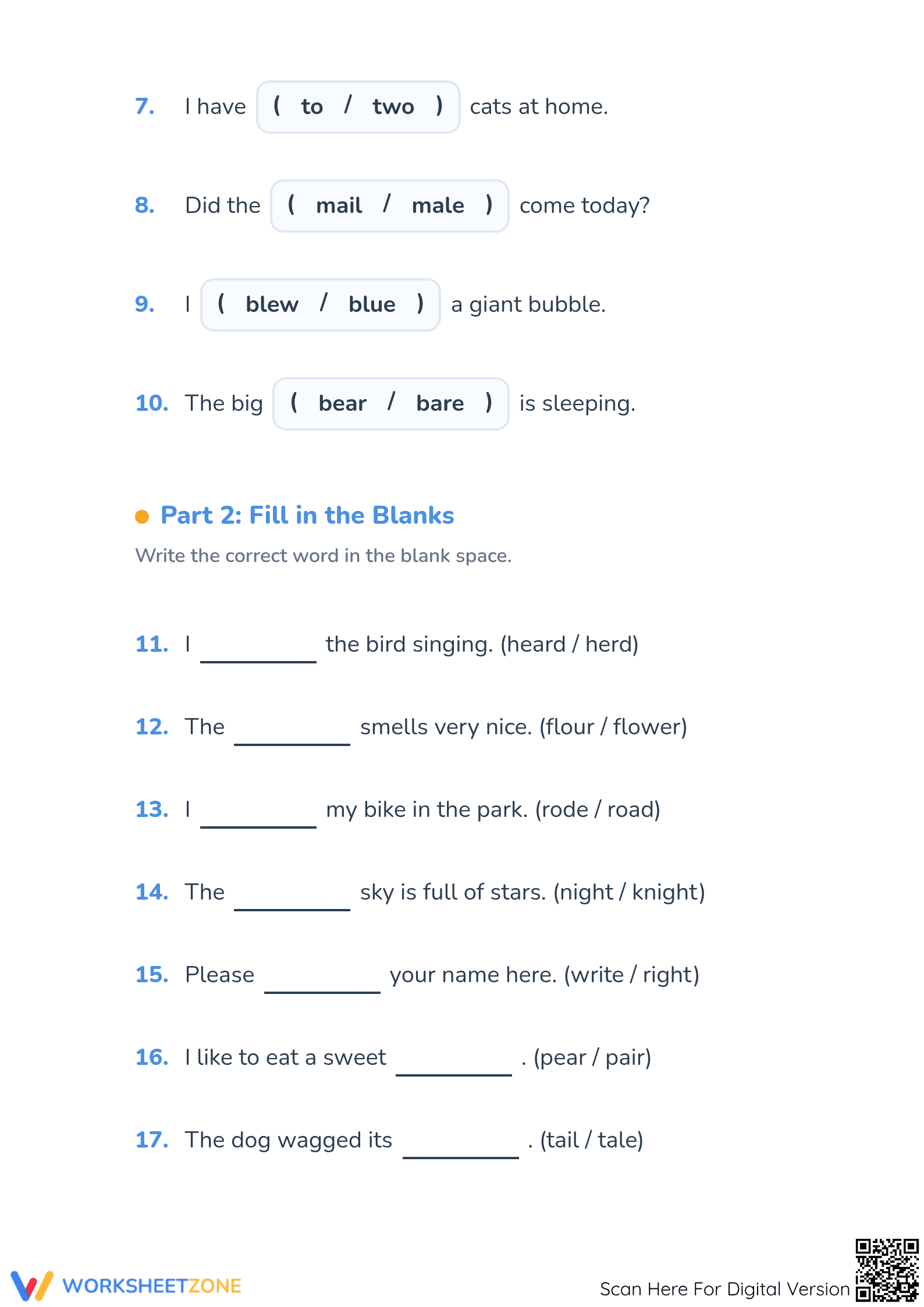


Printable Homophones Practice Worksheet | Grade 1 ELA
Paste this activity's link or code into your existing LMS (Google Classroom, Canvas, Teams, Schoology, Moodle, etc.).
Students can open and work on the activity right away, with no student login required.
You'll still be able to track student progress and results from your teacher account.
Mastering homophones is a vital step in developing Grade 1 literacy and spelling accuracy. This comprehensive worksheet guides students through the nuances of words that sound the same but carry different meanings and spellings. By engaging with 24 targeted tasks, learners build the confidence to select the correct lexical choice based on sentence-level context clues.
At a Glance
- Grade: 1 · Subject: English Language Arts
- Standard:
CCSS.ELA-LITERACY.L.1.4— Use sentence-level context clues to determine the meaning of multiple-meaning words- Skill Focus: Homophone Identification and Contextual Usage
- Format: 3 pages · 24 problems · Answer key included · PDF
- Best For: Independent practice and formative vocabulary assessment
- Time: 15–20 minutes
This three-page PDF resource features a robust collection of exercises designed for young learners. It includes 10 "Which Word?" circling tasks, 10 "Fill in the Blanks" sentence completion problems, and a "Match the Pairs" final review section. The layout is clean and spacious, featuring clear fonts and supportive icons, with a full answer key provided to facilitate quick grading or self-correction.
Skill Progression
- Guided Identification: 10 tasks provide a binary choice within a sentence, allowing students to recognize correct pairs like "see" and "sea" with immediate scaffolded support.
- Supported Production: 10 tasks require students to select the correct spelling from a word bank to complete a sentence, increasing the cognitive demand and spelling focus.
- Independent Matching: 4 final pairs reinforce semantic connections through visual association, ensuring students can link phonetically identical words to their distinct meanings.
This "I Do, We Do, You Do" framework ensures a gradual release of responsibility throughout the instructional cycle.
Standards Alignment
The primary focus of this activity is CCSS.ELA-LITERACY.L.1.4, which requires students to use sentence-level context as a clue to the meaning of a word or phrase. It also supports CCSS.ELA-LITERACY.L.1.2 by reinforcing conventional spelling for high-frequency words. Both standard codes can be copied directly into lesson plans, IEP goals, or district curriculum mapping tools.
How to Use It
This worksheet is ideal for use during the independent practice portion of a word study lesson. Teachers can distribute it after a direct instruction session on specific homophone pairs to check for understanding. For a formative assessment tip, observe students as they complete the fill-in-the-blank section to see if they are reading the entire sentence for context before choosing a word. Expect completion in 15–20 minutes.
Who It's For
Designed for Grade 1 students, this resource is also suitable for Grade 2 review or as a scaffolded activity for English Language Learners (ELLs). It pairs naturally with a homophone anchor chart or a read-aloud of "Dear Deer" by Gene Barretta to provide a rich, multi-modal learning experience for foundational literacy development.
This Grade 1 resource targets CCSS.ELA-LITERACY.L.1.4 by requiring students to distinguish between high-frequency homophones using sentence-level context. According to Fisher & Frey (2014), the development of lexical agility—specifically the ability to differentiate between phonologically identical but semantically distinct words—is a critical milestone in early literacy that bridges the gap between basic decoding and reading comprehension. By providing 24 structured tasks across three distinct modalities—multiple-choice circling, fill-in-the-blank production, and semantic matching—this worksheet reinforces the mental models needed for spelling accuracy and vocabulary expansion. The inclusion of high-utility pairs like see/sea and sun/son ensures that learners are engaging with the "trick words" most likely to appear in foundational texts. Educators can utilize these tasks to identify specific phonetic or semantic gaps in student understanding, making it an essential component of a balanced literacy curriculum that prioritizes both word study and contextual application in the early elementary grades.


