


























Views
Downloads

Printable Homophones Worksheet | Grade 1 ELA Essential
Paste this activity's link or code into your existing LMS (Google Classroom, Canvas, Teams, Schoology, Moodle, etc.).
Students can open and work on the activity right away, with no student login required.
You'll still be able to track student progress and results from your teacher account.
Mastering Words That Sound Alike
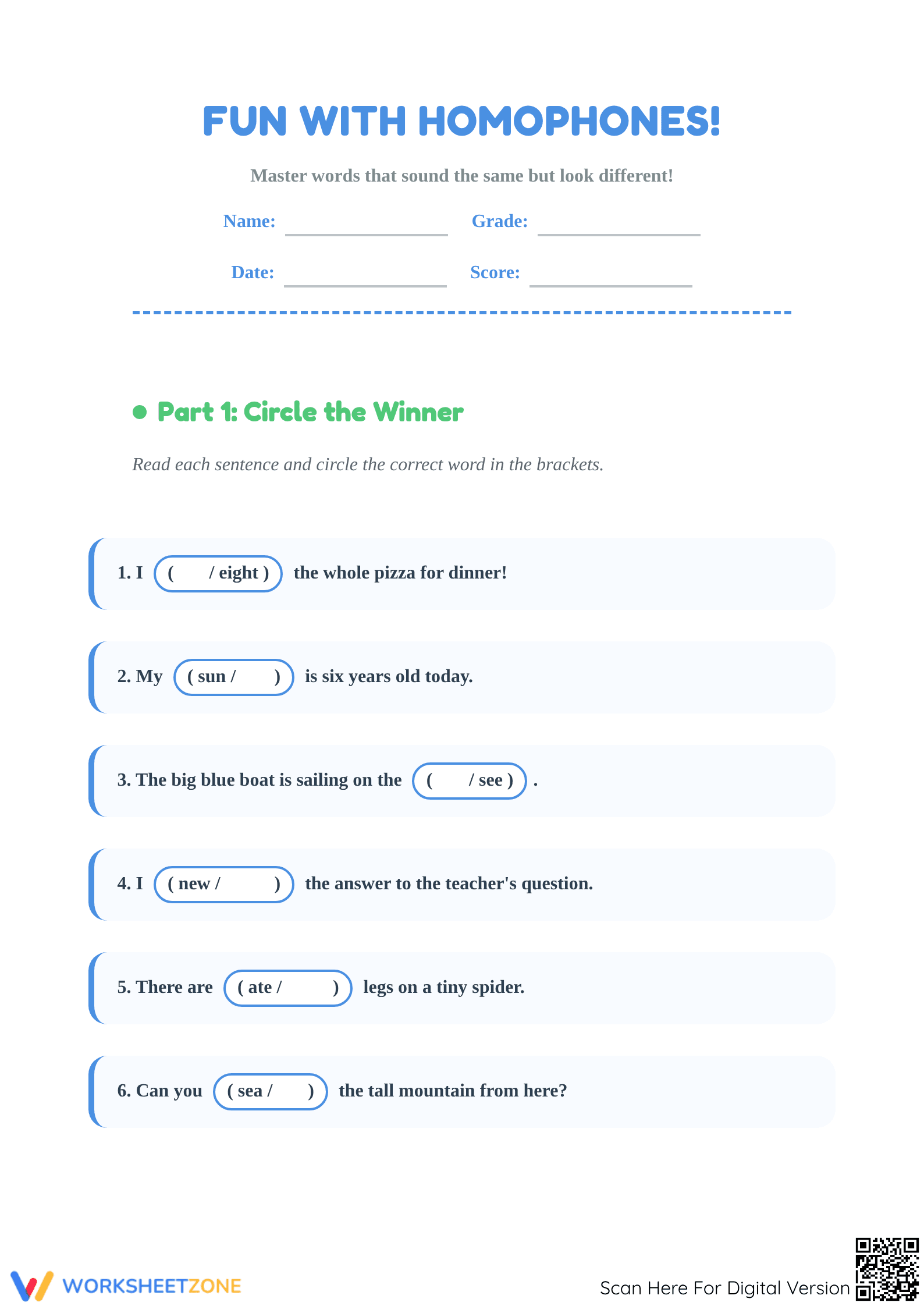
This Grade 1 homophones worksheet provides students with essential practice in identifying and using words that sound the same but have different spellings and meanings. Through 18 structured sentence problems and interactive matching tasks, learners build lexical precision necessary for early reading fluency and clear written communication. An included answer key ensures immediate feedback for students.
At a Glance
- Grade: 1 · Subject: English Language Arts
- Standard:
CCSS.ELA-LITERACY.L.1.4— Identify and use words with multiple meanings or similar sounds in context- Skill Focus: Contextual word selection and spelling precision
- Format: 4 pages · 23 problems · Answer key included · PDF
- Best For: Independent literacy centers or vocabulary warm-ups
- Time: 20–30 minutes
What's Inside
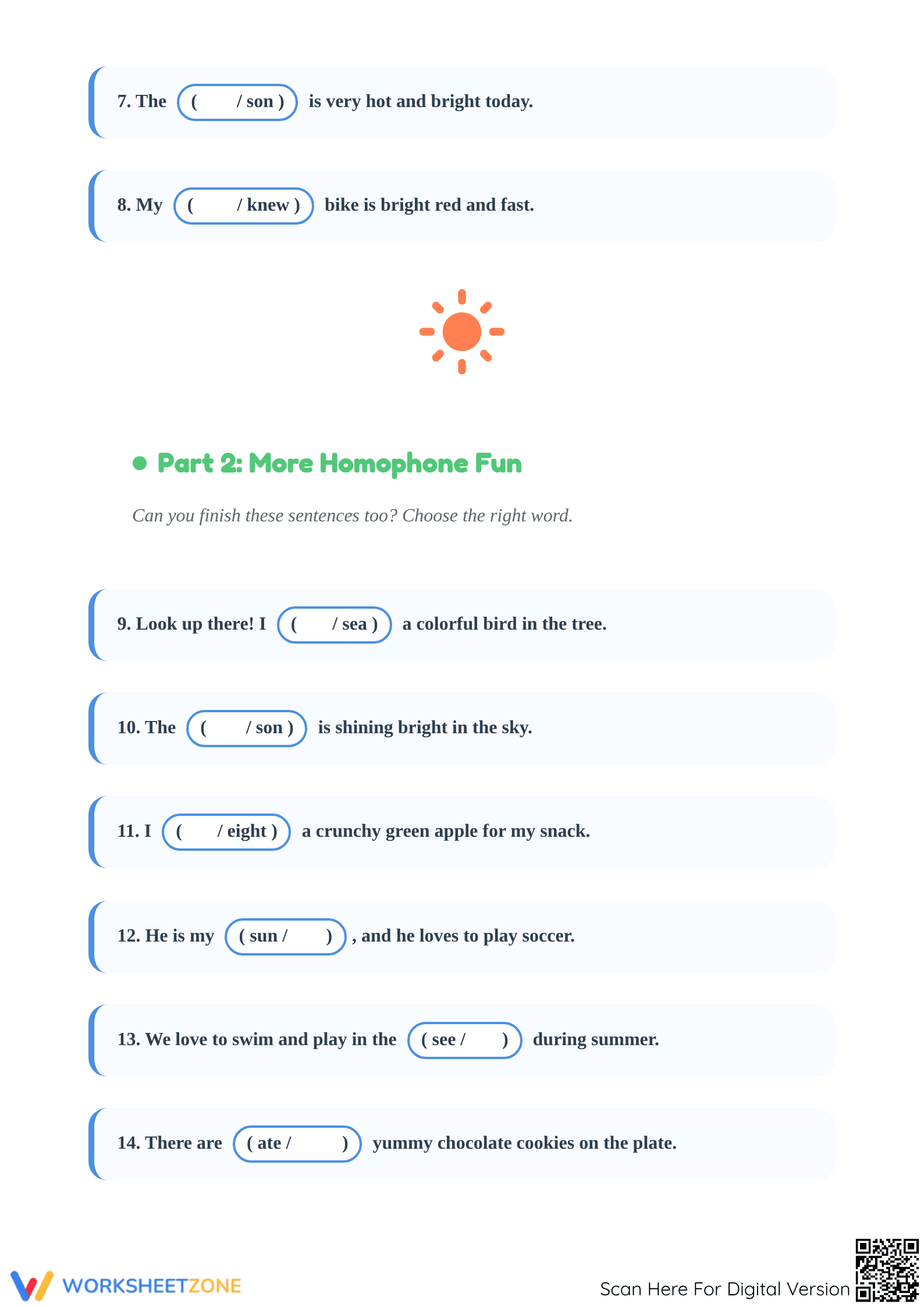
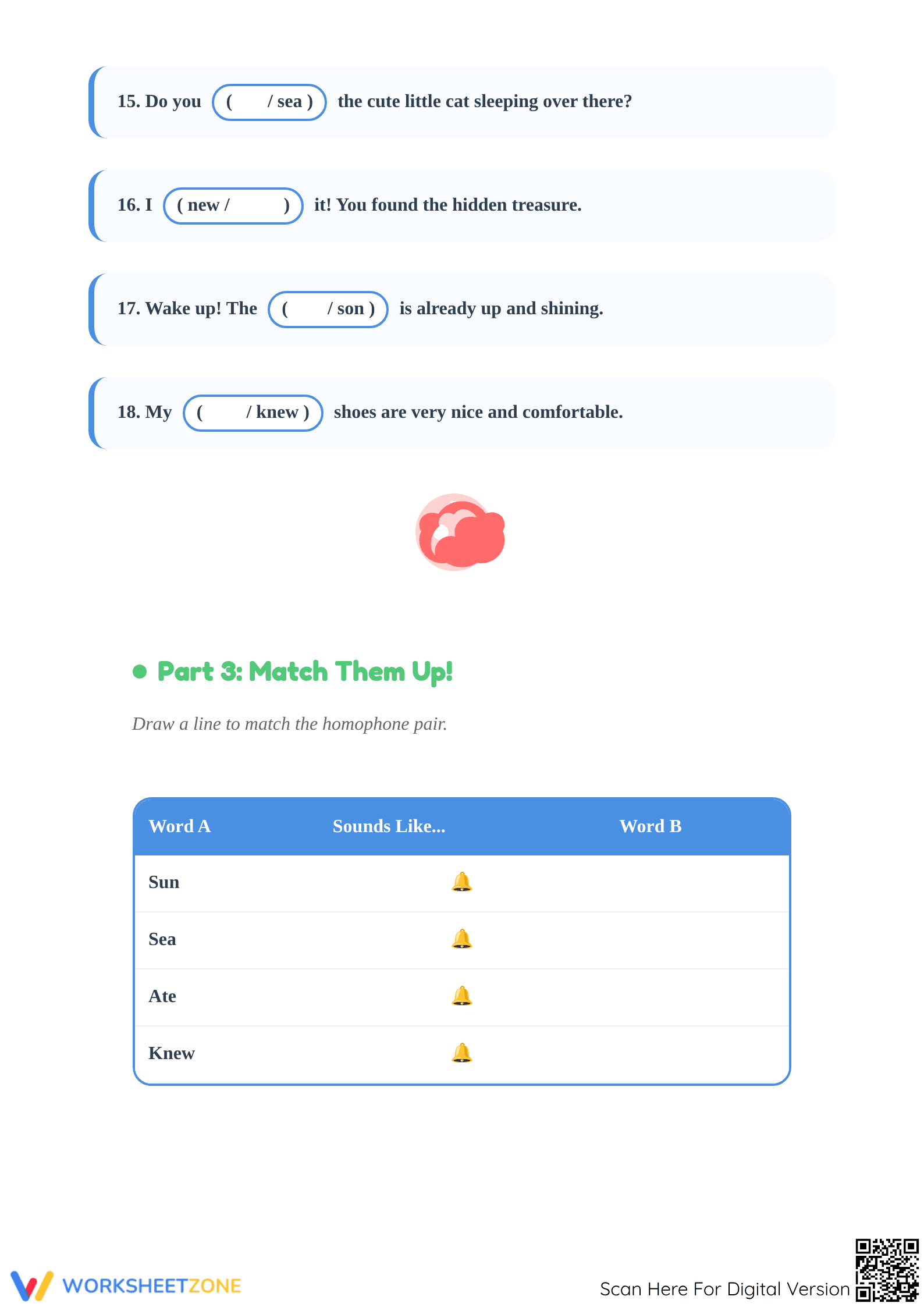
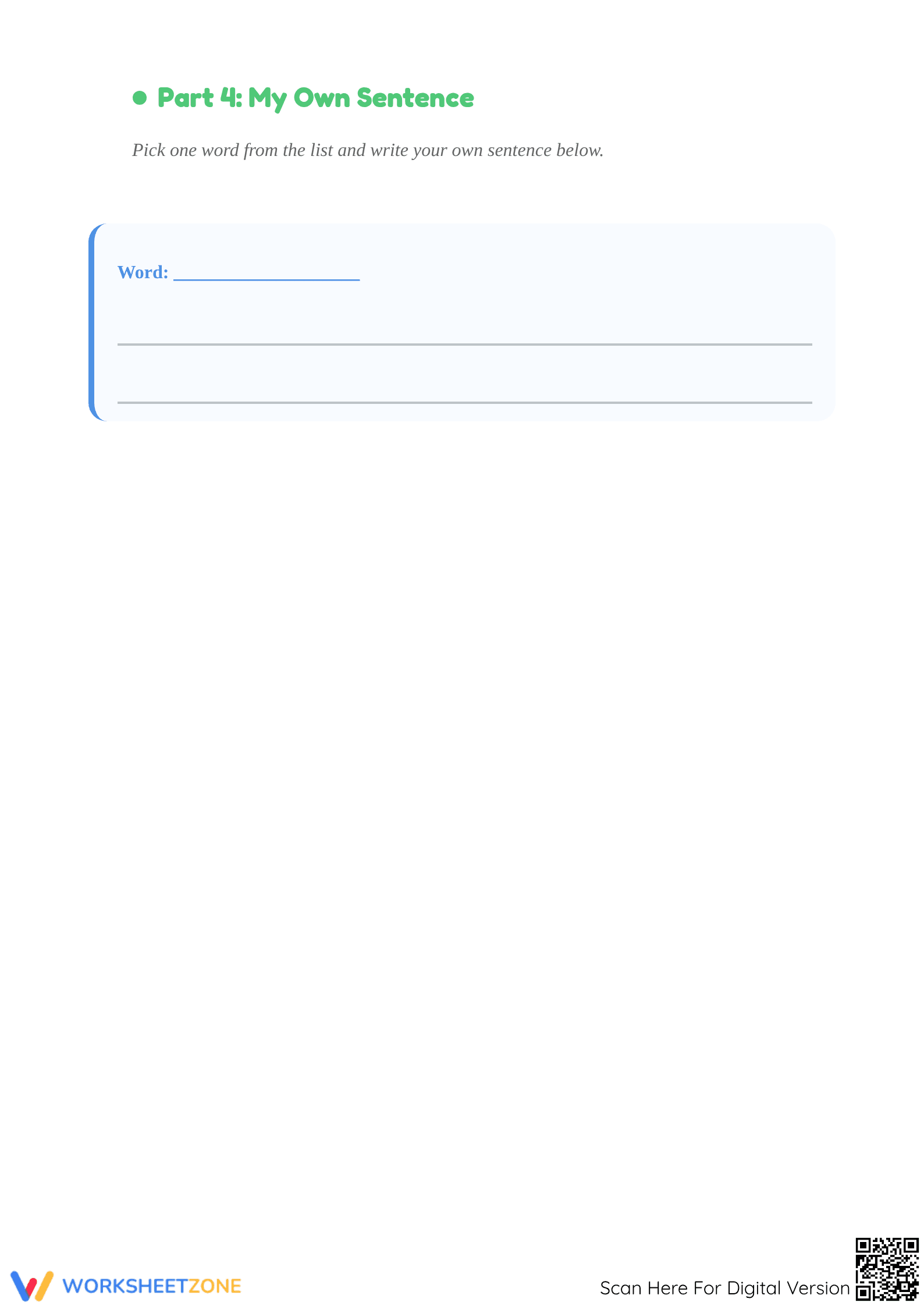
The packet includes 4 comprehensive pages of activities designed to solidify vocabulary acquisition. Main sections feature 18 circling tasks where students choose between common pairs like sun/son, sea/see, and ate/eight. A visual matching table reinforces pairings, while an independent writing prompt allows students to demonstrate mastery by applying their chosen word in an original sentence. This multi-modal approach supports different learning styles within the classroom.
Skill Progression
- Guided Recognition (Part 1): Students begin with 8 focused sentences utilizing high-frequency homophone pairs, practicing basic word choice with clear contextual clues.
- Supported Application (Part 2): Learners tackle 10 additional sentences with varied structures, requiring them to evaluate sentence meaning before selecting the correct spelling.
- Independent Synthesis (Parts 3 & 4): The final sections move beyond recognition to matching pairs and generating original sentences, transitioning students from passive identification to active usage.
This progression follows a gradual-release model, ensuring students feel supported as cognitive demand increases across the worksheet set.
Standards Alignment
The primary focus of this resource is CCSS.ELA-LITERACY.L.1.4, which requires students to determine or clarify the meaning of unknown and multiple-meaning words. By focusing specifically on homophones, the worksheet also supports foundational conventions and spelling accuracy. Both standard codes can be copied directly into lesson plans, IEP goals, or district curriculum mapping tools to streamline teacher documentation and reporting.
How to Use It
This worksheet is ideal for use during the "independent practice" phase of a direct instruction lesson on vocabulary. For a quick formative assessment, teachers can observe students during the matching phase to see if they can recall the pairings without sentence context. Completion typically takes between 20 and 30 minutes, making it a perfect fit for a standard literacy rotation or as a focused morning work activity.
Who It's For
This resource is specifically tailored for first-grade students, but also serves as an excellent intervention tool for second graders needing additional support with phonetic spelling. It pairs naturally with a classroom anchor chart displaying common homophone pairs or a short reading passage highlighting multiple-meaning words. Its clear layout and simple instructions make it accessible for English Language Learners developing phonemic awareness.
Homophones present a significant cognitive hurdle for Grade 1 learners, requiring a transition from phonological awareness to orthographic precision. As noted by Fisher & Frey (2014), gradual release of responsibility through scaffolded sentence-level practice is essential for lexical acquisition. This worksheet targets CCSS.ELA-LITERACY.L.1.4 by requiring students to evaluate sentence context to select the correct homophone, such as distinguishing between "sun" and "son." Providing 18 distinct circling opportunities alongside matching and independent sentence construction ensures high repetition, critical for moving new vocabulary from short-term memory into long-term orthographic mapping. Educators can use these tasks to identify common phonetic spelling errors and provide immediate corrective feedback. This evidence-based approach directly supports foundational literacy skills needed for reading fluency and writing accuracy in early elementary education, providing a clear pathway toward meeting national standards in language arts.


