


























Views
Downloads



Homeostasis Worksheet | Essential Grade 5-8 Science
Paste this activity's link or code into your existing LMS (Google Classroom, Canvas, Teams, Schoology, Moodle, etc.).
Students can open and work on the activity right away, with no student login required.
You'll still be able to track student progress and results from your teacher account.
This homeostasis worksheet provides a comprehensive framework for students to understand how the human body maintains internal stability. By exploring control systems and negative feedback loops, learners identify the critical roles of receptors, coordination centers, and effectors. This resource ensures students can explain complex biological regulation through clear, structured practice and real-world thermoregulation examples.
At a Glance
- Grade: 5-8 · Subject: Life Science
- Standard:
MS-LS1-3— Use evidence to explain how body systems interact to maintain homeostasis- Skill Focus: Negative Feedback Loops
- Format: 3 pages · 15 tasks · Answer key included · PDF
- Best For: Middle school biology unit review
- Time: 30–45 minutes
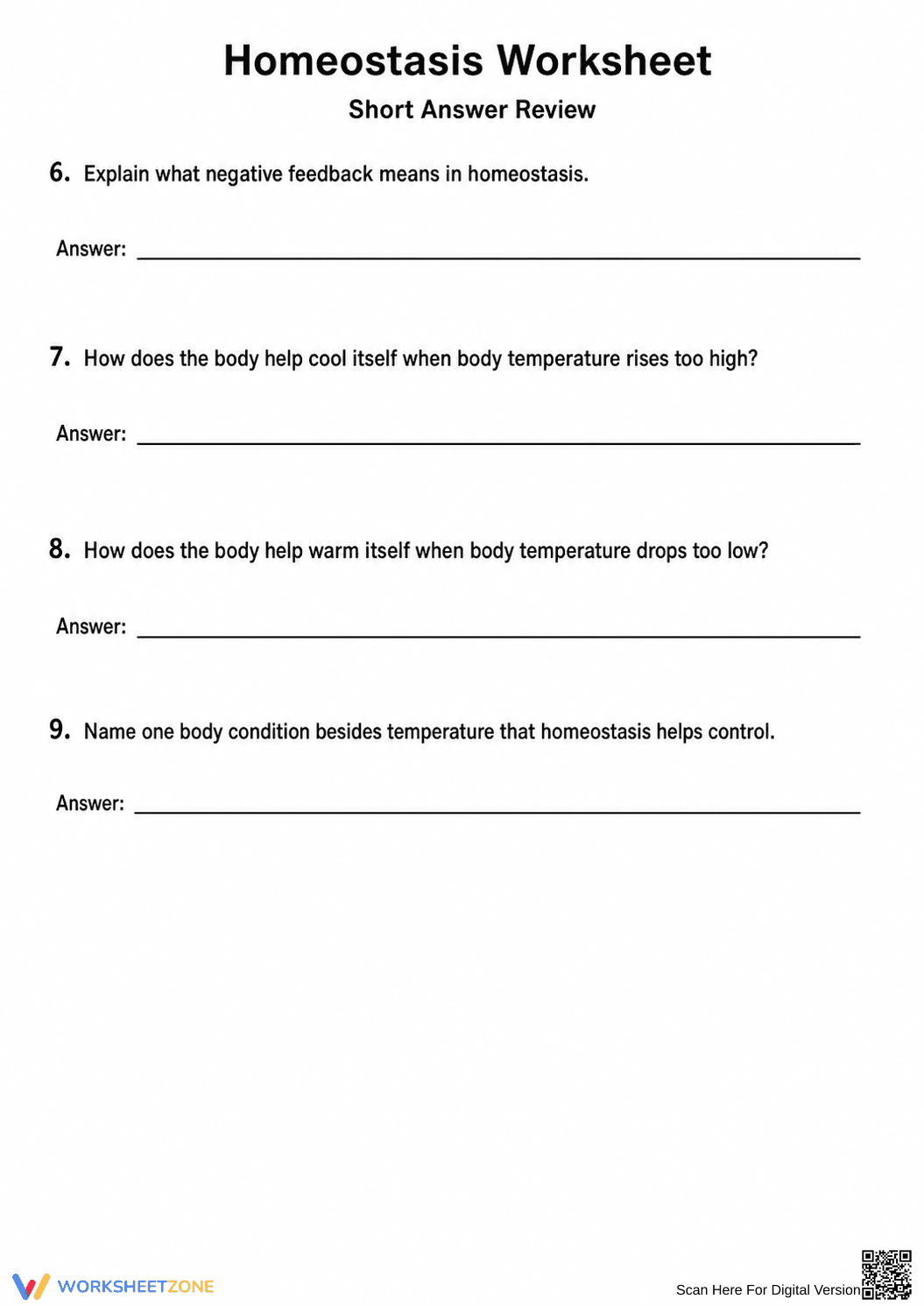
What's Inside: The three-page PDF includes a guided note-taking section for defining homeostasis and its three main components. Students encounter a detailed breakdown of negative feedback loops with a specific focus on body temperature regulation. The final pages feature 9 short-answer review questions designed to assess comprehension of thermoregulation, effector actions, and the necessity of coordination centers in biological systems.
Zero-Prep Workflow
- Print: Generate copies of the three-page document for your entire class in under 1 minute.
- Distribute: Hand out the worksheets as a guided reading activity or independent study packet during your human body systems unit.
- Review: Use the included answer key to facilitate a 10-minute class discussion, correcting misconceptions about how the brain coordinates responses to environmental changes.
Standards Alignment
This worksheet aligns with `MS-LS1-3`: "Use argument supported by evidence for how the body is a system of interacting subsystems composed of groups of cells." It specifically targets the crosscutting concept of systems and system models by illustrating how feedback loops maintain stability. This standard code can be copied directly into lesson plans, IEP goals, or district curriculum mapping tools.
How to Use It
Use this worksheet during the "Explain" phase of a 5E lesson cycle to formalize student understanding of internal regulation. It serves as an excellent formative assessment tool; observe students as they map the temperature regulation loop to identify if they confuse receptors with effectors. Completion typically takes 35 minutes, making it a reliable option for sub plans or homework assignments.
Who It's For
This resource is ideal for middle school life science students and upper elementary learners introduced to human anatomy. It provides necessary scaffolding for students who require structured notes while offering enough depth for advanced learners to analyze feedback mechanisms. Pair this with a digital simulation of thermoregulation or a physical anchor chart of the human nervous system.
Effective science instruction requires moving beyond rote memorization to understanding system interactions. According to the RAND AIRS 2024 report, structured guided notes in middle school science significantly improve the retention of complex biological processes like homeostasis. By explicitly labeling the components of a negative feedback loop—receptors, coordination centers, and effectors—this worksheet reduces cognitive load and allows students to build a mental model of internal regulation. Research from Fisher & Frey (2014) emphasizes that the gradual release of responsibility, supported by clear diagrams and targeted questioning, is essential for mastering standards like MS-LS1-3. This 3-page resource provides the necessary scaffolding for students to transition from identifying parts of a system to explaining the dynamic equilibrium required for survival. It ensures that 100% of the core vocabulary is applied in context, facilitating deeper scientific literacy and preparation for high school biology.


