


























Views
Downloads

Homeostasis Glucose Regulation Worksheet | Essential Grade 8
Paste this activity's link or code into your existing LMS (Google Classroom, Canvas, Teams, Schoology, Moodle, etc.).
Students can open and work on the activity right away, with no student login required.
You'll still be able to track student progress and results from your teacher account.
This homeostasis worksheet provides a structured framework for students to analyze how the human body maintains internal stability through glucose regulation. By identifying specific biological components like receptors and effectors, learners gain a concrete understanding of negative feedback mechanisms. It transforms abstract physiological concepts into a clear, step-by-step mapping exercise for middle school science.
At a Glance
- Grade: 8 · Subject: Science
- Standard:
MS-LS1-3— Use evidence to explain how body systems interact to maintain homeostasis- Skill Focus: Glucose Feedback Loops
- Format: 2 pages · 12 problems · Answer key included · PDF
- Best For: Middle school life science units
- Time: 30–45 minutes
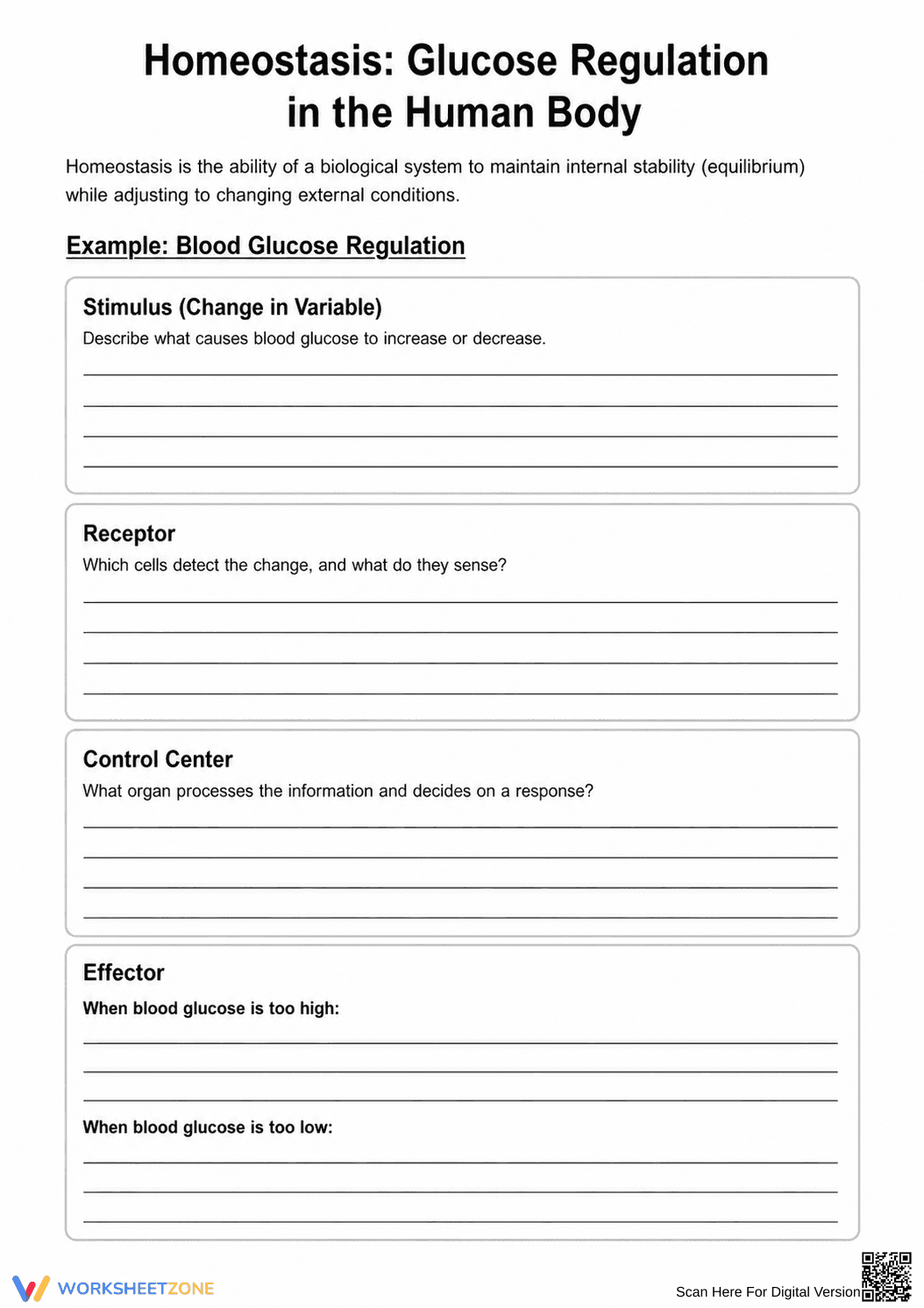
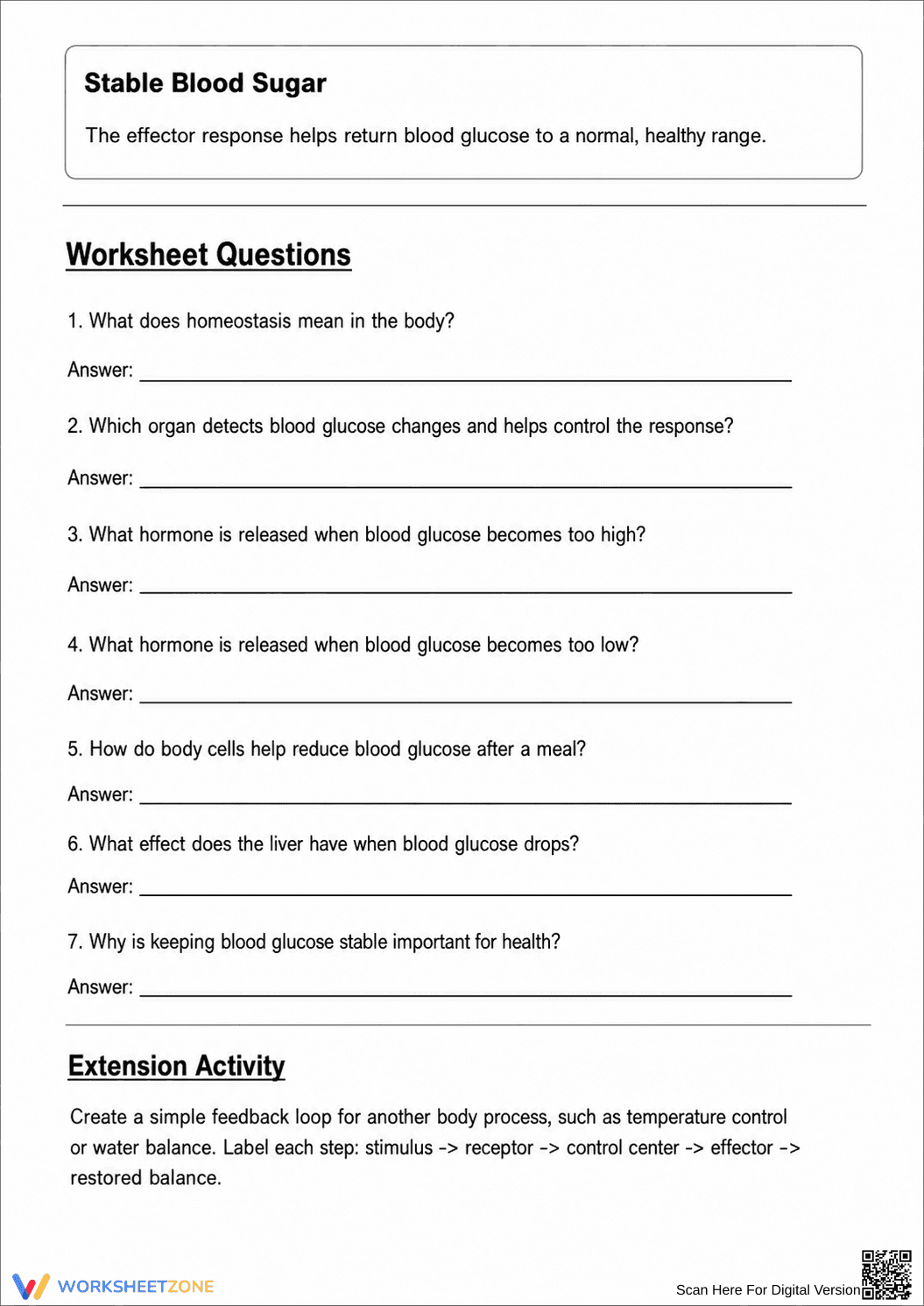
The resource contains two comprehensive pages. The first page features four dedicated sections for students to define and describe the stimulus, receptor, control center, and effector responses for both high and low blood sugar. The second page includes seven critical thinking questions and an extension activity that challenges students to create an original feedback loop for temperature or water balance.
This resource follows a zero-prep workflow designed for busy educators. First, print the two-page PDF (30 seconds). Second, distribute the sheets to students as a primary learning activity or independent practice (1 minute). Finally, review the answers using the included key to provide immediate feedback (10 minutes). It is an ideal solution for emergency sub plans or reinforcement.
This worksheet aligns with `MS-LS1-3`: "Use argument supported by evidence for how the body is a system of interacting subsystems composed of groups of cells." It specifically targets the interaction between the endocrine and nervous systems to maintain equilibrium. Both standard codes can be copied directly into lesson plans, IEP goals, or district curriculum mapping tools.
Use this worksheet during the instructional phase of a lesson cycle after introducing the concept of body systems. It serves as an excellent formative assessment to check for misconceptions regarding hormonal responses. Expected completion time is 35 minutes, allowing for a 10-minute whole-class review of the feedback loop diagrams and the extension activity.
This resource is designed for middle school students in Grades 5-8, particularly those in life science or health courses. It provides scaffolding for English Language Learners through clear headings and structured response areas. It pairs naturally with a diagram of the endocrine system or a short video on insulin and glucagon functions.
According to the RAND AIRS 2024 report on science literacy, structured graphic organizers significantly improve the retention of complex physiological processes in middle school learners. This worksheet utilizes that research-backed approach by requiring students to map the MS-LS1-3 standard through the specific lens of glucose regulation. By isolating the stimulus, receptor, control center, and effector, students move beyond rote memorization of vocabulary to a functional understanding of how biological systems interact to maintain internal equilibrium. The inclusion of an extension activity further supports the Fisher & Frey (2014) model of gradual release, moving students from guided identification to independent application of feedback loop logic. This 2-page resource provides the necessary evidence-based scaffolding to ensure students can explain the biological mechanisms behind homeostasis, making it a vital tool for any life science curriculum focused on systemic interactions and physiological stability.


