


























Views
Downloads
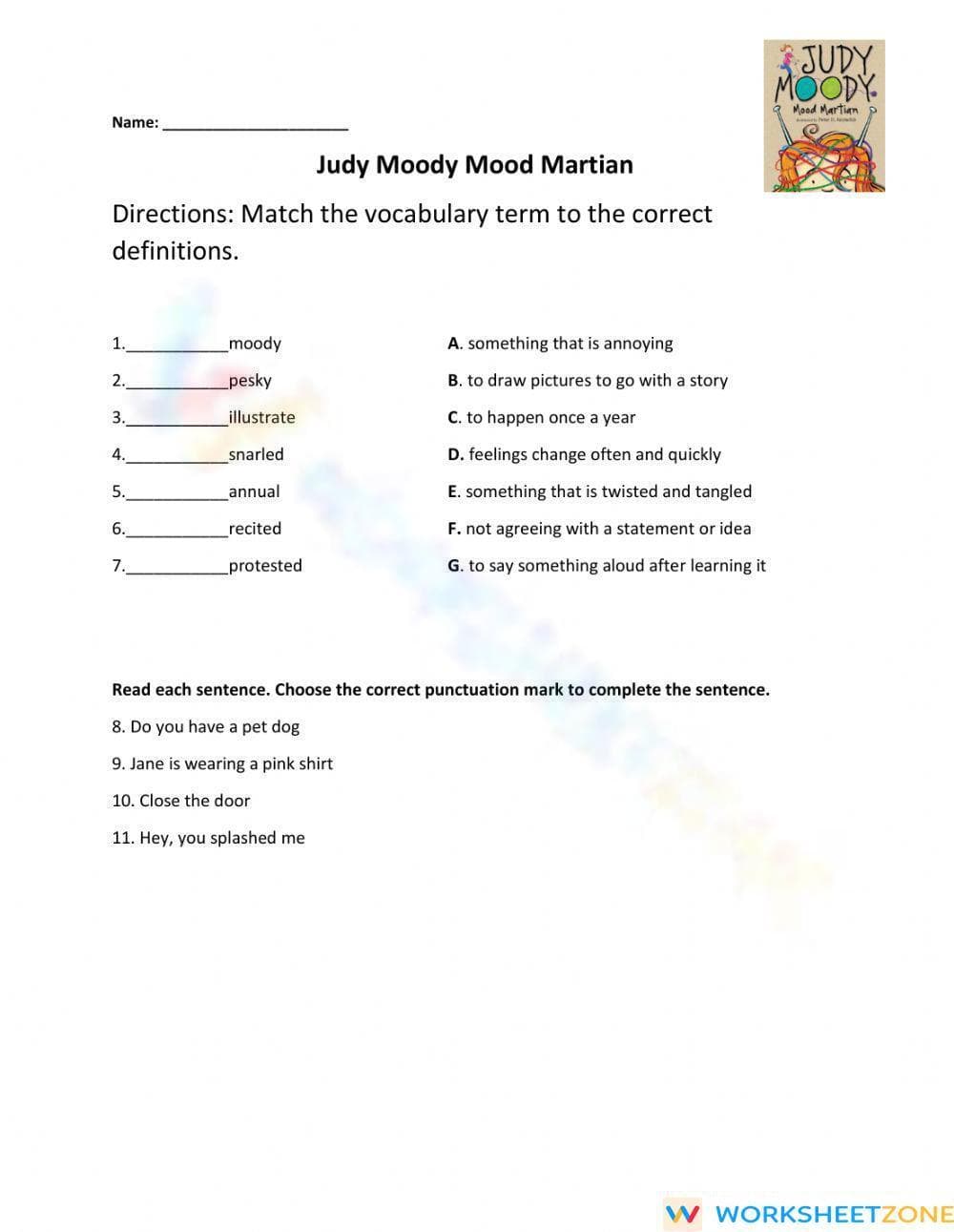

Essential Judy Moody Vocabulary and Punctuation Worksheet
Paste this activity's link or code into your existing LMS (Google Classroom, Canvas, Teams, Schoology, Moodle, etc.).
Students can open and work on the activity right away, with no student login required.
You'll still be able to track student progress and results from your teacher account.
This Grade 3 and Grade 4 Judy Moody Mood Martian worksheet provides students with targeted practice in vocabulary acquisition and sentence conventions. By combining context-based definition matching with punctuation identification, students strengthen their comprehension of the text while reinforcing foundational grammar skills. It is an ideal resource for literature circles or independent literacy centers.
At a Glance
- Grade: 3–4 · Subject: English Language Arts
- Standard:
CCSS.ELA-LITERACY.L.3.4— Use context to determine or clarify the meaning of unknown words and phrases- Skill Focus: Vocabulary Matching & Punctuation
- Format: 1 page · 11 problems · Answer key included · PDF
- Best For: Literature circles and quick formative assessment
- Time: 10–15 minutes
This single-page printable features 11 distinct tasks designed for immediate use. The first section contains 7 vocabulary terms directly from the Judy Moody series, such as "moody," "pesky," and "illustrate," requiring students to match them with accurate definitions. The second section presents 4 sentence-level punctuation challenges, focusing on correctly identifying periods, question marks, and exclamation points.
The zero-prep workflow for this resource is designed for maximum efficiency. Teachers can print the single PDF page in under 30 seconds, distribute it to the class instantly with no prior lecture required, and review student responses using the included answer key in less than a minute. This makes it an excellent choice for substitute folders or bell-ringer activities.
The primary standard for this resource is CCSS.ELA-LITERACY.L.3.4, which focuses on determining the meaning of unknown words through various strategies. Additionally, it supports CCSS.ELA-LITERACY.L.3.2 by requiring students to apply correct punctuation to end sentences. Both standard codes can be copied directly into lesson plans, IEP goals, or district curriculum mapping tools.
Use this worksheet as a post-reading check after finishing a chapter of Judy Moody to ensure students have mastered the key terminology. During instruction, teachers can use it as a "check for understanding" to see if students can distinguish between different sentence types. Observe whether students can explain the "why" behind their punctuation choices for a quick formative data point.
This resource is tailored for Grade 3 and Grade 4 students engaging with contemporary children's literature. It provides excellent support for English Language Learners through clear definitions and sentence frames. It pairs naturally with a Judy Moody anchor chart or a direct instruction lesson on sentence types and ending punctuation marks.
Research from Fisher & Frey (2014) emphasizes the importance of tiered vocabulary instruction within the context of authentic literature to improve long-term retention and reading comprehension. This worksheet aligns with those findings by isolating 7 critical academic terms and 4 punctuation conventions linked to the CCSS.ELA-LITERACY.L.3.4 standard. By engaging in active matching and application, students move beyond rote memorization toward a functional understanding of word meanings and grammatical structures. The structured format provides a low-stakes environment for students to demonstrate mastery of Grade 3 and Grade 4 literacy expectations. This balanced approach to language arts practice ensures that students are not only identifying words but also understanding how those words function within the mechanics of standard English. Educators can utilize these 11 tasks as evidence of progress toward foundational literacy benchmarks, making it a valuable component of a comprehensive ELA curriculum.


