




























Views
Downloads
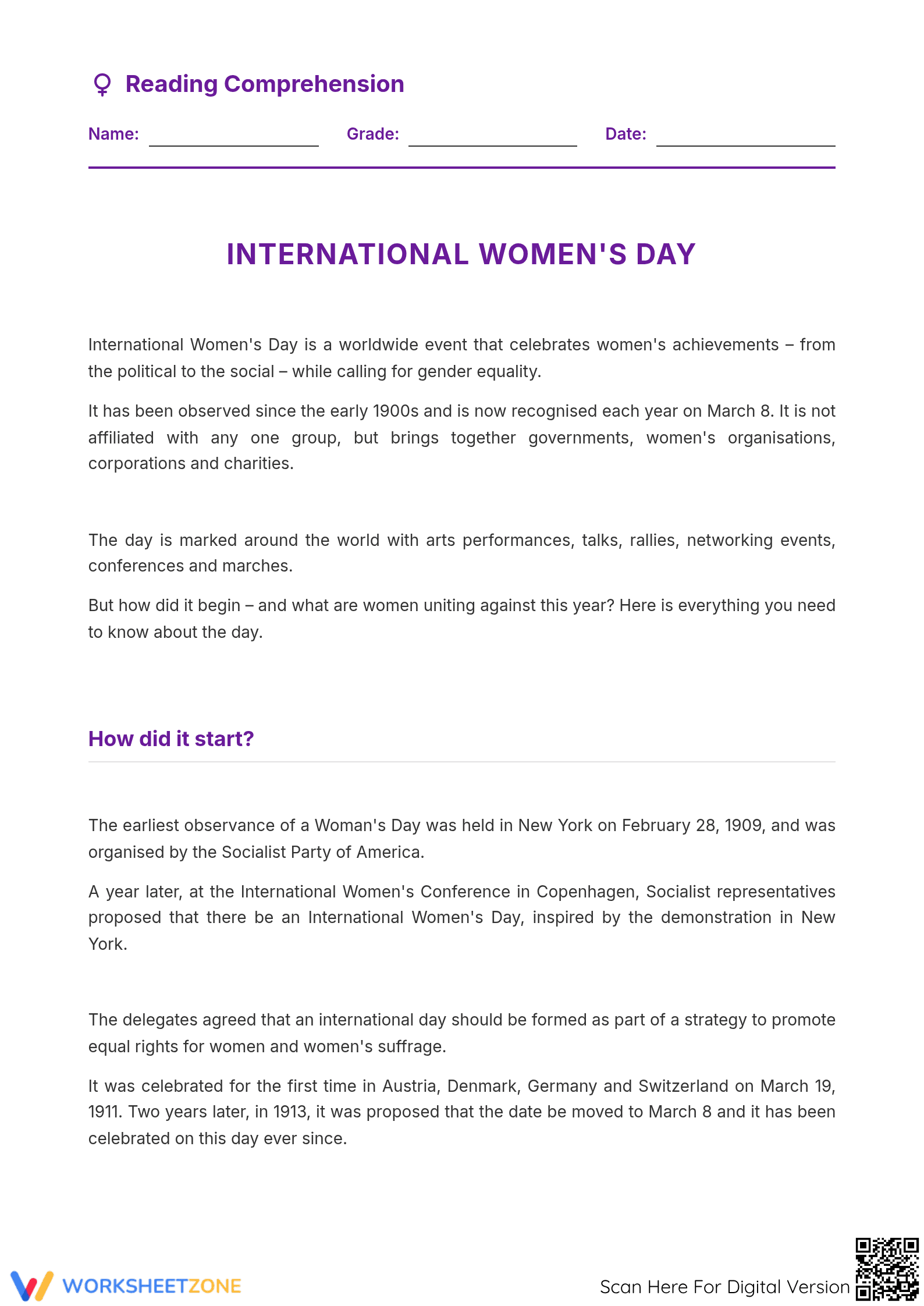


History of Women's Day Worksheet | Essential Grade 6 ELA

Paste this activity's link or code into your existing LMS (Google Classroom, Canvas, Teams, Schoology, Moodle, etc.).
Students can open and work on the activity right away, with no student login required.
You'll still be able to track student progress and results from your teacher account.
This informational text worksheet guides students through the complex history and global significance of International Women's Day. By engaging with chronological events and modern social movements, learners develop the ability to cite textual evidence and summarize central ideas from non-fiction sources. This resource bridges historical facts with contemporary relevance to ensure high student engagement.
At a Glance
- Grade: 6 · Subject: ELA
- Standard:
CCSS.ELA-LITERACY.RI.6.1— Cite textual evidence to support analysis of what the text says explicitly- Skill Focus: Informational Text Comprehension
- Format: 4 pages · 4 problems · Answer key included · PDF
- Best For: Women's History Month or sub plans
- Time: 30–45 minutes
Inside this 4-page PDF, you will find a comprehensive article detailing the origins of the holiday starting in 1909. The text covers the suffrage movement, the establishment of the March 8th date, and modern contexts including the gender pay gap and the Me Too movement. The packet concludes with a dedicated Comprehension Check section featuring 4 targeted short-answer questions designed to test literal and inferential understanding.
Zero-Prep Workflow
- Print: Select the 4-page student packet and the corresponding answer key (30 seconds).
- Distribute: Hand out the materials for independent reading or structured partner work (2 minutes).
- Review: Use the provided answer key to facilitate a whole-class discussion or grade submissions (5 minutes).
Total teacher preparation time is under 2 minutes, making this an ideal resource for busy mornings or unexpected substitute teacher days.
Standards Alignment
This resource is primarily aligned to `CCSS.ELA-LITERACY.RI.6.1`: "Cite textual evidence to support analysis of what the text says explicitly as well as inferences drawn from the text." It also supports secondary standards related to determining central ideas and analyzing text structure. Both standard codes can be copied directly into lesson plans, IEP goals, or district curriculum mapping tools.
How to Use It
This worksheet is best used during the "You Do" phase of a gradual release model or as a standalone literacy block during Women's History Month in March. For a formative assessment, observe how students locate the specific dates and names mentioned in the text to answer the comprehension questions. Expected completion time ranges from 30 to 45 minutes depending on reading speed.
Who It's For
This resource is designed for middle school students in Grades 6 through 8, though it is accessible for Grade 5 and useful for high school remediation. It is particularly effective for students who need practice with multi-page informational articles. Pair this worksheet with a timeline graphic organizer or a direct instruction lesson on the history of civil rights.
Research from Fisher & Frey (2014) emphasizes that student engagement with complex informational texts is significantly enhanced when the subject matter connects historical foundations to contemporary social relevance. This History of Women's Day worksheet applies this principle by bridging the 1909 New York observances with modern contexts like the Me Too movement and the gender pay gap. By requiring students to cite specific evidence under CCSS.ELA-LITERACY.RI.6.1, the resource ensures that comprehension is rooted in the text rather than general knowledge. Such structured reading tasks are critical for developing the stamina required for high-school level literacy. The inclusion of a clear answer key allows for immediate feedback, a practice shown by NAEP data to improve long-term retention of historical facts and linguistic structures. This 4-page resource provides the necessary scaffolding for students to navigate dense non-fiction while building essential global citizenship awareness through evidence-based analysis.


