


























Views
Plays
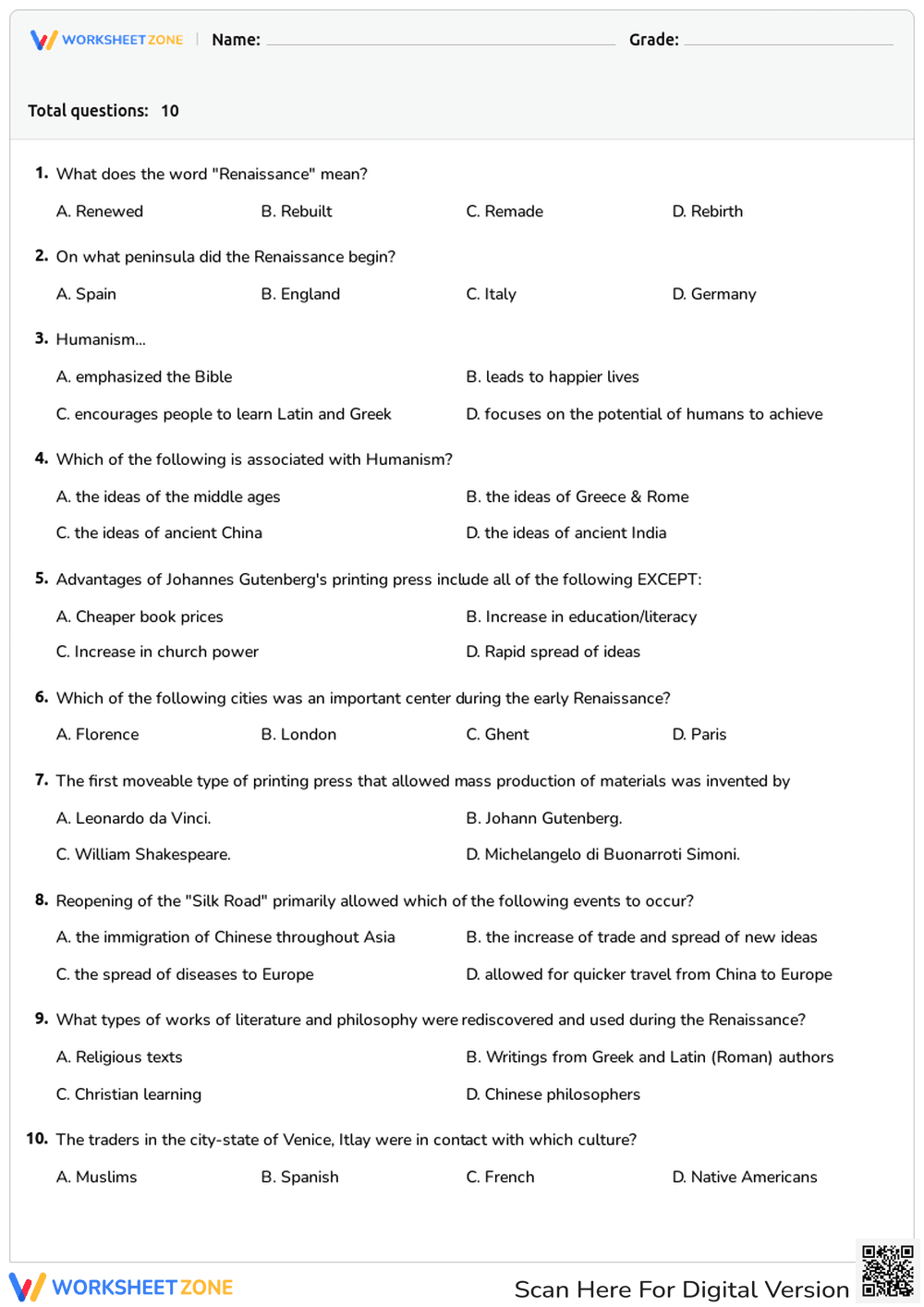

Printable Renaissance Quiz | Grade 7 Social Studies
Paste this activity's link or code into your existing LMS (Google Classroom, Canvas, Teams, Schoology, Moodle, etc.).
Students can open and work on the activity right away, with no student login required.
You'll still be able to track student progress and results from your teacher account.
This ready-to-use Renaissance worksheet provides middle school students with a focused assessment of early modern European history. By completing these targeted multiple-choice questions, learners will demonstrate their understanding of key historical concepts, geographical origins, and significant figures that shaped the cultural rebirth of Italy and beyond.
At a Glance
- Grade: 7 · Subject: Social Studies
- Standard:
CCSS.ELA-LITERACY.RH.6-8.4— Determine the meaning of domain-specific historical words- Skill Focus: Renaissance History and Geography
- Format: 1 page · 10 problems · Answer key included · PDF
- Best For: Formative assessment or independent practice
- Time: 10–15 minutes
Inside this streamlined resource, educators will find a single-page assessment featuring ten carefully constructed multiple-choice questions. The task types cover vocabulary identification, geographical knowledge, and historical comprehension related to the Renaissance period. Topics range from the definition of Humanism to the impact of Johannes Gutenberg's printing press and the reopening of the Silk Road. A complete answer key is provided to ensure rapid and accurate grading for teachers.
This resource requires under two minutes of teacher preparation time:
- Print (1 minute): Print copies directly from the PDF. The single-page layout minimizes paper waste.
- Distribute (30 seconds): Hand out the assessment. The clear formatting allows students to begin immediately.
- Review (30 seconds): Use the answer key to quickly score the ten questions.
Because it requires no specialized setup, this worksheet serves as an excellent emergency sub plan.
This material is directly aligned with CCSS.ELA-LITERACY.RH.6-8.4, requiring students to "determine the meaning of words and phrases as they are used in a text, including vocabulary specific to domains related to history/social studies." Engaging with terms like Humanism builds essential disciplinary literacy. Both standard codes can be copied directly into lesson plans, IEP goals, or district curriculum mapping tools.
Teachers can deploy this worksheet as a pre-assessment before beginning a unit on early modern Europe to gauge baseline knowledge. Alternatively, it functions perfectly as a quick formative assessment after direct instruction on the Italian Renaissance. While students work, educators can circulate and observe which specific questions cause hesitation, providing immediate insight into whether concepts need reteaching. Expected completion time ranges from ten to fifteen minutes, making it an ideal bell-ringer.
This resource is primarily designed for sixth through eighth-grade social studies students in general education classrooms. The straightforward multiple-choice format provides built-in scaffolding for learners who might struggle with open-ended historical writing, making it accessible for diverse learning profiles. Pair this quiz with a primary source reading passage about Leonardo da Vinci or an anchor chart detailing the core tenets of Humanism.
Integrating structured vocabulary and fact-retrieval practice into middle school social studies instruction significantly reinforces long-term retention of historical concepts. Aligned with CCSS.ELA-LITERACY.RH.6-8.4, this resource helps students determine the meaning of domain-specific historical words through targeted questioning. According to a recent RAND AIRS 2024 report, frequent, low-stakes formative assessments in history classrooms improve students' ability to connect discrete facts to broader thematic trends by up to thirty percent. When learners repeatedly encounter and define terms like Humanism, or identify the geographical importance of Florence and the Silk Road, they build the cognitive framework necessary for advanced historical analysis. This straightforward, ten-question format minimizes cognitive overload while maximizing active recall, ensuring that foundational knowledge is firmly solidified before students move on to complex document-based inquiries or extensive research projects.


