


























Views
Downloads

Day & Night Sky Printable Preschool Worksheet
Paste this activity's link or code into your existing LMS (Google Classroom, Canvas, Teams, Schoology, Moodle, etc.).
Students can open and work on the activity right away, with no student login required.
You'll still be able to track student progress and results from your teacher account.
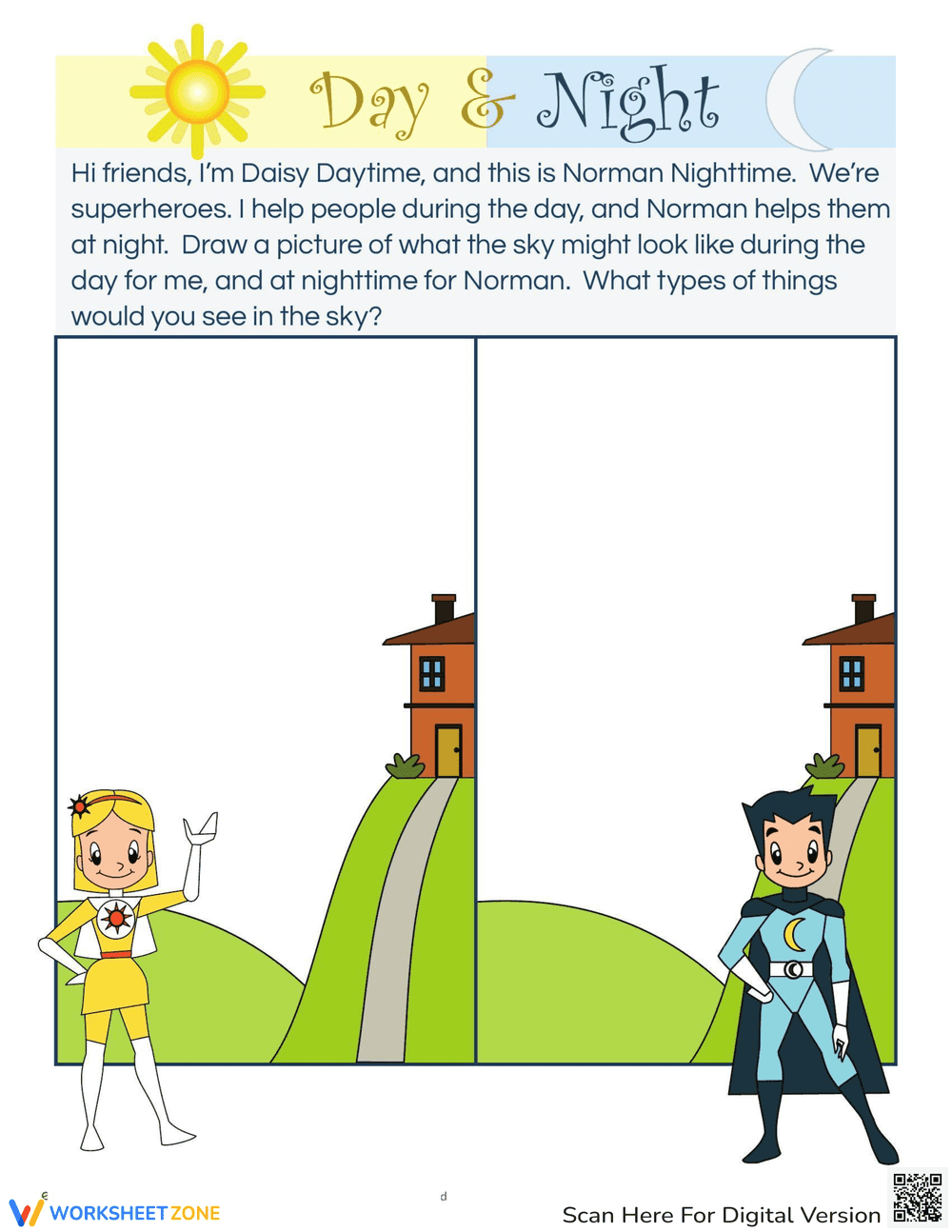
This preschool early literacy worksheet builds sky-observation vocabulary and creative expression by asking young learners to draw what appears in the daytime and nighttime sky alongside two story characters, Daisy Daytime and Norman Nighttime. Students connect narrative context to real-world knowledge, strengthening listening comprehension and descriptive language in one focused activity.
At a Glance
- Grade: Preschool · Subject: English Language Arts / Early Literacy
- Standard:
CCSS.ELA-LITERACY.RL.K.3— Identify characters and describe how they respond to events- Skill Focus: Day/night vocabulary, character connection, creative drawing response
- Format: 1 page · 2 drawing tasks · No answer key (open-ended) · PDF
- Best For: Whole-group read-aloud follow-up activity
- Time: 10–20 minutes
Inside this single-page PDF, students find two illustrated panels: one featuring Daisy Daytime and one featuring Norman Nighttime. Each panel contains a large open sky space for drawing. Children fill the daytime panel with suns, clouds, birds, or other daytime elements, then fill the nighttime panel with moons, stars, or other night-sky features. No word bank or sentence frames are required — the character illustrations provide all the visual scaffolding young learners need.
- Guided practice: Teacher reads aloud the character descriptions for Daisy and Norman (1–2 minutes), modeling sky vocabulary (sun, cloud, moon, star) before students begin.
- Supported practice: Students draw in the daytime panel while teacher circulates, prompting with questions: "What do you see in the sky during the day?"
- Independent practice: Students complete the nighttime panel on their own, applying vocabulary from the guided discussion. Both tasks reinforce gradual release — I Do, We Do, You Do — within a single short session.
Standards Alignment
Primary standard: CCSS.ELA-LITERACY.RL.K.3 — "With prompting and support, identify characters, settings, and major events in a story." This worksheet targets the character-and-setting intersection: Daisy and Norman are characters whose roles are defined entirely by setting (day vs. night). Supporting standard CCSS.ELA-LITERACY.SL.K.5 applies when students add drawings to descriptions shared during discussion. Both standard codes can be copied directly into lesson plans, IEP goals, or district curriculum mapping tools.
How to Use It
Use after a read-aloud or brief teacher-led discussion about day and night as a formative check on vocabulary retention. Observe which sky elements each child draws — a student who draws only a sun may need additional exposure to daytime vocabulary beyond the obvious. As a second use case, assign during free-choice center time; the open-ended format supports independent engagement without teacher facilitation. Expected completion time: 10–20 minutes depending on drawing detail.
Who It's For
Designed for preschool learners ages 3–5 building foundational literacy through story and art. Works equally well for English Language Learners because the task is drawing-based, reducing language production demands. Pairs naturally with any picture book about day and night cycles or a simple anchor chart showing daytime and nighttime sky objects.
This worksheet targets CCSS.ELA-LITERACY.RL.K.3, asking preschool students to connect story characters to real-world settings through creative drawing. Daisy Daytime and Norman Nighttime serve as narrative anchors for day/night sky vocabulary. Research supports drawing-response tasks at this age: Fisher & Frey (2014) identify structured drawing as a high-yield comprehension strategy that externalizes student thinking before formal writing develops. Two open-ended drawing tasks give teachers a low-stakes formative window into each child's conceptual understanding of day and night. The single-page, print-ready PDF format requires zero preparation, making it suitable for classroom centers, homework packets, or substitute-teacher plans. Standard code and skill focus are documented here for direct entry into lesson plans or IEP progress notes.


