


























Views
Downloads
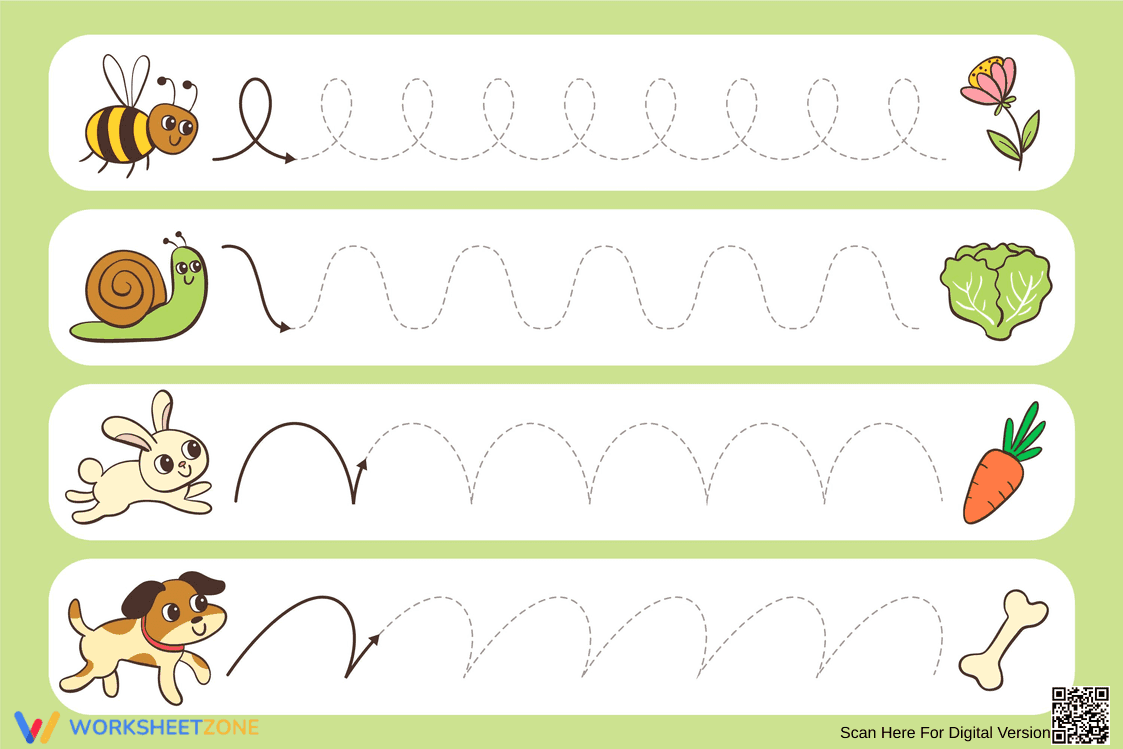

Animal Tracing Activity | Essential Preschool Worksheet
Paste this activity's link or code into your existing LMS (Google Classroom, Canvas, Teams, Schoology, Moodle, etc.).
Students can open and work on the activity right away, with no student login required.
You'll still be able to track student progress and results from your teacher account.
This Preschool tracing worksheet helps young learners develop the essential fine motor control required for successful handwriting. By guiding animals to their food, students practice the fluid hand movements necessary for letter formation. This activity transforms repetitive practice into an engaging mission that builds confidence and grip strength before formal writing begins.
At a Glance
- Grade: Preschool · Subject: Handwriting
- Standard:
CCSS.ELA-LITERACY.L.K.1.A— Print many upper- and lowercase letters through pre-writing readiness- Skill Focus: Fine motor line tracing
- Format: 1 page · 4 problems · Answer key included · PDF
- Best For: Early morning work or centers
- Time: 5–10 minutes
This single-page PDF features four distinct tracing challenges. Each row presents a different animal—a bee, snail, rabbit, and dog—paired with a specific food item. The tracing paths vary in complexity, including loops, soft waves, and sharper peaks, providing a comprehensive workout for small hand muscles. The clear start and end points ensure students understand the task immediately without heavy teacher intervention.
The zero-prep workflow for this worksheet is designed for busy educators. First, print the single-page PDF (30 seconds). Second, distribute the sheets to students with crayons or markers (30 seconds). Third, observe student grip and path accuracy as they work (5 minutes). Total teacher preparation time is under two minutes, making this an ideal choice for unexpected schedule changes or sub plans.
This activity aligns with CCSS.ELA-LITERACY.L.K.1.A, which focuses on the foundational mechanics of writing. While the standard specifically mentions letter formation, pre-writing tracing is the recognized developmental precursor to printing. By mastering these curves and angles, students prepare for the specific strokes found in the alphabet. This standard code can be copied directly into lesson plans or IEP goals.
Use this worksheet as a warm-up before a formal handwriting lesson to loosen hand muscles. It also serves as an excellent formative assessment tool; teachers can observe which students struggle with crossing the midline or maintaining a consistent pencil grip. Completion typically takes between 5 and 10 minutes depending on the child's developmental stage and motor proficiency.
This resource is designed for Preschool and early Kindergarten students who are just beginning their writing journey. It is particularly helpful for students requiring occupational therapy support or those who need extra practice with spatial awareness. Pair this worksheet with a physical finger tracing activity in sand or shaving cream for a multi-sensory learning experience that reinforces the motor patterns.
Research from RAND AIRS 2024 emphasizes that early fine motor development is a significant predictor of later academic success in both reading and mathematics. This worksheet targets the specific hand-eye coordination and muscular endurance required for the transition from drawing to formal printing. By utilizing the CCSS.ELA-LITERACY.L.K.1.A framework, the activity ensures that students are practicing the specific directional strokes—loops, waves, and zig-zags—that constitute the building blocks of the English alphabet. Fisher & Frey (2014) note that scaffolded pre-writing tasks provide the necessary transition for early learners, allowing them to gain mastery over their writing instruments before facing the cognitive load of letter recognition. This printable resource provides a structured environment for that essential motor practice, ensuring students meet developmental milestones with precision and engagement.


