




























Views
Downloads
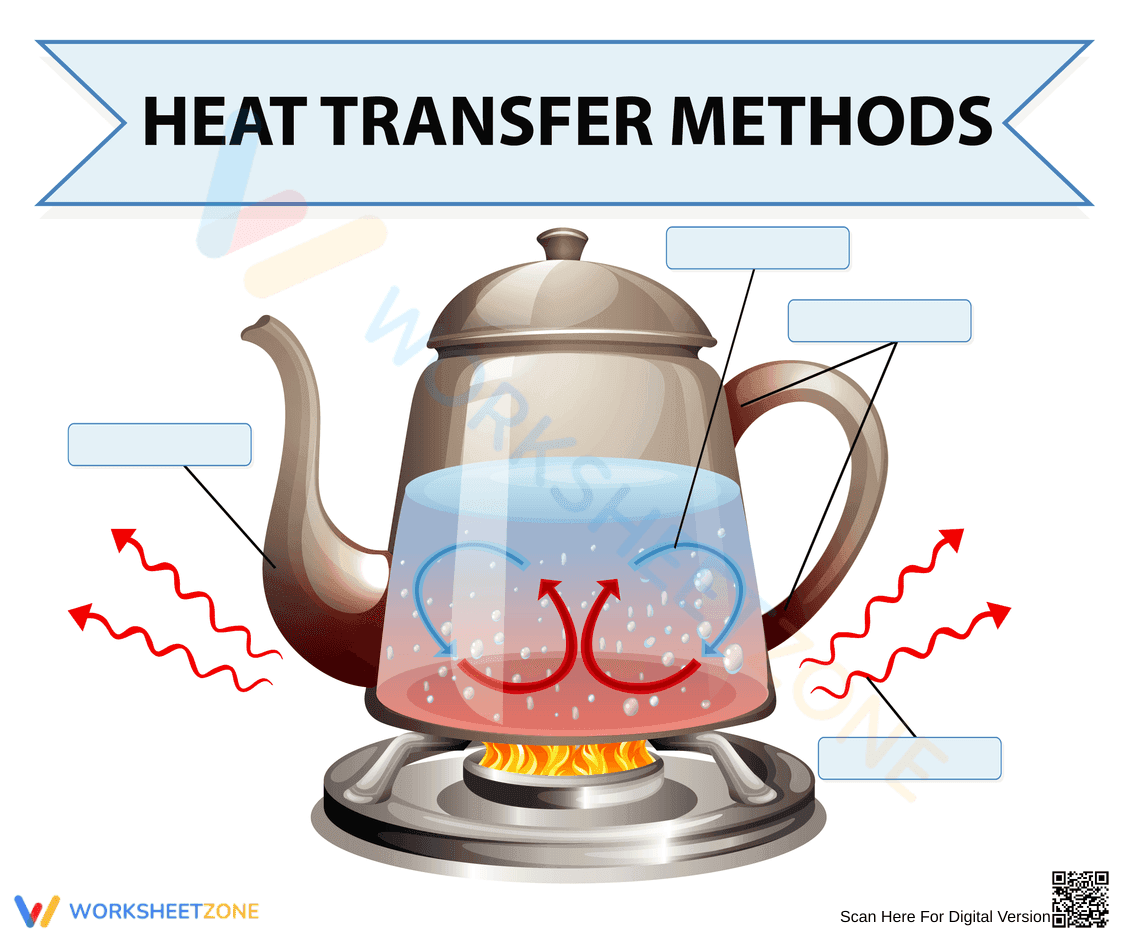

Heat Transfer Methods Worksheet | Grade 6 Essential

Paste this activity's link or code into your existing LMS (Google Classroom, Canvas, Teams, Schoology, Moodle, etc.).
Students can open and work on the activity right away, with no student login required.
You'll still be able to track student progress and results from your teacher account.
This Grade 6 heat transfer methods worksheet helps students identify and differentiate between conduction, convection, and radiation using a real-world kettle diagram. Students apply their knowledge of thermal energy movement to label specific interactions. It provides a clear visual representation of how heat moves through solids, liquids, and gases.
At a Glance
- Grade: 6 · Subject: Science
- Standard:
MS-PS3-3— Apply scientific principles to describe thermal energy transfer through various materials- Skill Focus: Conduction, Convection, Radiation
- Format: 1 page · 4 problems · Answer key included · PDF
- Best For: Quick formative assessment or bell ringer
- Time: 5–10 minutes
This single-page PDF features a high-quality illustration of a kettle heating on a stove. It includes 4 strategically placed labeling boxes that point to specific heat transfer phenomena. The layout is clean and distraction-free, ensuring students focus on the physics concepts. A full answer key is provided for rapid grading or student self-correction.
- Print: Select the single-page PDF and print enough copies for your class (30 seconds).
- Distribute: Hand out the diagrams as a warm-up or exit ticket (1 minute).
- Review: Use the included answer key to check for misconceptions immediately (1 minute). Total teacher preparation time is under 3 minutes, making this an ideal resource for busy science blocks or emergency sub plans.
This resource aligns with MS-PS3-3, which requires students to apply scientific principles to thermal energy transfer. By identifying the three primary methods of heat movement in a domestic scenario, students demonstrate foundational knowledge required for more complex thermodynamic modeling. This standard code can be copied directly into lesson plans, IEP goals, or district curriculum mapping tools.
Use this worksheet during the "Explain" phase of a 5E lesson cycle to verify that students can distinguish between the three methods of heat transfer. It also serves as an excellent formative assessment observation tool; watch for students who confuse convection within the water with radiation from the burner. Completion typically takes 5 to 10 minutes.
This worksheet is designed for Grade 6 science students but is appropriate for Grade 5-8 depending on the curriculum depth. It supports visual learners through its clear diagram and is a natural pairing for a physical demonstration of boiling water or a teacher-led anchor chart on thermodynamics.
According to the RAND AIRS 2024 report, high-quality visual aids in science education significantly improve the retention of abstract concepts like thermal energy transfer. This worksheet targets the MS-PS3-3 standard by requiring students to identify conduction, convection, and radiation in a familiar context. Research from Fisher & Frey (2014) suggests that scaffolded visual labeling tasks help bridge the gap between vocabulary acquisition and conceptual mastery. By providing 4 distinct labeling points, this resource ensures students can isolate specific physical processes within a complex system. The inclusion of an answer key supports immediate feedback, a critical component of effective formative assessment. This 1-page PDF is a reliable tool for middle school science teachers looking to verify student understanding of heat transfer methods without extensive preparation or grading overhead.


