


























Views
Downloads

Heat Transfer Methods Printable Worksheet | Grade 6
Paste this activity's link or code into your existing LMS (Google Classroom, Canvas, Teams, Schoology, Moodle, etc.).
Students can open and work on the activity right away, with no student login required.
You'll still be able to track student progress and results from your teacher account.
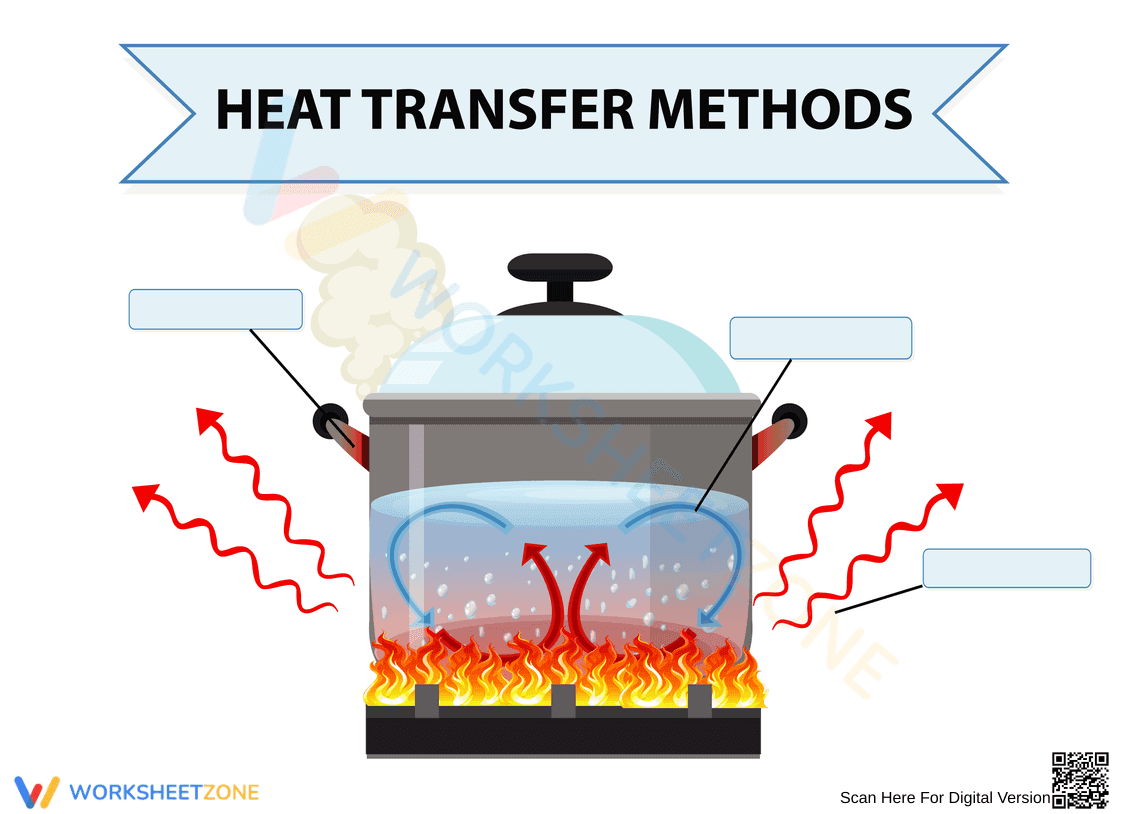
This Grade 6 science worksheet helps students visually identify the three primary methods of heat transfer: conduction, convection, and radiation. By labeling a clear, real-world diagram of a boiling pot, learners solidify their understanding of how thermal energy moves through different mediums.
At a Glance
- Grade: 6 · Subject: Science
- Standard:
MS-PS3-3— Identify and describe thermal energy transfer methods- Skill Focus: Heat transfer methods
- Format: 1 page · 3 problems · Answer key included · PDF
- Best For: Quick formative assessment
- Time: 5–10 minutes
What's Inside
This single-page resource features a high-quality, full-color illustration of a pot of water boiling over an open flame. Students are tasked with filling in three blank text boxes pointing to specific thermal phenomena: the heated handle, the circulating water, and the radiating heat from the fire. A complete answer key is provided to ensure accurate grading and immediate feedback.
Zero-Prep Workflow
- Print (1 minute): Simply download the PDF and print class sets. The clear graphics reproduce well in both color and grayscale.
- Distribute (1 minute): Hand out the diagram as a warm-up activity or exit ticket. No additional materials or teacher setup are required.
- Review (3 minutes): Quickly go over the three answers as a class, allowing students to self-correct. Total teacher prep time is under two minutes, making this an excellent addition to any emergency sub plan.
Standards Alignment
Aligned to MS-PS3-3, this activity supports the foundational knowledge required to apply scientific principles to thermal energy transfer. Recognizing conduction, convection, and radiation is the first step before students can design devices that minimize or maximize heat movement. Both standard codes can be copied directly into lesson plans, IEP goals, or district curriculum mapping tools.
How to Use It
Use this diagram as a visual anchor during direct instruction, having students fill in the boxes as you introduce each concept. Alternatively, assign it as a quick formative assessment at the end of a lesson to check for understanding. While circulating, observe whether students confuse convection (the circulating water) with conduction (the solid handle), which provides immediate insight into their conceptual grasp. Expect completion to take between 5 and 10 minutes.
Who It's For
This resource is designed for middle school science students, particularly those in Grade 6. The highly visual nature of the diagram makes it an excellent tool for English Language Learners and visual learners who benefit from concrete examples of abstract concepts. Pair this worksheet with a hands-on lab demonstrating heat transfer or a comprehensive anchor chart.
Mastering the identification of thermal energy movement is a critical component of middle school physical science. This resource aligns with MS-PS3-3, requiring students to identify and describe thermal energy transfer methods in a real-world context. According to EdReports 2024, visual models and diagrams are essential for helping students bridge the gap between observable phenomena and abstract scientific principles. By labeling the specific mechanisms of conduction, convection, and radiation on a familiar object like a boiling pot, learners develop a more robust mental model of energy flow. This targeted practice reduces cognitive load and allows students to focus entirely on the core scientific vocabulary. Integrating such visual assessments into daily instruction ensures that foundational concepts are firmly established before moving on to complex engineering and design challenges.


