


























Views
Downloads

Healthy Eating Worksheet | Essential Grade 1 Science
Paste this activity's link or code into your existing LMS (Google Classroom, Canvas, Teams, Schoology, Moodle, etc.).
Students can open and work on the activity right away, with no student login required.
You'll still be able to track student progress and results from your teacher account.
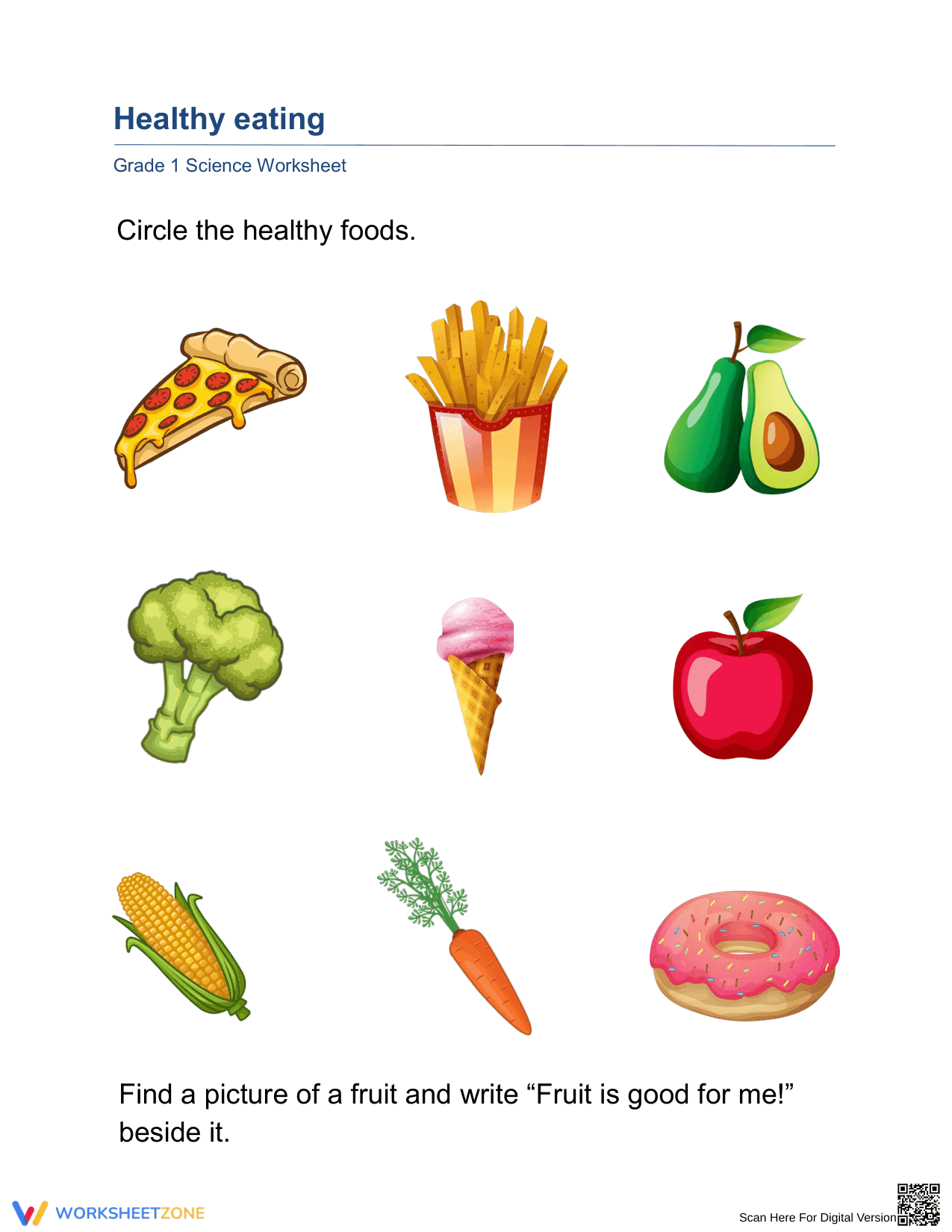
Students learn to categorize everyday food items into healthy and unhealthy groups with this engaging Grade 1 Science worksheet. By identifying fruits, vegetables, and treats, learners build a foundation for nutrition. This resource helps young students recognize how food choices impact health while practicing visual discrimination and basic writing.
At a Glance
- Grade: 1 · Subject: Science
- Standard:
1-LS1-1— Identify how living things meet their basic needs for survival.- Skill Focus: Nutrition and healthy food identification
- Format: 1 page · 10 problems · Answer key included · PDF
- Best For: Individual practice or formative nutrition assessment
- Time: 10–15 minutes
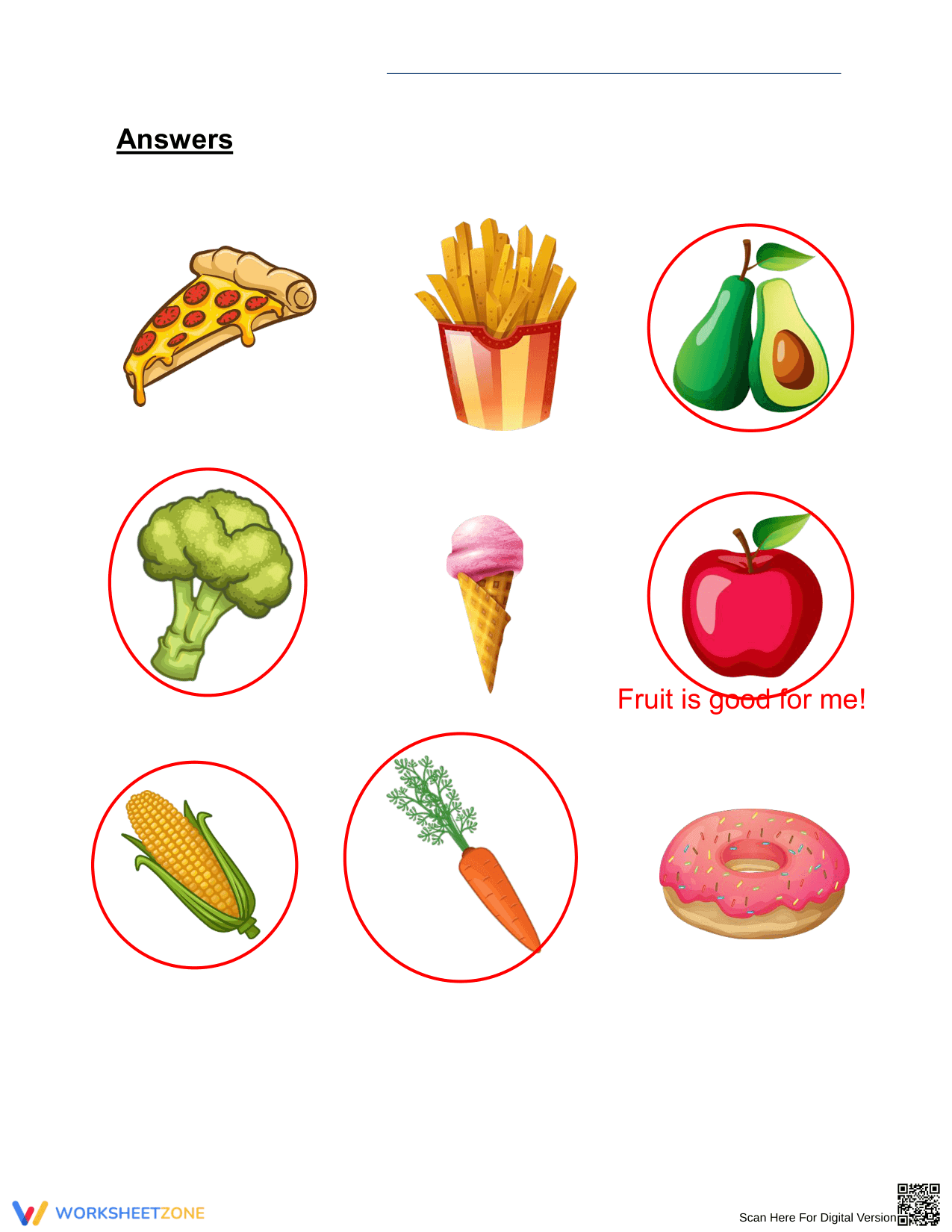
This single-page PDF includes 10 total tasks designed for first-grade learners. The primary activity features 9 colorful food illustrations—including pizza, avocados, broccoli, and donuts—where students must circle the healthy options. A secondary writing component asks students to identify a fruit and transcribe a specific sentence, reinforcing literacy skills alongside nutritional concepts. A comprehensive answer key is provided for quick grading.
Zero-Prep Workflow
- Print (30 seconds): Simply load the PDF and print copies for your entire class.
- Distribute (1 minute): Pass out the sheets as a bell-ringer or independent station activity.
- Review (30 seconds): Use the included answer key to check for understanding in seconds.
The entire setup takes under 2 minutes of teacher preparation. This worksheet is an ideal "sub-plan" addition or a quick wrap-up for a unit on living things and their needs.
Standards Alignment
This resource is aligned with `1-LS1-1`, which focuses on how living things use external resources to meet their needs for survival and growth. By identifying healthy foods, students demonstrate an understanding of how humans utilize biological resources to maintain health. Both standard codes can be copied directly into lesson plans, IEP goals, or district curriculum mapping tools.
How to Use It
Use this worksheet as a formative assessment after a direct instruction lesson on the five food groups. Alternatively, assign it as a "science center" activity where students work independently. Observe whether students can distinguish between "sometimes" foods like donuts and "always" foods like apples. Completion typically takes between 10 and 15 minutes, making it a perfect transition piece.
Who It's For
This activity is tailored for 1st-grade students but serves well for Kindergarten extension. It is especially effective for visual learners and English Language Learners (ELLs) who benefit from clear pictorial representations. Pair this worksheet with a shared reading or a nutrition-focused anchor chart for maximum instructional impact.
Aligned with the `1-LS1-1` standard, this worksheet targets the essential Grade 1 skill of identifying nutritional needs for human health. According to Fisher & Frey (2014), the use of visual scaffolds and categorization tasks in early childhood education significantly enhances the retention of complex biological concepts. By requiring students to circle images and write a confirming sentence, the resource employs dual-coding theory to solidify the connection between visual stimuli and nutritional facts. Research from EdReports 2024 highlights that standards-aligned supplemental materials are most effective when they provide immediate "print-and-go" utility for teachers without sacrificing academic rigor. This worksheet provides exactly that balance, offering 10 specific tasks that map directly to wellness benchmarks while maintaining a completion time suitable for 6-7 year olds. It serves as a reliable instrument for measuring student mastery of basic life science requirements in a classroom setting.


