


























Views
Downloads
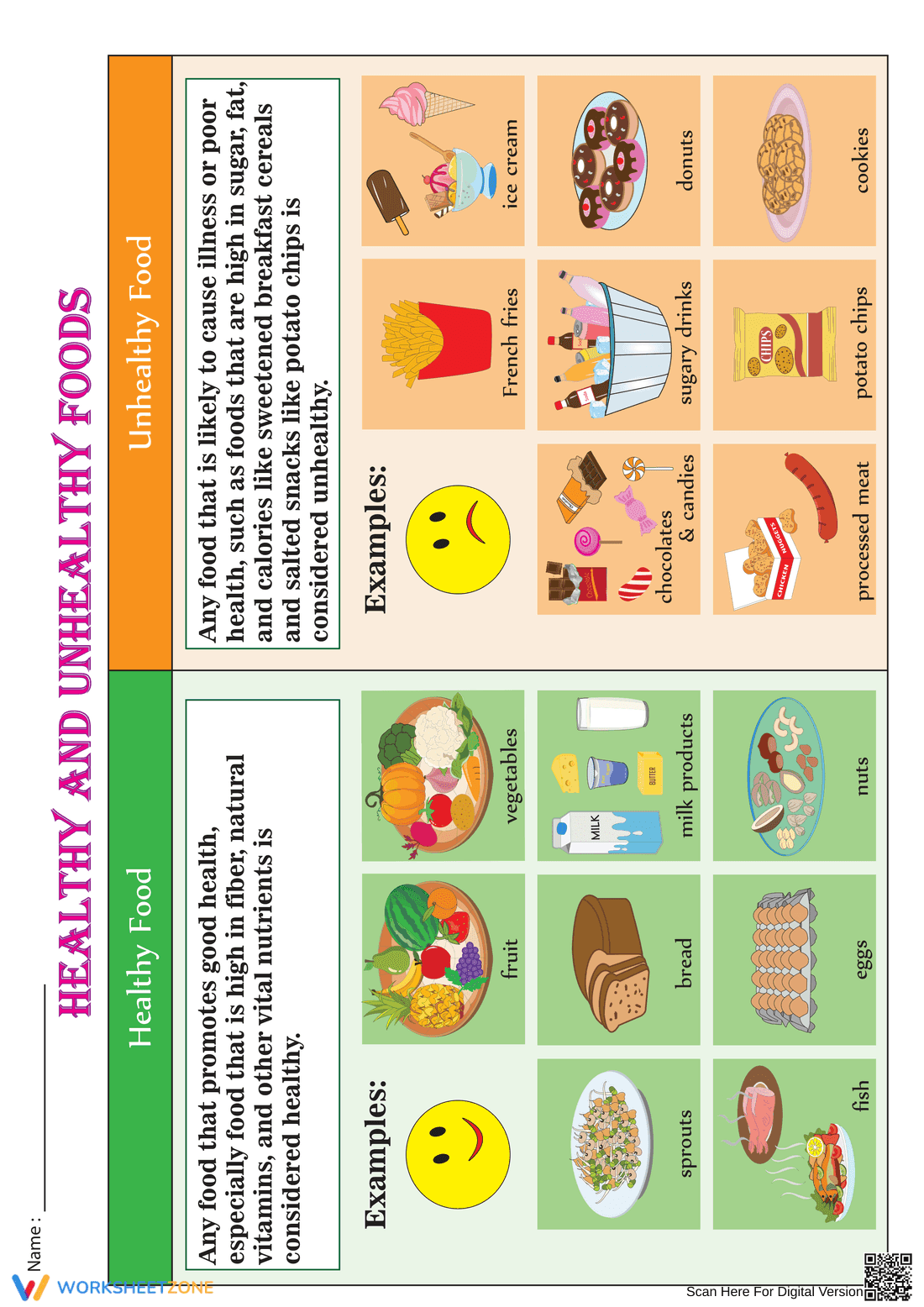

Essential Healthy and Unhealthy Foods Chart | Grade 1-2
Paste this activity's link or code into your existing LMS (Google Classroom, Canvas, Teams, Schoology, Moodle, etc.).
Students can open and work on the activity right away, with no student login required.
You'll still be able to track student progress and results from your teacher account.
This Grade 1-2 healthy and unhealthy food chart provides a clear visual reference to help students distinguish between nutrient-dense options and those high in sugar or fat. By defining each category and providing 16 examples, it simplifies complex nutritional concepts into digestible visual cues that improve student retention and healthy choices.
At a Glance
- Grade: 1-2 · Subject: Health
- Standard:
CCSS.ELA-LITERACY.L.1.5.A— Sort common objects into categories to gain a sense of the concepts represented- Skill Focus: Food Classification
- Format: 1 page · 16 examples · Reference Chart · PDF
- Best For: Classroom Anchor Chart or Student Reference
- Time: 5–10 minutes
This high-quality PDF chart features two sections: Healthy Food and Unhealthy Food. Each side includes a concise definition followed by "Examples." The healthy side displays 8 nutrient-rich items like fruit and fish, while the unhealthy side illustrates 8 calorie-dense items like donuts. "Smiley" and "frowny" face icons provide an immediate visual value judgment for younger learners, making the distinction between food types intuitive.
Zero-Prep Workflow
Implement this resource in three easy steps. First, print the chart in color (30 seconds). Second, distribute it as a desktop reference or display it on a smartboard for whole-class instruction (1 minute). Third, review the examples by asking students to name one food from each side (30 seconds). The total prep time is under 2 minutes, making it an ideal last-minute addition to health units or a reliable sub-plan resource for elementary teachers.
Standards Alignment
This chart is aligned with `CCSS.ELA-LITERACY.L.1.5.A`, which requires students to sort common objects into categories. By classifying items into "healthy" and "unhealthy," students practice the fundamental cognitive skill of categorization based on shared attributes. It also supports health literacy by teaching students to identify foods that promote wellness versus those that cause poor health. These standard codes can be copied directly into lesson plans, IEP goals, or district curriculum mapping tools.
How to Use It
Use this chart during direct instruction as a visual anchor when introducing nutrition. It serves as an excellent formative assessment tool; simply point to a specific image and ask students to explain why it belongs in its respective column. For best results, pair this handout with a sorting activity where students use real-world grocery circulars. The expected completion time for a guided review of the chart is 5 to 10 minutes.
Who It's For
This resource is designed for Grade 1 and Grade 2 students beginning to explore nutritional science. It is particularly effective for English Language Learners and visual learners who benefit from pairing clear illustrations with bold labels. It naturally pairs with a balanced diet passage or a "My Plate" anchor chart to provide a comprehensive look at daily nutritional requirements for elementary children in a classroom setting.
This Healthy and Unhealthy Foods Chart facilitates the acquisition of health-related vocabulary and classification skills, directly addressing CCSS.ELA-LITERACY.L.1.5.A. According to Fisher & Frey (2014), visual scaffolds like charts are critical for the gradual release of responsibility, providing the "I Do" and "We Do" models necessary before students attempt independent classification. The resource employs dual-coding theory—combining text and imagery—to reduce cognitive load and improve the long-term retrieval of nutritional facts. By establishing a clear binary between nutrient-dense foods (high in fiber and vitamins) and calorie-dense snacks (high in sugar and fat), the chart provides Grade 1-2 learners with a functional framework for making dietary choices. This alignment with evidence-based instructional design ensures that the worksheet serves as a foundational tool for developing health literacy and critical thinking skills in early childhood education settings.


