


























Views
Downloads



Printable Easter Addition Worksheet | Grade 1 Math
Paste this activity's link or code into your existing LMS (Google Classroom, Canvas, Teams, Schoology, Moodle, etc.).
Students can open and work on the activity right away, with no student login required.
You'll still be able to track student progress and results from your teacher account.
This festive Easter addition worksheet provides first and second-grade students with targeted practice to build math fluency within 20. By working through varied equation formats and word problems, young learners strengthen foundational arithmetic skills while enjoying a spring-themed activity.
At a Glance
- Grade: 1 · Subject: Math
- Standard:
CCSS.MATH.CONTENT.1.OA.C.6— Add and subtract within 20 fluently- Skill Focus: Addition within 20
- Format: 3 pages · 25 problems · Answer key included · PDF
- Best For: Independent practice and holiday review
- Time: 15–20 minutes
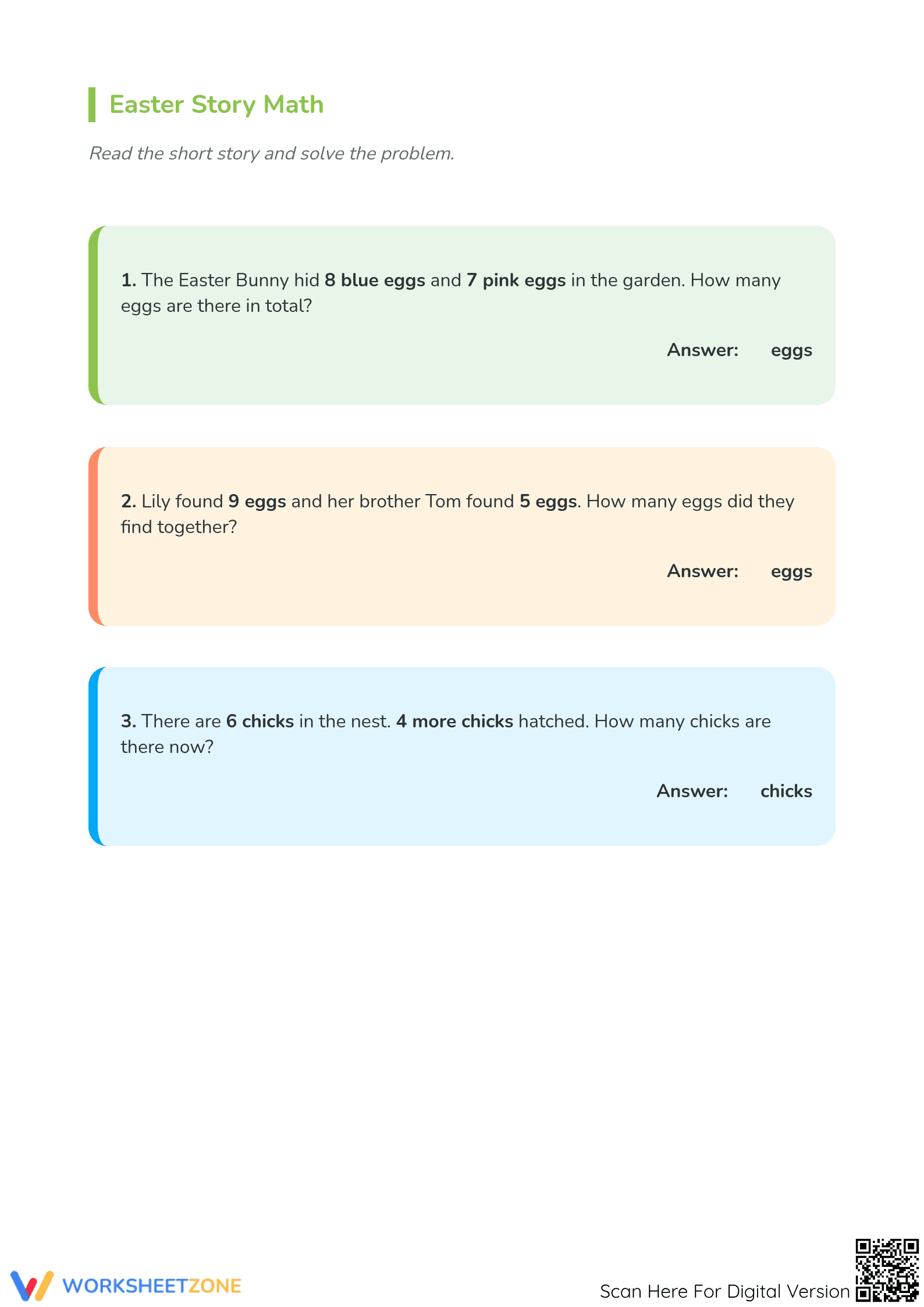
This three-page packet includes 25 math tasks. Page one features vertical addition to reinforce basic calculation. Page two introduces horizontal sentences alongside visual egg-counting exercises to bridge concrete and abstract thinking. Page three challenges students with Easter-themed word problems. A full answer key is provided.
- Guided practice: Visual egg-counting offers scaffolding, allowing students to count objects to find sums.
- Supported practice: Vertical and horizontal drills provide 18 equations, helping students transition to mental math.
- Independent practice: Three story-based word problems require students to extract data and apply addition in context.
This gradual-release approach ensures students build confidence through the I Do, We Do, You Do model.
Aligned to primary standard CCSS.MATH.CONTENT.1.OA.C.6, this resource requires students to add and subtract within 20 fluently. It also supports CCSS.MATH.CONTENT.1.OA.A.1 by incorporating word problems. Both standard codes can be copied directly into lesson plans, IEP goals, or district curriculum mapping tools.
Use this during independent math centers after direct instruction, allowing students to practice at their own pace. It also serves as an excellent morning work packet. As a formative assessment tip, observe whether students rely on mental math during the horizontal addition section to gauge fluency. Expected completion time is 15 to 20 minutes.
Designed for first-grade students mastering addition, this also serves as review for second graders. For differentiation, provide manipulatives like counting blocks for students struggling with abstract equations. It pairs perfectly with a direct instruction lesson on counting on.
Mastering addition within 20 is a critical milestone in early elementary mathematics, directly impacting a student's future success in complex algebraic reasoning. According to EdReports 2024, instructional materials that provide a mix of visual models, standard equations, and contextual word problems significantly improve long-term retention of math facts. This resource aligns with CCSS.MATH.CONTENT.1.OA.C.6, ensuring students add and subtract within 20 fluently while building the cognitive flexibility required for higher-level math. By transitioning learners from concrete visual counting to abstract horizontal equations and finally to reading comprehension-based story problems, educators can effectively assess multiple dimensions of mathematical understanding. Consistent, structured practice with varied problem types reduces cognitive load over time, allowing young learners to automate basic arithmetic and focus their working memory on multi-step problem-solving in later grades.


