


























Views
Downloads
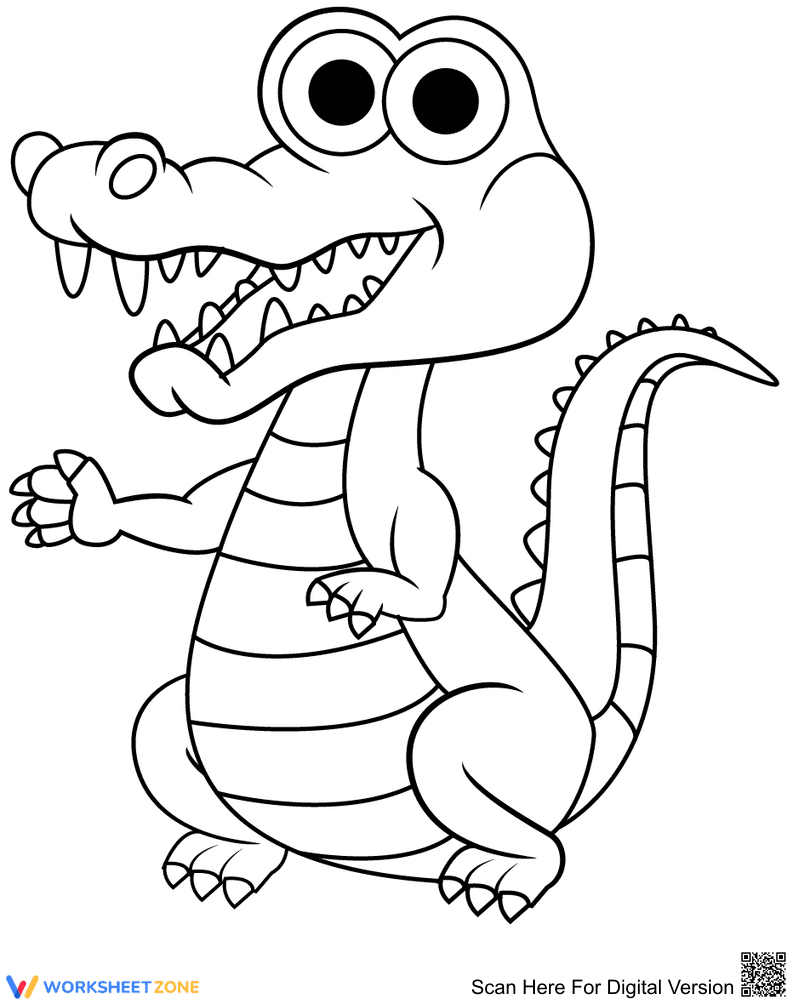

Happy Alligator Coloring Page | Essential Printable
Paste this activity's link or code into your existing LMS (Google Classroom, Canvas, Teams, Schoology, Moodle, etc.).
Students can open and work on the activity right away, with no student login required.
You'll still be able to track student progress and results from your teacher account.
This printable alligator coloring page provides early learners with a creative way to develop essential fine motor control and hand-eye coordination. By engaging with this friendly cartoon character, students practice grip strength and spatial awareness while reinforcing animal vocabulary. It is an ideal resource for transitioning between high-energy activities and focused desk work.
At a Glance
- Grade: K-2 · Subject: Arts & Crafts
- Standard:
CCSS.ELA-LITERACY.L.K.6— Use words and phrases acquired through conversations and reading about animals- Skill Focus: Fine Motor Skills & Vocabulary
- Format: 1 page · 1 task · No answer key needed · PDF
- Best For: Early finishers and morning work
- Time: 10–15 minutes
What's Inside
Inside this resource, you will find a single-page, high-resolution PDF featuring a Happy Cartoon Alligator. The illustration is designed with bold, thick outlines to assist young children in staying within the lines, which is a critical developmental milestone. There are no complex backgrounds, allowing the student to focus entirely on the primary subject and color selection.
Zero-Prep Workflow
The zero-prep workflow for this worksheet is designed for maximum efficiency in a busy classroom:
- Print: Output the single-page PDF in under 30 seconds.
- Distribute: Hand out pages with crayons or colored pencils to your students.
- Review: Ask students to name the animal and describe their color choices.
Total teacher preparation time is under 2 minutes, making it a perfect sub-plan addition.
Standards Alignment
This activity aligns with `CCSS.ELA-LITERACY.L.K.6`, which focuses on students using words and phrases acquired through conversations and being read to. By identifying the alligator and discussing its features, students bridge the gap between visual arts and language acquisition. This standard code can be copied directly into lesson plans, IEP goals, or district curriculum mapping tools.
How to Use It
Use this worksheet as a morning bin activity to settle students as they arrive, or as a reward for early finishers who complete their core ELA tasks. During the activity, observe student pencil grip and pressure; this provides a quick formative assessment of their physical readiness for writing. Expect students to spend 10 to 15 minutes on this task.
Who It's For
This resource is tailored for Preschool through Grade 2 students, particularly those working on foundational motor skills. It is highly effective for English Language Learners to practice basic animal nouns. Pair this coloring page with a non-fiction picture book about reptiles or an anchor chart featuring "A" words to create a cohesive thematic unit.
According to research by Fisher & Frey (2014) regarding the gradual release of responsibility, providing low-stakes creative tasks like this alligator coloring page helps build the foundational stamina required for more complex academic writing. The activity directly supports CCSS.ELA-LITERACY.L.K.6 by encouraging students to identify and label biological subjects within a structured visual framework. Fine motor development, often overlooked in digital-heavy curricula, remains a significant predictor of later literacy success as noted in the RAND AIRS 2024 report. By integrating 15 minutes of focused coloring, educators provide the necessary physical practice for hand-muscle development. This worksheet serves as a bridge between play-based learning and formal instruction, ensuring that students in the K-2 range maintain the dexterity needed for letter formation. It is a scientifically supported method for improving concentration and task persistence in early childhood settings while reinforcing specific animal-related vocabulary.


