


























Views
Downloads



Printable Letter P Worksheet | Kindergarten Handwriting
Paste this activity's link or code into your existing LMS (Google Classroom, Canvas, Teams, Schoology, Moodle, etc.).
Students can open and work on the activity right away, with no student login required.
You'll still be able to track student progress and results from your teacher account.
This printable Kindergarten handwriting worksheet helps early learners master the uppercase letter P. By combining stroke-by-stroke tracing with visual identification exercises, students develop fine motor control and letter recognition simultaneously. The clear, structured layout ensures young writers can practice proper letter formation with confidence.
At a Glance
- Grade: Kindergarten · Subject: English
- Standard:
CCSS.ELA-LITERACY.L.K.1.A— Print many upper- and lowercase letters- Skill Focus: Letter P formation and recognition
- Format: 1 page · 22 problems · No answer key · PDF
- Best For: Independent practice and centers
- Time: 10–15 minutes
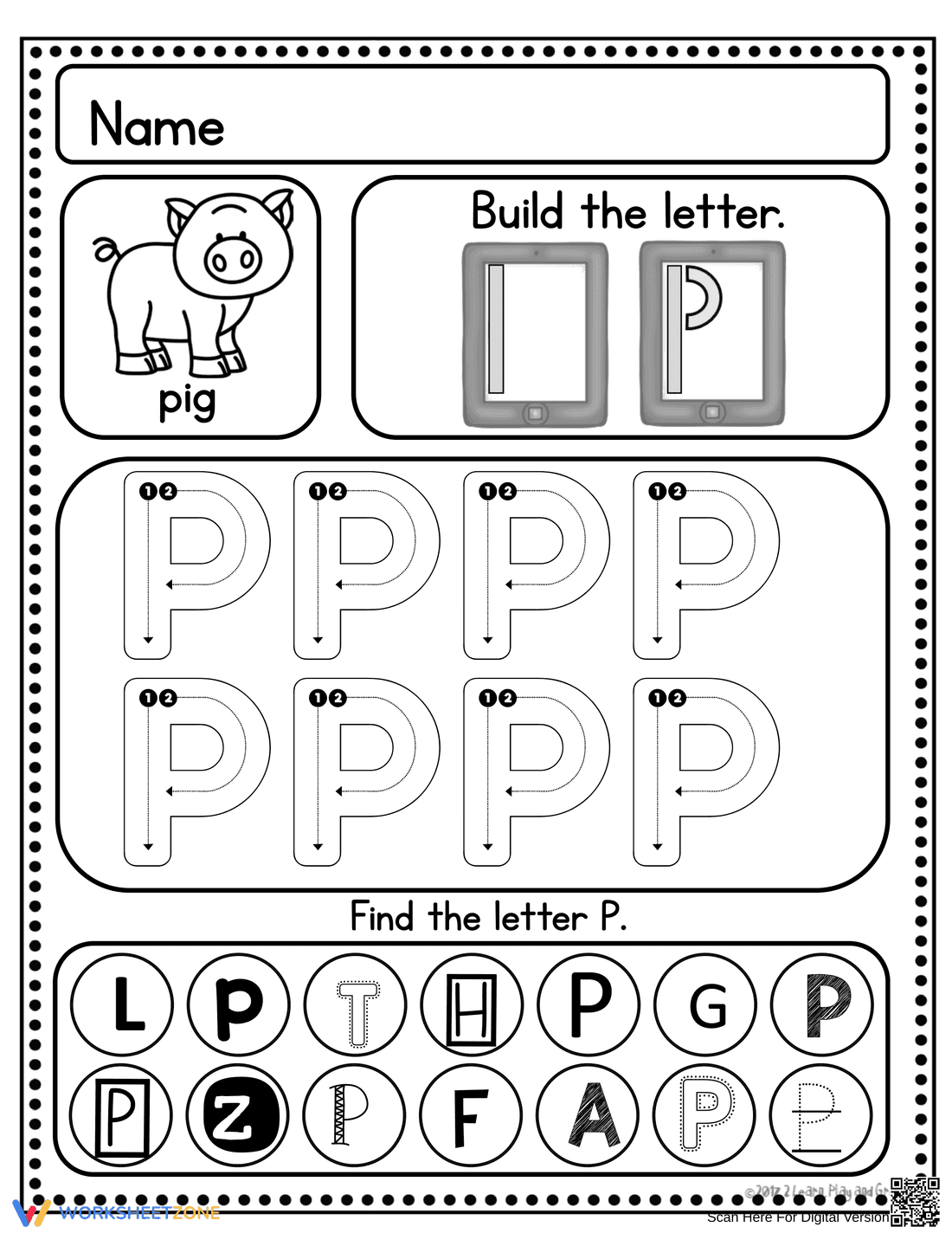
This single-page resource features three distinct activity zones designed for early literacy development. It begins with a visual anchor showing a pig and a "Build the letter" demonstration of the two strokes needed for an uppercase P. The middle section provides eight large, guided tracing letters with numbered directional arrows. Finally, the bottom section includes a "Find the letter P" visual discrimination task with fourteen mixed-font letters inside bubbles.
Zero-Prep Workflow
This worksheet allows for immediate classroom implementation:
- Print (1 minute): Simply download the PDF and print the required number of copies. The black-and-white design is ink-friendly.
- Distribute (1 minute): Hand out to students along with pencils or crayons. The visual instructions make the tasks self-evident.
- Review (0 minutes): The straightforward tasks require no complex grading, allowing for quick visual checks.
With under two minutes of total prep time, this is an ideal resource for morning work, literacy centers, or emergency substitute plans.
Standards Alignment
This resource is directly aligned to CCSS.ELA-LITERACY.L.K.1.A, requiring students to print many upper- and lowercase letters. It also supports foundational reading skills by reinforcing letter-shape recognition across different fonts and styles. Both standard codes can be copied directly into lesson plans, IEP goals, or district curriculum mapping tools.
How to Use It
Deploy this worksheet during morning work to give students focused practice as they settle in. It also functions perfectly as an independent literacy center activity following direct instruction on the letter P. As a formative assessment tip, observe students while they complete the tracing section to ensure they are following the numbered arrows and starting their strokes from the top down, rather than bottom up. Expected completion time is 10 to 15 minutes.
Who It's For
This worksheet is for Kindergarten students, first graders needing remediation, and preschool learners. The large tracing paths and clear visual cues provide built-in differentiation for students developing fine motor skills. Pair this resource with an alphabet anchor chart or a read-aloud book featuring words starting with the letter P to reinforce phonetic connections.
Effective handwriting instruction requires explicit modeling followed by guided and independent practice to build fine motor automaticity. Aligned to CCSS.ELA-LITERACY.L.K.1.A, this resource helps students print many upper- and lowercase letters accurately and confidently. According to Fisher & Frey (2014), providing students with clear visual cues, such as numbered directional arrows, alongside structured repetition is essential for transferring foundational skills from working memory to long-term automaticity. By combining directional tracing exercises with visual discrimination tasks, this worksheet ensures that early learners not only memorize the physical strokes required for proper letter formation but also recognize the target letter across various typographic contexts. This dual approach strengthens the neural pathways necessary for fluent writing and reading. Consistent practice with these targeted, multi-modal activities makes it a highly effective tool for early childhood literacy development and long-term academic success.


