


























Views
Downloads

Printable Line Tracing Worksheet | Preschool
Paste this activity's link or code into your existing LMS (Google Classroom, Canvas, Teams, Schoology, Moodle, etc.).
Students can open and work on the activity right away, with no student login required.
You'll still be able to track student progress and results from your teacher account.
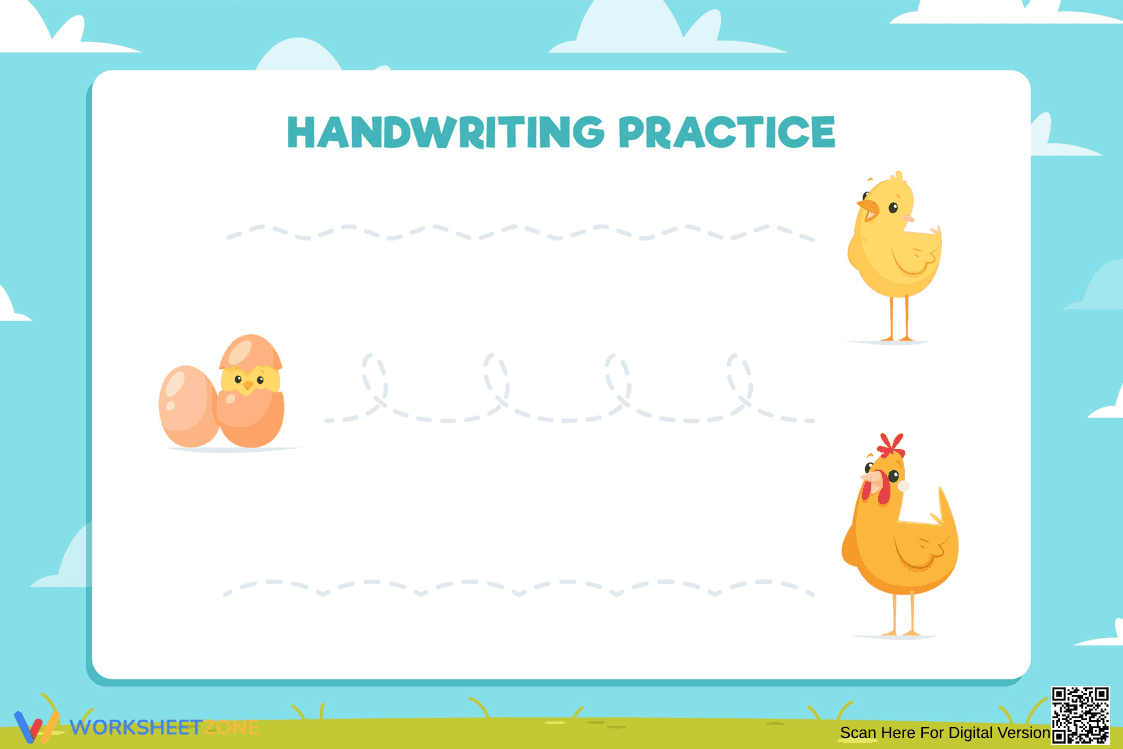
This foundational pre-writing worksheet helps preschool students develop essential fine motor control by tracing distinct line patterns. Early learners must master pencil grip and directional tracking before forming letters. This engaging chicken-themed activity provides targeted practice to build the hand strength and coordination required for future handwriting success.
At a Glance
- Grade: Preschool · Subject: Handwriting
- Standard:
CCSS.ELA-LITERACY.L.K.1.A— Form foundational strokes for printing letters- Skill Focus: Line tracing and fine motor control
- Format: 1 page · 3 problems · No answer key needed · PDF
- Best For: Morning work or centers
- Time: 5–10 minutes
Inside this single-page resource, educators will find three distinct tracing paths designed to mimic the strokes used in standard letter formation. The worksheet features a straight dashed line, a continuous looping path, and a wavy zigzag pattern. Each tracing task is paired with a charming chicken or egg illustration to maintain student engagement. The clean layout ensures young learners focus entirely on pencil control.
This resource is designed for immediate classroom implementation with a streamlined zero-prep workflow:
- Print (1 minute): Generate the PDF and print the required number of copies directly from your computer.
- Distribute (1 minute): Hand out the worksheets along with thick pencils, crayons, or markers suitable for early learners.
- Review (1 minute): Briefly model how to start at the left side of the page and follow the dashed line to the right.
Total teacher preparation time is under two minutes, making this an excellent option for emergency sub plans, quick morning work, or spontaneous center activities.
This activity aligns with foundational pre-writing skills leading up to CCSS.ELA-LITERACY.L.K.1.A: Print many upper- and lowercase letters. By mastering the straight, curved, and looping lines on this worksheet, students develop the specific motor memory required to form actual letters later in their academic journey. Both standard codes can be copied directly into lesson plans, IEP goals, or district curriculum mapping tools.
Teachers can utilize this worksheet during morning arrival as a calm, focused activity to start the day. It also serves perfectly as an independent station during literacy centers. While students work, teachers should observe pencil grip and directional tracking—ensuring children are moving from left to right rather than scrubbing back and forth. Expected completion time ranges from 5 to 10 minutes depending on the child's current fine motor development.
This resource is primarily designed for preschool and pre-K students who are just beginning their handwriting journey. It is also highly beneficial for kindergarten students needing occupational therapy support or extra fine motor intervention. For a complete lesson, pair this tracing sheet with a read-aloud about farm animals or a hands-on sensory bin activity where students trace similar lines in sand or shaving cream.
Developing early fine motor skills through targeted tracing activities is a critical step in early childhood education. This worksheet supports the foundational skills necessary for CCSS.ELA-LITERACY.L.K.1.A, helping students form foundational strokes for printing letters. According to an EdReports 2024 analysis, explicit instruction in fine motor control and pre-writing strokes significantly improves later handwriting legibility. When young learners practice tracking lines from left to right, they build the visual-motor integration required for reading and writing. This simple yet effective tracing exercise provides the exact repetition needed to strengthen hand muscles and establish proper pencil grip. By incorporating these structured pre-writing tasks into daily routines, educators ensure students are physically prepared for the rigorous writing demands of kindergarten and beyond.


