


























Views
Downloads

Printable Handwriting Practice | Grade 3 English
Paste this activity's link or code into your existing LMS (Google Classroom, Canvas, Teams, Schoology, Moodle, etc.).
Students can open and work on the activity right away, with no student login required.
You'll still be able to track student progress and results from your teacher account.
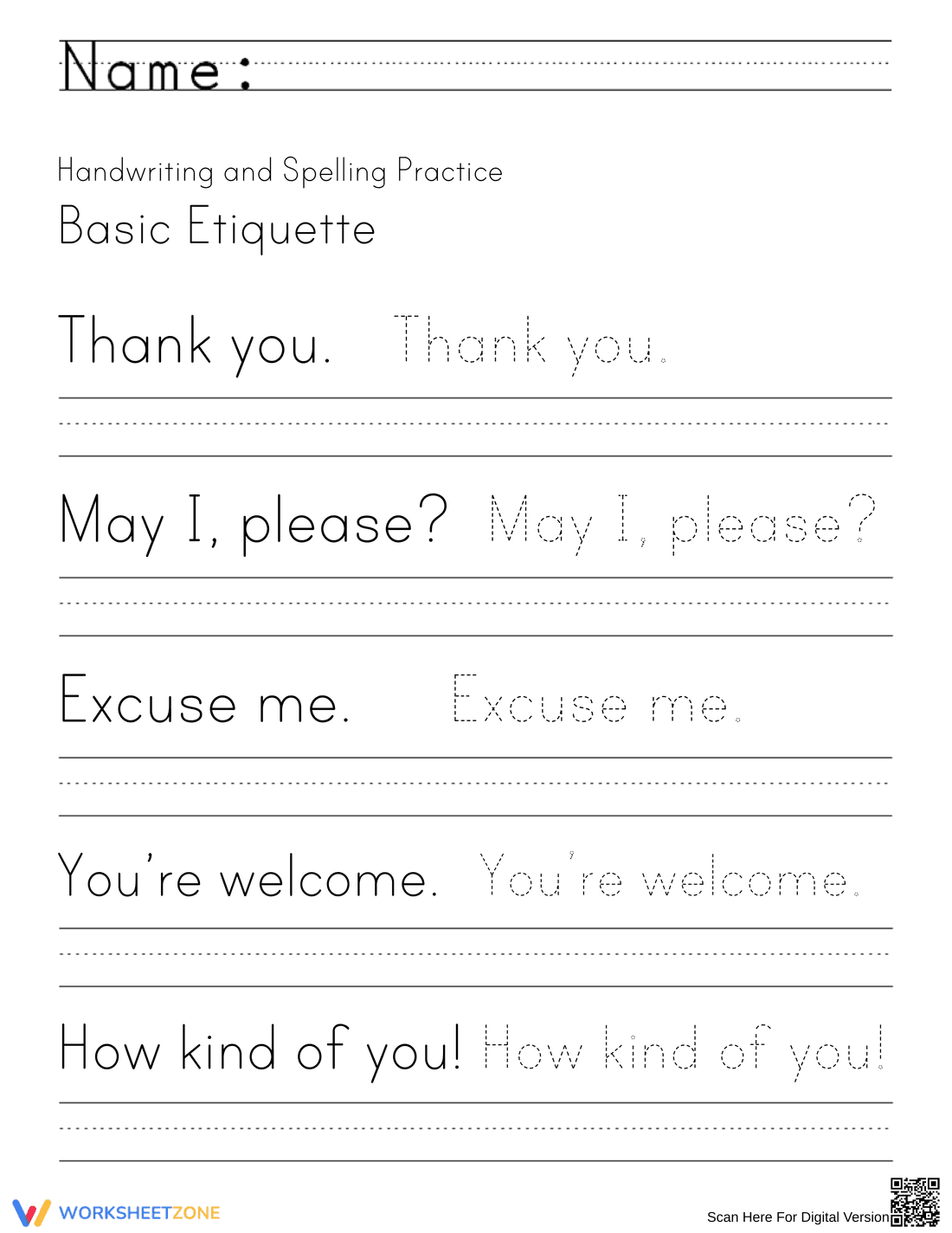
This Grade 3 and 4 handwriting worksheet helps students refine their penmanship while practicing common polite phrases. By tracing and independently writing five basic etiquette sentences, learners improve their spelling, letter formation, and punctuation skills. The clear primary lines provide essential spatial guidance for developing writers.
At a Glance
- Grade: 3 · Subject: English
- Standard:
CCSS.ELA-LITERACY.L.3.2— Demonstrate command of capitalization, punctuation, and spelling.- Skill Focus: Handwriting and spelling
- Format: 1 page · 5 problems · No answer key required · PDF
- Best For: Independent practice and morning work
- Time: 10–15 minutes
This single-page resource features five polite phrases. Each row presents the target sentence in solid text, followed by dotted text for guided tracing. Below the models, standard primary dashed lines allow students to practice writing independently. The clean layout focuses entirely on letter formation and spacing.
Enjoy a zero-prep workflow:
- Print (1 minute): Simply download the PDF and print the required number of copies. The black-and-white design is highly ink-efficient.
- Distribute (1 minute): Hand out the sheets during morning routines or literacy centers. The instructions are self-evident, requiring minimal teacher explanation.
- Review (1 minute): Quickly scan completed pages to check for proper letter sizing, spacing, and correct end punctuation.
With a total teacher prep time of under two minutes, this activity is an excellent addition to any emergency sub plan or fast-finisher folder.
This activity aligns directly with CCSS.ELA-LITERACY.L.3.2: "Demonstrate command of the conventions of standard English capitalization, punctuation, and spelling when writing." As students copy the sentences, they must pay close attention to capital letters at the beginning of phrases and the correct use of periods, question marks, and exclamation points. Both standard codes can be copied directly into lesson plans, IEP goals, or district curriculum mapping tools.
Use this worksheet as calming morning work or a focused literacy center station. While students work, observe pencil grip and stroke direction, offering corrections if letters are formed bottom-up. Most complete this task in 10 to 15 minutes.
This material is primarily designed for third and fourth-grade students who need continued reinforcement in print handwriting and sentence mechanics. It is highly beneficial for occupational therapy sessions or special education students working on fine motor control. Pair this worksheet with a broader social-emotional learning lesson on classroom manners and respectful communication to maximize its impact.
Developing automaticity in handwriting is a critical component of early literacy that directly impacts a student's ability to express complex thoughts. According to research by Fisher & Frey (2014), when students no longer have to expend significant cognitive energy on letter formation, their working memory is freed up to focus on vocabulary selection, sentence structure, and overall composition quality. This resource supports that developmental milestone by targeting CCSS.ELA-LITERACY.L.3.2, requiring learners to demonstrate command of capitalization, punctuation, and spelling. By repeatedly tracing and writing these basic etiquette phrases, children build the muscle memory necessary for fluent writing. Consistent, brief practice sessions are proven to be more effective for motor skill acquisition than infrequent, lengthy blocks. This targeted approach ensures that foundational mechanics become second nature, ultimately supporting broader academic success across all subject areas.


