




























Views
Downloads
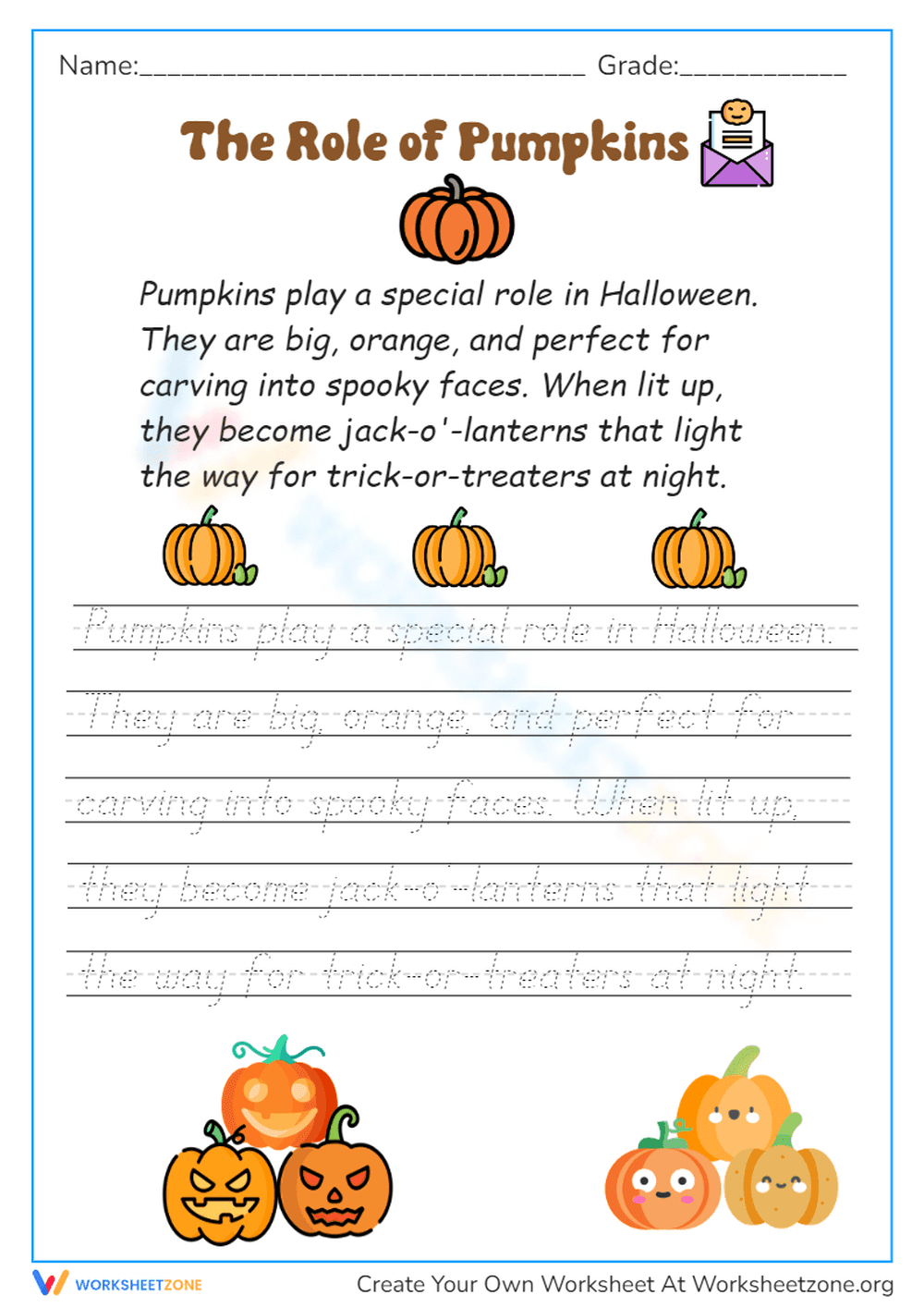

Printable Cursive Writing Worksheet | Grade 3 Halloween

Paste this activity's link or code into your existing LMS (Google Classroom, Canvas, Teams, Schoology, Moodle, etc.).
Students can open and work on the activity right away, with no student login required.
You'll still be able to track student progress and results from your teacher account.
This printable Halloween cursive writing worksheet provides targeted handwriting practice to help students develop fluid, legible letter formation. By tracing a thematic paragraph about pumpkins, second and third graders build fine motor control and muscle memory while engaging with fun, seasonal content.
At a Glance
- Grade: 3 · Subject: English
- Standard:
CCSS.ELA-LITERACY.L.3.1— Demonstrate command of standard English conventions when writing.- Skill Focus: Cursive handwriting and tracing
- Format: 1 page · 5 tracing lines · No answer key · PDF
- Best For: Morning work or literacy centers
- Time: 10–15 minutes
Inside this single-page resource, educators will find a short paragraph about pumpkins. The text is presented first in a clear font, followed by five lines of dotted cursive text for students to trace. The worksheet includes standard handwriting guidelines with dashed middle lines to ensure proper letter sizing. Festive illustrations decorate the page, keeping young learners motivated as they practice penmanship.
Zero-Prep Workflow
This resource is designed for immediate classroom implementation.
- Print (1 minute): Download the PDF and print a class set.
- Distribute (1 minute): Hand out during morning routines. Instructions are self-explanatory.
- Review (0 minutes): As a tracing activity, no grading is required. Teachers can quickly assess completion visually.
With prep time under two minutes, this is ideal for emergency sub plans.
Standards Alignment
This activity aligns with CCSS.ELA-LITERACY.L.3.1, requiring students to demonstrate command of standard English conventions when writing. Consistent practice ensures students produce legible text meeting grade-level expectations. Both standard codes can be copied directly into lesson plans, IEP goals, or district curriculum mapping tools.
How to Use It
This worksheet serves as excellent morning work during October. Students can independently trace the paragraph while the teacher prepares for the day. Alternatively, use it as a quiet task within a literacy center. While students trace, teachers can conduct formative assessments by observing pencil grip and letter stroke directionality. Expected completion time is 10 to 15 minutes.
Who It's For
This resource is primarily designed for second and third-grade students who are being introduced to cursive or need additional reinforcement. It is highly beneficial for students requiring occupational therapy support for fine motor skills, as the dotted lines provide heavy scaffolding. For differentiation, teachers might pair this worksheet with a blank lined page, challenging advanced writers to copy the paragraph independently. It pairs naturally with seasonal read-alouds about autumn.
Developing fluent handwriting is a critical component of early literacy that directly impacts a student's ability to express complex ideas. According to Fisher & Frey (2014), explicit instruction and consistent practice in handwriting conventions reduce cognitive load, allowing students to focus their mental energy on content generation rather than letter formation. This worksheet supports that development by targeting CCSS.ELA-LITERACY.L.3.1, helping students demonstrate command of standard English conventions when writing. By tracing the structured sentences, learners build the necessary muscle memory and spatial awareness required for legible cursive. The integration of seasonal themes further enhances engagement, ensuring that students remain focused during repetitive practice. Providing structured, scaffolded tasks like this tracing activity allows young writers to internalize proper letter connections, ultimately fostering greater automaticity and confidence in their written communication skills across all academic subjects.


