




























Views
Downloads

Parts of Speech Worksheet — Printable Grade 1 ELA

Paste this activity's link or code into your existing LMS (Google Classroom, Canvas, Teams, Schoology, Moodle, etc.).
Students can open and work on the activity right away, with no student login required.
You'll still be able to track student progress and results from your teacher account.
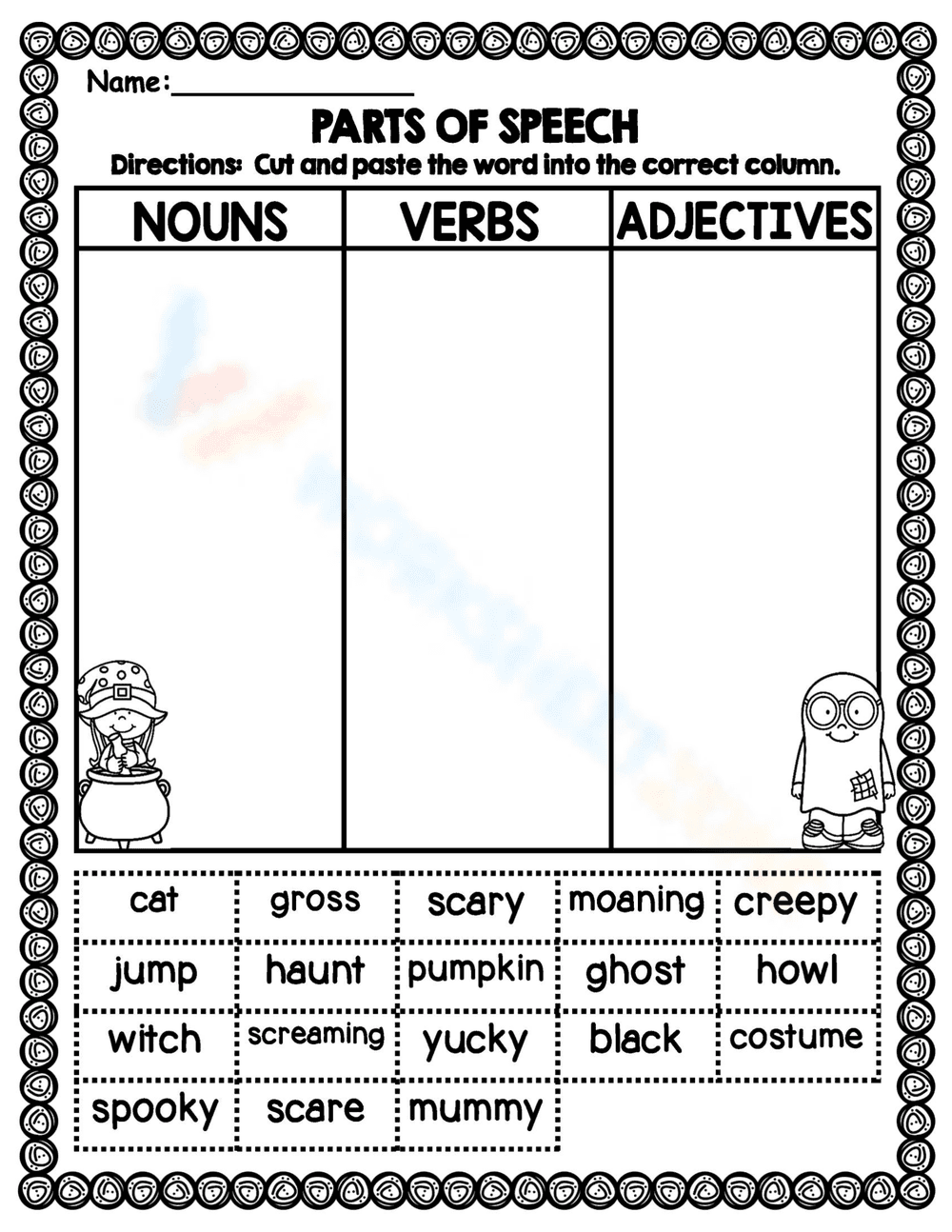
This Halloween-themed parts of speech worksheet helps students identify and categorize nouns, verbs, and adjectives. By sorting eighteen spooky vocabulary words into the correct columns, young learners build foundational grammar skills while engaging with fun, seasonal content. The hands-on cut-and-paste format reinforces fine motor skills alongside language development.
At a Glance
- Grade: 1 · Subject: ELA
- Standard:
CCSS.ELA-LITERACY.L.1.1— Categorize nouns, verbs, and adjectives- Skill Focus: Parts of Speech
- Format: 1 page · 18 problems · Answer key included · PDF
- Best For: Independent practice and centers
- Time: 15–20 minutes
Inside this single-page resource, educators will find a structured graphic organizer featuring three distinct columns for nouns, verbs, and adjectives. The bottom section provides a word bank of eighteen Halloween-themed words, such as "ghost," and "creepy," formatted with dashed lines for easy cutting. A complete answer key is included to facilitate quick grading or allow for student self-checking.
- Print (1 minute): Simply print the single-page PDF and the accompanying answer key. No special materials are required beyond standard scissors and glue sticks.
- Distribute (1 minute): Hand out the worksheets to students during literacy centers, morning work, or as a festive seasonal activity.
- Review (3 minutes): Use the provided answer key to quickly assess student understanding of basic grammar categories.
With a total teacher prep time of under two minutes, this resource is highly suitable for emergency sub plans or last-minute lesson additions.
This activity aligns directly with CCSS.ELA-LITERACY.L.1.1, requiring students to demonstrate command of the conventions of standard English grammar and usage when writing or speaking. It specifically targets the ability to sort words into basic categories like nouns, verbs, and adjectives. Both standard codes can be copied directly into lesson plans, IEP goals, or district curriculum mapping tools.
Deploy this worksheet during literacy centers after direct instruction on parts of speech. It serves as excellent independent practice while the teacher works with small groups. Alternatively, use it as a festive morning work assignment. As a formative assessment observation tip, watch how students handle words that could act as multiple parts of speech, guiding them to choose the most common usage. Expected completion time ranges from 15 to 20 minutes.
This resource is primarily designed for first and second-grade students mastering basic grammar concepts. For differentiation, teachers can pre-cut the words for students who struggle with fine motor skills, or challenge advanced learners to write a creative sentence using one word from each column on the back of the page. It pairs naturally with a seasonal read-aloud book or a classroom anchor chart detailing the definitions of nouns, verbs, and adjectives.
Mastering basic grammar categories is a critical step in early literacy development. This resource supports CCSS.ELA-LITERACY.L.1.1 by asking students to categorize nouns, verbs, and adjectives through a hands-on sorting task. According to Fisher & Frey (2014), incorporating tactile activities like cut-and-paste sorting can significantly improve student retention of abstract concepts such as parts of speech. When young learners physically manipulate vocabulary words and place them into structured categories, they build stronger cognitive connections than they would through rote memorization alone. This targeted practice helps solidify their understanding of sentence structure, ultimately improving both reading comprehension and expressive writing skills. By integrating seasonal themes, educators can maintain high levels of student engagement while delivering rigorous, standards-aligned grammar instruction that meets the developmental needs of early elementary learners.


