


























Views
Downloads

Halloween Vocabulary Flashcards | Printable Grade K-2
Paste this activity's link or code into your existing LMS (Google Classroom, Canvas, Teams, Schoology, Moodle, etc.).
Students can open and work on the activity right away, with no student login required.
You'll still be able to track student progress and results from your teacher account.
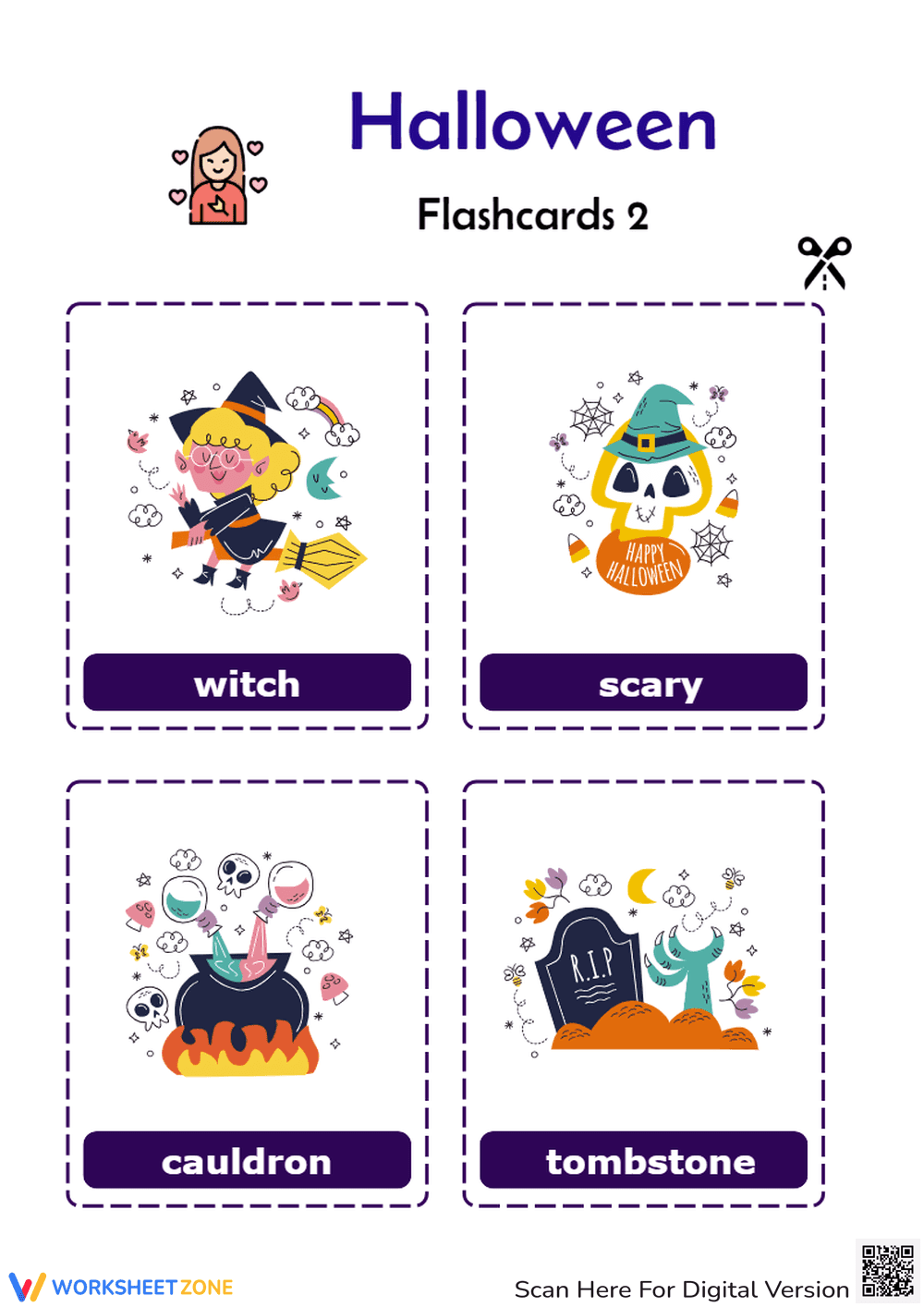
These printable Halloween flashcards help young learners master seasonal vocabulary through visual association and word recognition. By connecting vibrant illustrations with specific terms like witch and cauldron, students build the foundational language skills necessary for reading and writing. This resource provides a simple, effective way to introduce holiday-themed concepts while supporting early literacy development in primary classrooms.
At a Glance
- Grade: K-2 · Subject: English Language Arts
- Standard:
CCSS.ELA-LITERACY.L.K.6— Use words and phrases acquired through conversations, reading and being read to- Skill Focus: Halloween Vocabulary & Fine Motor
- Format: 1 page · 4 flashcards · No-prep · PDF
- Best For: Small group literacy centers or word walls
- Time: 5–10 minutes
This single-page PDF features four high-quality, illustrated flashcards designed for immediate classroom use. Each card includes a clear, colorful graphic paired with a bolded vocabulary word: witch, scary, cauldron, and tombstone. The layout includes dotted cutting guides to assist students with fine motor development or to save teacher preparation time. These cards are formatted for durability when printed on cardstock.
The workflow for this resource is designed for maximum efficiency. First, print the single-page PDF in approximately 30 seconds. Second, distribute the sheets to students or a volunteer for cutting along the provided dotted lines, which takes about 1 minute. Third, review the words as a whole group or place them in a literacy center for immediate student engagement. Total teacher preparation time is under 2 minutes, making this an ideal sub plan addition.
The primary focus is `CCSS.ELA-LITERACY.L.K.6`, which requires students to use words and phrases acquired through conversations, reading and being read to, and responding to texts. These flashcards provide the visual scaffolding necessary for students to acquire and use domain-specific seasonal language. Both standard codes can be copied directly into lesson plans, IEP goals, or district curriculum mapping tools.
Use these cards during a morning meeting to introduce seasonal words of the day before a creative writing session. Alternatively, place them in a pocket chart center where students can practice matching the cards to Halloween-themed picture books. Formative assessment can occur by observing if students can independently identify the image and read the corresponding word. Expected completion for the cutting and initial review is 10 minutes.
This resource is ideal for Kindergarten through 2nd-grade students, including English Language Learners (ELL) who benefit from visual aids. It serves as a perfect companion to a seasonal anchor chart or a read-aloud about autumn traditions. The simple design ensures accessibility for students working on basic word recognition and phonics, providing a clear entry point for diverse learners.
According to the RAND AIRS 2024 report on early literacy, the use of visual aids like flashcards significantly enhances vocabulary retention in primary-grade learners by providing a concrete anchor for abstract concepts. This worksheet aligns with CCSS.ELA-LITERACY.L.K.6, focusing on the acquisition of seasonal vocabulary through visual-verbal pairing. Research from Fisher & Frey (2014) emphasizes that word-rich environments, supported by tools such as these Halloween flashcards, are essential for closing the achievement gap in early childhood education. By integrating these 4 specific terms—witch, scary, cauldron, and tombstone—into daily instruction, educators provide the repetitive exposure needed for long-term memory encoding. This printable resource offers a high-utility, low-cost solution for teachers seeking to build thematic literacy. The inclusion of fine motor practice through cutting further supports the holistic development of Kindergarten and 1st-grade students, making it a versatile addition to any seasonal curriculum.


