




























Views
Downloads
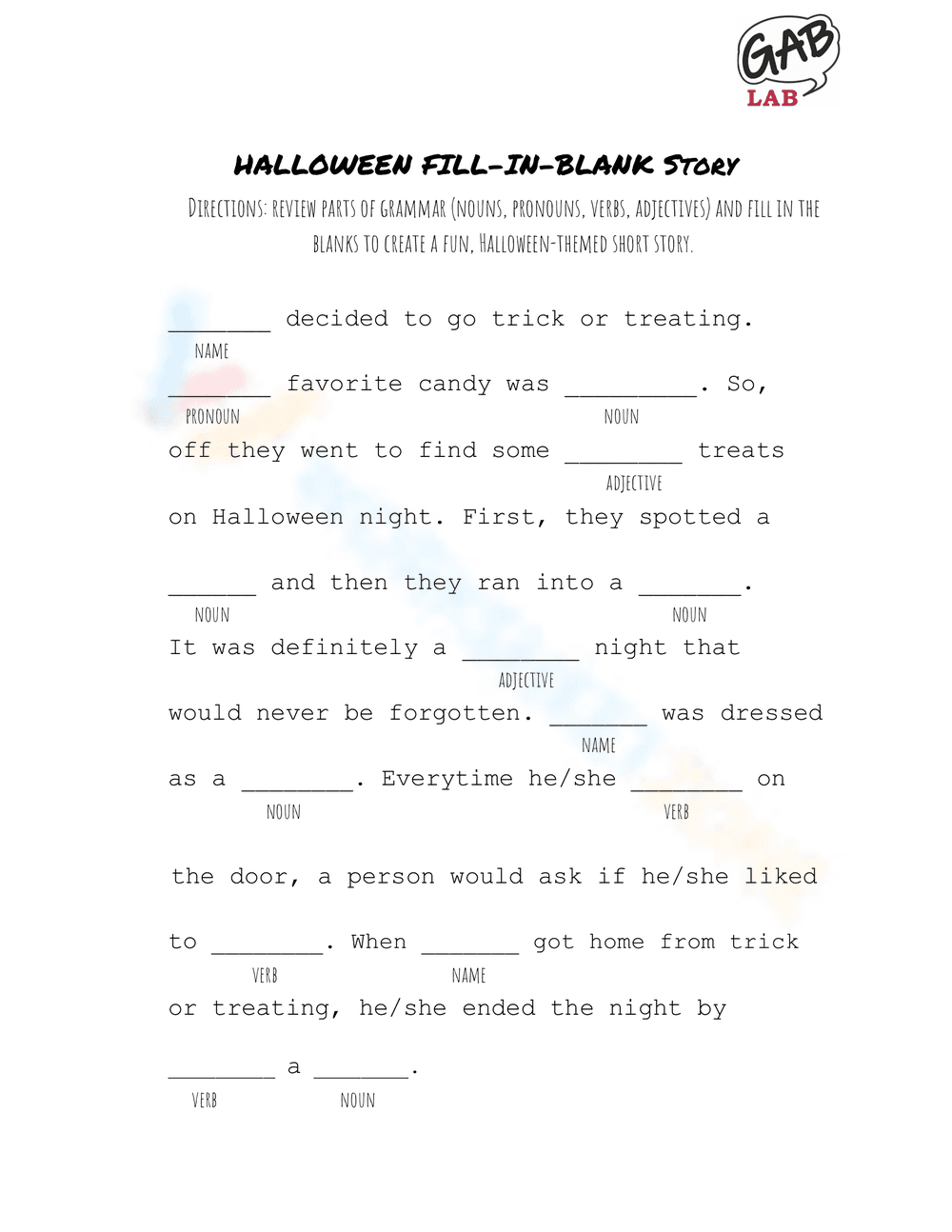

Grade 1 Parts of Speech — Printable Halloween Worksheet

Paste this activity's link or code into your existing LMS (Google Classroom, Canvas, Teams, Schoology, Moodle, etc.).
Students can open and work on the activity right away, with no student login required.
You'll still be able to track student progress and results from your teacher account.
This Halloween fill-in-the-blank story worksheet provides early elementary students with engaging practice identifying and using parts of speech. By selecting appropriate nouns, verbs, adjectives, and pronouns to complete the narrative, learners strengthen their foundational grammar skills while creating a unique, festive tale.
At a Glance
- Grade: 1–2 · Subject: ELA
- Standard:
CCSS.ELA-LITERACY.L.1.1— Use common grammar conventions when writing- Skill Focus: Parts of speech
- Format: 1 page · 14 problems · Open-ended · PDF
- Best For: Independent practice or centers
- Time: 15–20 minutes
Inside this single-page resource, educators will find a structured, Halloween-themed short story missing key vocabulary words. Students are prompted to fill in 14 specific blanks labeled with the required part of speech, including nouns, verbs, adjectives, pronouns, and proper names. Because the activity relies on student creativity, there is no single correct answer key, allowing for open-ended expression and varied results that make sharing stories aloud a fun classroom activity.
Zero-Prep Workflow
- Print (1 minute): Simply download the PDF and print a class set. The black-and-white design ensures quick, ink-friendly copying.
- Distribute (1 minute): Hand out the worksheets during your literacy block or place them in a designated grammar center. No additional materials or teacher setup are required.
- Review (3 minutes): Have students read their completed stories to a partner or the class to check that the selected words match the requested parts of speech.
With total teacher preparation time under two minutes, this resource suits emergency sub plans.
Standards Alignment
This activity aligns directly with CCSS.ELA-LITERACY.L.1.1: "Demonstrate command of the conventions of standard English grammar and usage when writing or speaking." It also supports second-grade grammar review expectations. Both standard codes can be copied directly into lesson plans, IEP goals, or district curriculum mapping tools.
How to Use It
Assign this worksheet during independent practice after direct instruction on parts of speech. It serves as an excellent application task where students must recall vocabulary that fits specific grammatical categories. Alternatively, use it as a collaborative literacy center activity where pairs brainstorm words together to complete the story. As a formative assessment observation tip, walk around the room and check if students are correctly distinguishing between nouns and verbs when filling in the corresponding blanks. Expected completion time ranges from 15 to 20 minutes.
Who It's For
This resource is primarily designed for first and second-grade students mastering basic parts of speech. For differentiation, teachers can provide a word bank on the board for students who struggle with vocabulary recall, or challenge advanced learners to use multi-syllable adjectives and strong action verbs. It pairs naturally with a seasonal read-aloud or a classroom anchor chart detailing the definitions of nouns, verbs, and adjectives.
Mastering foundational grammar conventions, such as those outlined in CCSS.ELA-LITERACY.L.1.1 (Use common grammar conventions when writing), requires consistent, contextualized practice. According to Fisher & Frey (2014), integrating grammar instruction into meaningful writing tasks rather than isolated drills significantly improves student retention and application of language rules. By asking students to supply specific parts of speech to complete a narrative structure, this worksheet bridges the gap between rote identification and active composition. This method encourages cognitive flexibility, as learners must retrieve appropriate vocabulary from memory while ensuring grammatical alignment within the sentence. Providing opportunities to manipulate language in engaging formats builds syntactic awareness and supports broader reading comprehension across early elementary grades.


