


























Views
Downloads
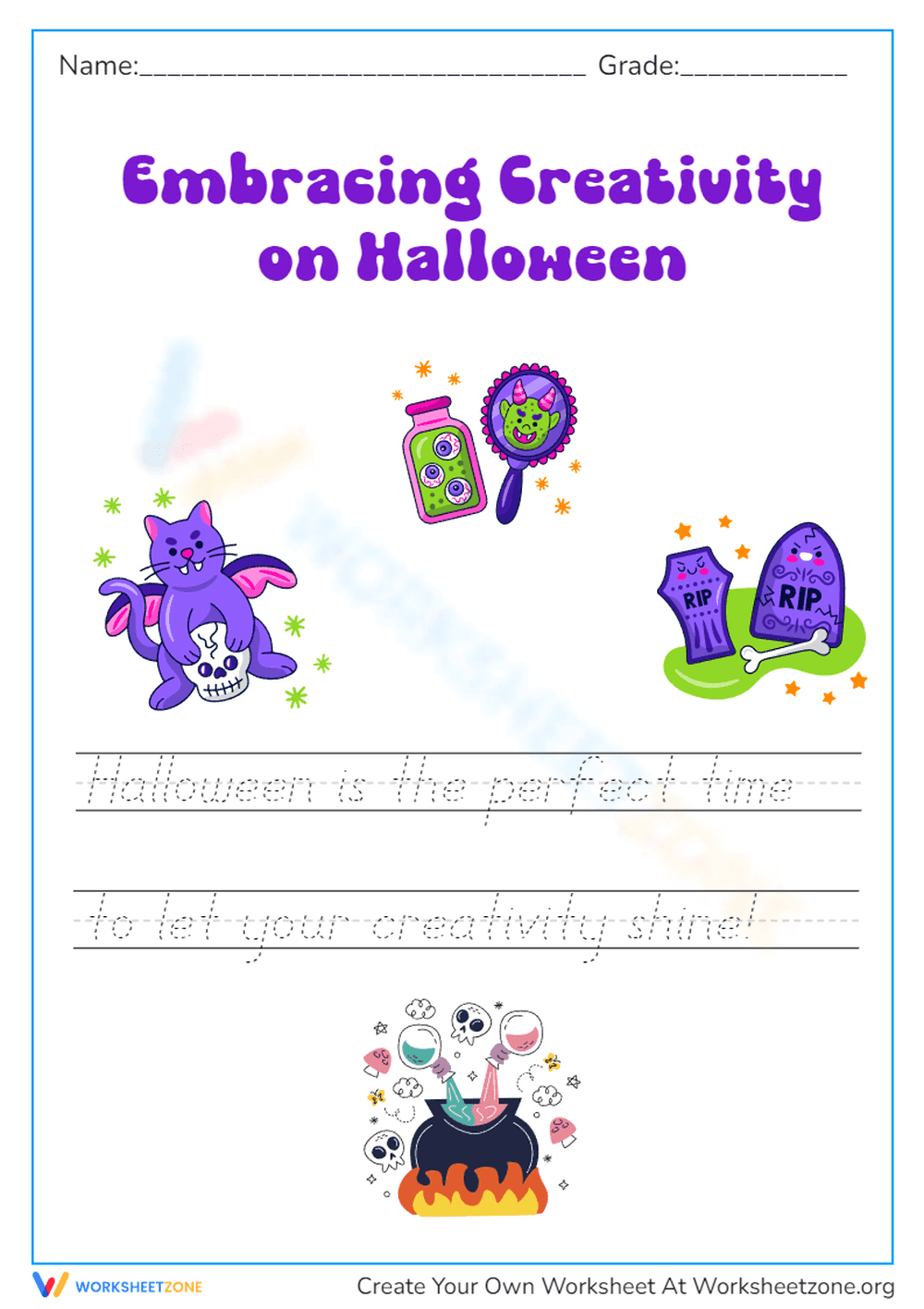

Halloween Cursive Worksheet | Printable Grade 2
Paste this activity's link or code into your existing LMS (Google Classroom, Canvas, Teams, Schoology, Moodle, etc.).
Students can open and work on the activity right away, with no student login required.
You'll still be able to track student progress and results from your teacher account.
This Grade 2 Halloween cursive worksheet provides students with focused handwriting practice to improve letter formation and fine motor control. By tracing a festive, themed sentence, young learners build muscle memory and confidence in their writing abilities while celebrating the holiday season.
At a Glance
- Grade: 2 · Subject: Cursive
- Standard:
CCSS.ELA-LITERACY.L.2.2— Demonstrate command of writing conventions- Skill Focus: Sentence tracing and handwriting
- Format: 1 page · 1 tracing task · No answer key needed · PDF
- Best For: Morning work or centers
- Time: 5–10 minutes
Inside this single-page printable, educators will find a clearly formatted tracing exercise featuring a complete sentence about Halloween creativity. The page includes dotted guidelines for each letter, ensuring students can easily follow the correct stroke paths. Engaging, full-color holiday illustrations—such as a friendly monster, a bubbling cauldron, and a playful cat—surround the text to keep students visually stimulated and motivated as they complete their handwriting practice.
This resource offers a zero-prep workflow for busy teachers.
- Print (1 minute): Simply download the PDF and print the required number of copies. The vibrant graphics print beautifully in color or grayscale.
- Distribute (1 minute): Hand out the sheets during morning work, literacy centers, or as a quick transition activity.
- Review (0 minutes): Because this is a tracing activity, students can self-monitor their progress, requiring no formal grading or answer key review.
With a total teacher prep time of under two minutes, this worksheet is highly suitable for emergency sub plans or spontaneous holiday activities.
This activity aligns with CCSS.ELA-LITERACY.L.2.2, requiring students to demonstrate command of the conventions of standard English capitalization, punctuation, and spelling when writing. By tracing a properly structured sentence, students reinforce their understanding of spacing, capitalization at the beginning of a sentence, and end punctuation. Both standard codes can be copied directly into lesson plans, IEP goals, or district curriculum mapping tools.
Teachers can utilize this worksheet as a calming morning work assignment as students arrive on Halloween day. It also serves as an excellent independent station during literacy centers. While students trace the letters, teachers can conduct quick formative assessments by observing pencil grip, posture, and stroke direction. The expected completion time is a brief five to ten minutes, making it a perfect filler activity between longer lessons.
This resource is primarily designed for first and second-grade students who are developing their handwriting and fine motor skills. For students requiring additional differentiation, teachers can provide pencil grips or highlight the starting points of complex letters. It pairs naturally with a read-aloud of a favorite Halloween picture book or a direct instruction mini-lesson on proper letter formation and spacing.
Developing legible handwriting remains a critical component of early literacy instruction in elementary classrooms. Research by Fisher & Frey (2014) shows explicit handwriting practice significantly supports broader literacy development, including spelling accuracy and written expression fluency. When students engage with targeted tracing tasks, they reduce the cognitive load required for letter formation, freeing up mental resources for higher-order composition skills. This worksheet directly supports CCSS.ELA-LITERACY.L.2.2 by helping students demonstrate command of writing conventions through guided repetition. By integrating festive themes with foundational skills, educators can maintain high engagement levels during holiday periods while ensuring academic momentum continues. Regular, brief practice sessions—such as tracing a single, well-structured sentence—are proven to build the muscle memory necessary for automaticity in writing, setting young learners up for long-term academic success.


