


























Views
Downloads

Printable Hairdressing Cutting Worksheet | Grade K-1 Art
Paste this activity's link or code into your existing LMS (Google Classroom, Canvas, Teams, Schoology, Moodle, etc.).
Students can open and work on the activity right away, with no student login required.
You'll still be able to track student progress and results from your teacher account.
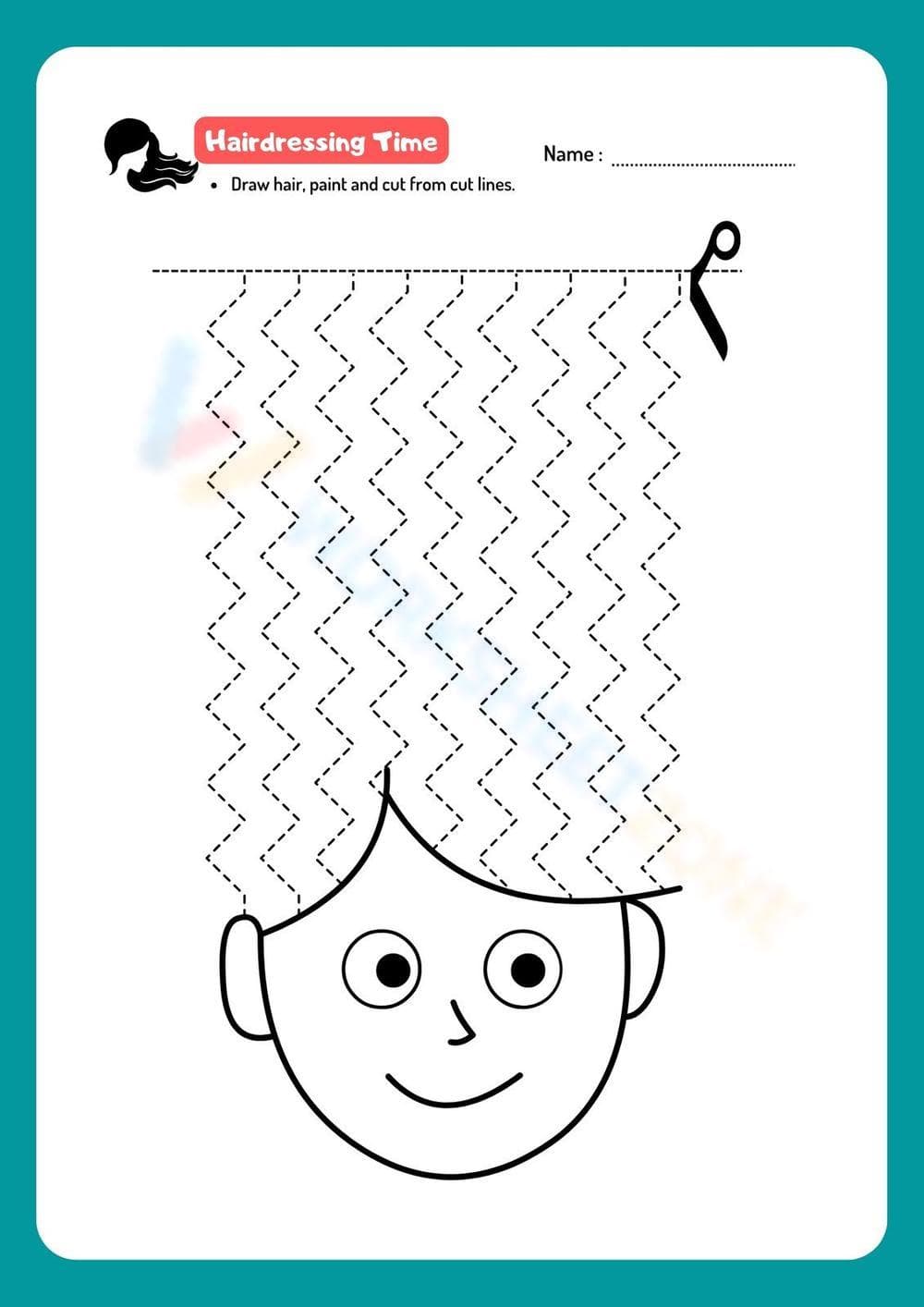
This printable hairdressing worksheet helps early learners develop essential fine motor control. By drawing, coloring, and cutting along zig-zag lines to create fun hairstyles, kindergarten and first-grade students strengthen hand-eye coordination required for foundational writing tasks.
At a Glance
- Grade: K-1 · Subject: Fine Art
- Standard:
CCSS.ELA-LITERACY.W.K.2— Use drawing and writing to compose informative texts- Skill Focus: Scissor skills and fine motor control
- Format: 1 page · 10 cutting lines · No answer key needed · PDF
- Best For: Independent centers or morning work
- Time: 15–20 minutes
Inside this single-page resource, educators will find a highly engaging cutting activity. The page features a friendly face with ten zig-zag dashed lines extending upward. Students draw additional details, color the character, and cut along the dashed lines to give a "haircut." Clear visual cues make the task self-explanatory for young learners, requiring no materials beyond crayons and safety scissors.
- Print (1 minute): Download the PDF and print a class set. Black-and-white line art ensures minimal ink usage.
- Distribute (1 minute): Hand out pages with classroom scissors and coloring supplies. No complex modeling required.
- Review (0 minutes): As a process-oriented fine motor task, there is no formal grading.
Total teacher prep time is under two minutes, making this ideal for substitute plans or morning arrival bins.
Aligned to primary standard CCSS.ELA-LITERACY.W.K.2, this activity supports the physical mechanics needed to "use drawing and writing to compose informative texts." The hand strength developed here directly supports early handwriting stamina. Both standard codes can be copied directly into lesson plans, IEP goals, or district curriculum mapping tools.
This worksheet is highly versatile. Use it during morning work as a focused activity allowing students to practice hand-eye coordination. Alternatively, place it in an independent fine motor center. As a formative assessment observation tip, watch how students grip scissors and rotate paper, noting who may need targeted occupational therapy interventions. Expected completion time ranges from 15 to 20 minutes.
Designed for kindergarten and first-grade students, this resource also serves as an intervention tool for older students requiring occupational therapy support. For differentiation, teachers can highlight cutting lines with a thick marker for students needing a stronger visual boundary. Pair this activity with a direct instruction lesson on scissor safety.
Developing essential fine motor skills through targeted, hands-on activities is a critical precursor to long-term academic success in early elementary grades. Aligned with CCSS.ELA-LITERACY.W.K.2, this worksheet requires students to use drawing and writing to compose informative texts by first mastering the physical tools of expression. According to a comprehensive ScienceDirect TpT Analysis of early childhood resources, materials that integrate play-based themes—such as a hairdressing salon—with functional mechanical tasks significantly increase student time-on-task and task persistence. The repetitive motion of cutting along the ten zig-zag lines builds the intrinsic hand muscle strength necessary for proper pencil grasp and sustained writing stamina. By embedding these crucial physical developmental milestones within an engaging, creative art project, educators can efficiently support both artistic expression and the foundational mechanics of early literacy without adding to their instructional prep time.


