


























Views
Downloads



Groucho Marx Biography Worksheet | Essential Grade 3 ELA
Paste this activity's link or code into your existing LMS (Google Classroom, Canvas, Teams, Schoology, Moodle, etc.).
Students can open and work on the activity right away, with no student login required.
You'll still be able to track student progress and results from your teacher account.
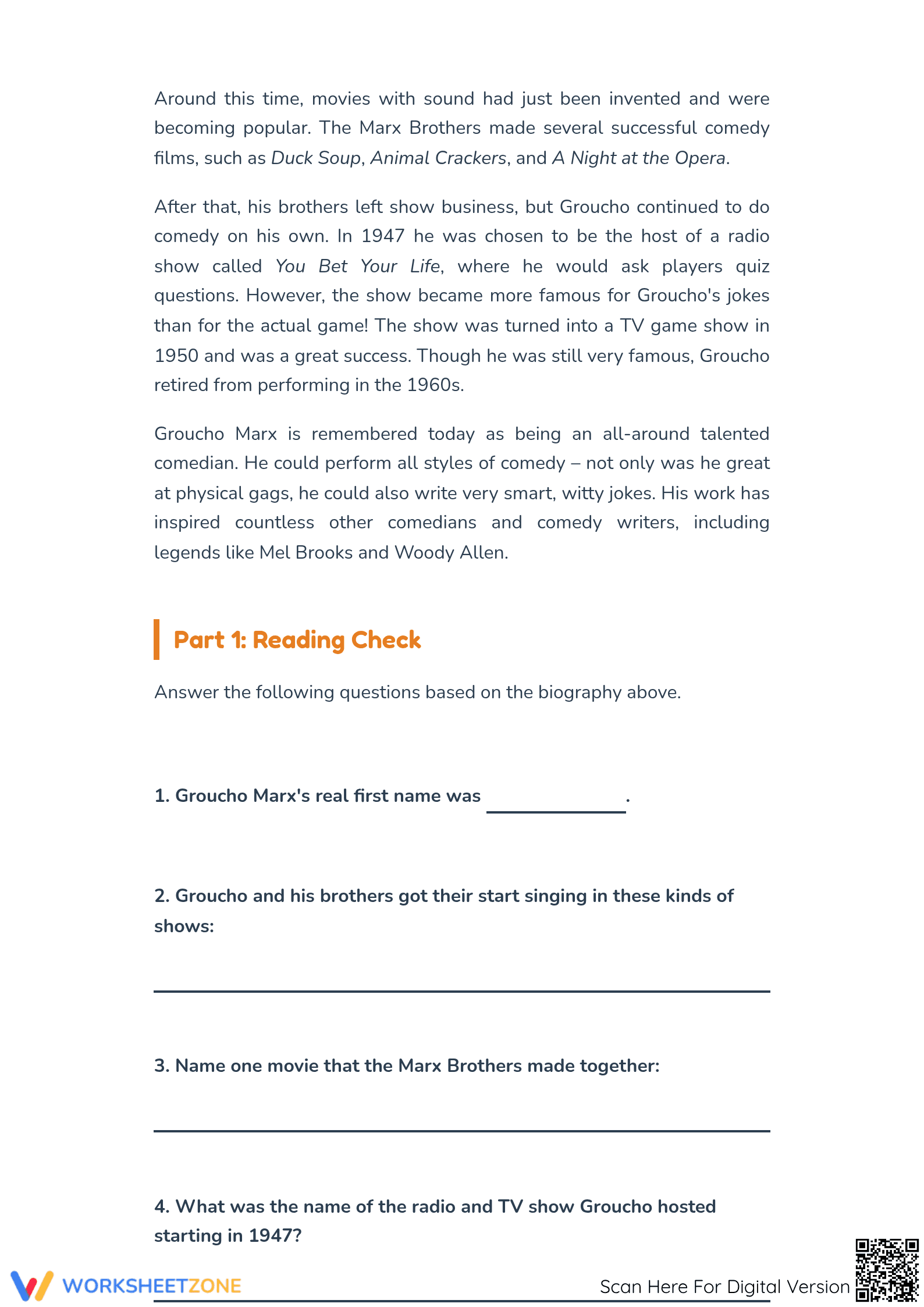
This Grade 3 nonfiction reading comprehension worksheet introduces students to the life and legacy of comedic icon Groucho Marx. By engaging with a detailed biography, learners practice extracting key information and applying their understanding through creative extension activities. It provides a comprehensive look at vaudeville history while building essential literacy skills.
At a Glance
- Grade: 3 · Subject: ELA
- Standard:
CCSS.ELA-LITERACY.RI.3.1— Ask and answer questions to demonstrate understanding by referring explicitly to the text- Skill Focus: Nonfiction Reading Comprehension
- Format: 4 pages · 7 tasks · Answer key included · PDF
- Best For: Biography units and Jewish-American history
- Time: 30–45 minutes
The packet contains a multi-paragraph biography of Groucho Marx, covering his early life in vaudeville and his transition to film and television. It features a five-question Reading Check to assess literal comprehension, a secondary informational text defining vaudeville, a creative writing prompt for student-designed acts, and a poster design space. A full answer key is provided for the reading check.
Skill Progression
- Guided practice: Students read the biography and identify specific facts like Groucho's birth name and early performance venues across 3 initial questions.
- Supported practice: Learners synthesize information to explain the Marx Brothers' transition from singing to comedy in the final 2 comprehension tasks.
- Independent practice: The "Your Own Vaudeville Act" and "Show Poster" sections require students to apply their knowledge of the genre to original creative work.
This sequence follows a gradual-release model, moving from text-dependent identification to higher-order creative application.
Standards Alignment
This resource is aligned with CCSS.ELA-LITERACY.RI.3.1, which requires students to ask and answer questions to demonstrate understanding of a text, referring explicitly to the text as the basis for the answers. It also supports RI.3.3 by exploring the relationship between historical events and the development of comedy. Both standard codes can be copied directly into lesson plans, IEP goals, or district curriculum mapping tools.
How to Use It
Use this worksheet during a biography unit or as part of a Jewish-American Heritage Month celebration. It works well as a mid-lesson activity following direct instruction on nonfiction text features. Teachers can observe student performance on the creative poster task to formatively assess their understanding of the vaudeville era's tone and purpose. Completion typically takes 35 minutes.
Who It's For
This resource is designed for third-grade general education students, but the clear text structure makes it accessible for fourth-grade students needing reading intervention. It pairs naturally with an anchor chart on Asking and Answering Questions or a short video clip of a classic Marx Brothers comedy routine to provide visual context.
According to the RAND AIRS 2024 report, high-quality nonfiction materials that integrate creative response tasks significantly improve student engagement and retention of historical facts. This worksheet targets CCSS.ELA-LITERACY.RI.3.1 by requiring students to cite specific evidence from the biography of Groucho Marx to answer comprehension questions. By blending literal recall with creative application—such as designing a vaudeville poster—the resource aligns with Fisher & Frey’s (2014) research on the importance of purposeful literacy tasks that move beyond simple decoding. The inclusion of a secondary text defining the vaudeville genre further supports vocabulary acquisition and domain-specific knowledge. Educators can utilize this structured approach to ensure students meet Grade 3 reading benchmarks while exploring significant cultural figures in American history. This evidence-based design ensures that students are not just reading, but actively processing and applying informational content in a meaningful way.


