


























Views
Downloads



Gravity Investigation Worksheet | Grade 4 Essential
Paste this activity's link or code into your existing LMS (Google Classroom, Canvas, Teams, Schoology, Moodle, etc.).
Students can open and work on the activity right away, with no student login required.
You'll still be able to track student progress and results from your teacher account.
This Grade 4 science investigation helps students identify and describe the effects of gravitational force through observation and critical thinking. By predicting outcomes of physical experiments and observing real-world examples, learners build a concrete understanding of how Earth's pull affects objects of varying mass. The packet transforms abstract physics concepts into tangible classroom experiences.
At a Glance
- Grade: 4 · Subject: Science
- Standard:
5-PS2-1— Support an argument that the gravitational force exerted by Earth is directed down- Skill Focus: Gravitational force and mass vs. weight
- Format: 5 pages · 13 problems · No-prep investigation · PDF
- Best For: Introduction to physical science forces
- Time: 45–60 minutes
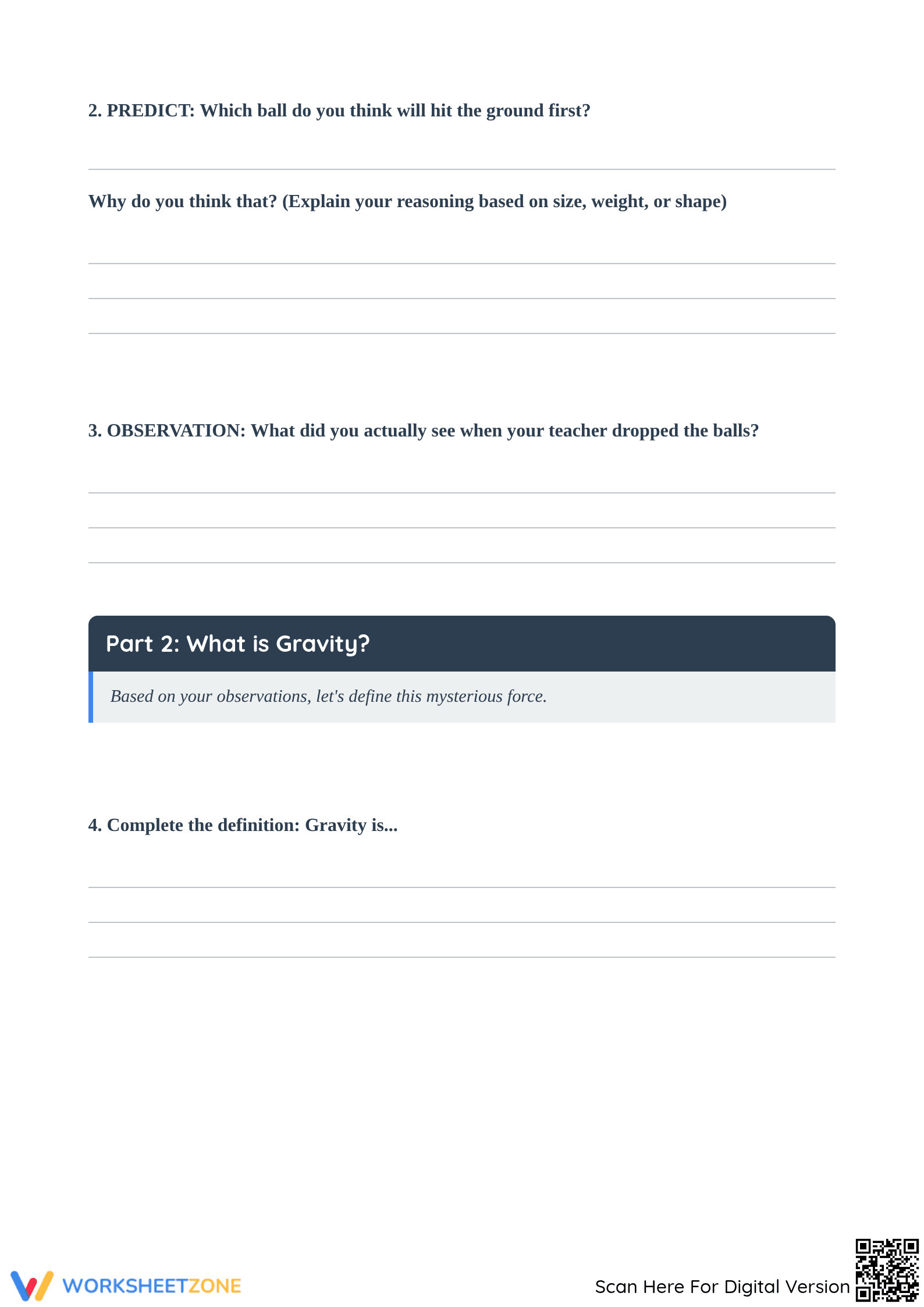
The packet contains five structured pages designed to guide students through a scientific inquiry process. It includes a teacher-led demonstration section for predicting and observing falling objects, a conceptual definition area with true/false checks, and a mass versus weight comparison. The final pages transition to independent field observations during recess, encouraging students to find gravity in action outside the classroom.
Zero-Prep Workflow
The zero-prep workflow is designed for immediate implementation. First, print the five-page packet for each student (1 minute). Second, distribute the materials and perform the "Great Drop Experiment" using two different balls (5 minutes). Third, allow students to complete the field observation during their scheduled break and review their findings as a group (10 minutes). Total teacher preparation time is under two minutes, making this suitable for sub plans.
Standards Alignment
This resource aligns with `5-PS2-1`, which requires students to support the argument that the gravitational force exerted by Earth on objects is directed down. It specifically addresses the misconception that gravity only works on heavy objects or requires air to function. Both standard codes can be copied directly into lesson plans, IEP goals, or district curriculum mapping tools.
How to Use It
Use this worksheet during the "Explore" phase of a 5E lesson model. Before direct instruction, have students complete the prediction and observation sections to surface existing mental models. It also serves as an excellent formative assessment tool; observe students during Part 4 to see if they can correctly identify the path of falling objects. Completion typically takes 45 to 60 minutes depending on the depth of the recess observation.
Who It's For
This investigation is ideal for general education fourth-grade science blocks and upper elementary homeschool settings. The inclusion of drawing boxes and simple checklists provides scaffolding for English Language Learners and students with writing difficulties. It pairs naturally with a classroom anchor chart on forces or a short introductory video about planetary gravity to provide a multi-modal learning experience.
The 5-PS2-1 standard emphasizes the directional nature of Earth's pull, a concept this worksheet reinforces through 13 distinct tasks. According to the RAND AIRS 2024 analysis, structured inquiry-based worksheets significantly improve retention of physical science concepts compared to passive reading alone. By requiring students to differentiate between mass and weight—a common point of confusion in middle childhood—this resource builds the necessary foundation for middle school physics. The field observation component aligns with Fisher & Frey (2014) recommendations for extending classroom learning into real-world contexts, ensuring that the student outcome is a functional understanding of gravity rather than just rote memorization of a definition. This comprehensive packet provides the evidence-based structure needed for effective elementary science instruction and supports long-term academic growth in STEM fields.


