




























Views
Downloads

Gravity Pulls Things Down | Essential Grade 5 Science

Paste this activity's link or code into your existing LMS (Google Classroom, Canvas, Teams, Schoology, Moodle, etc.).
Students can open and work on the activity right away, with no student login required.
You'll still be able to track student progress and results from your teacher account.
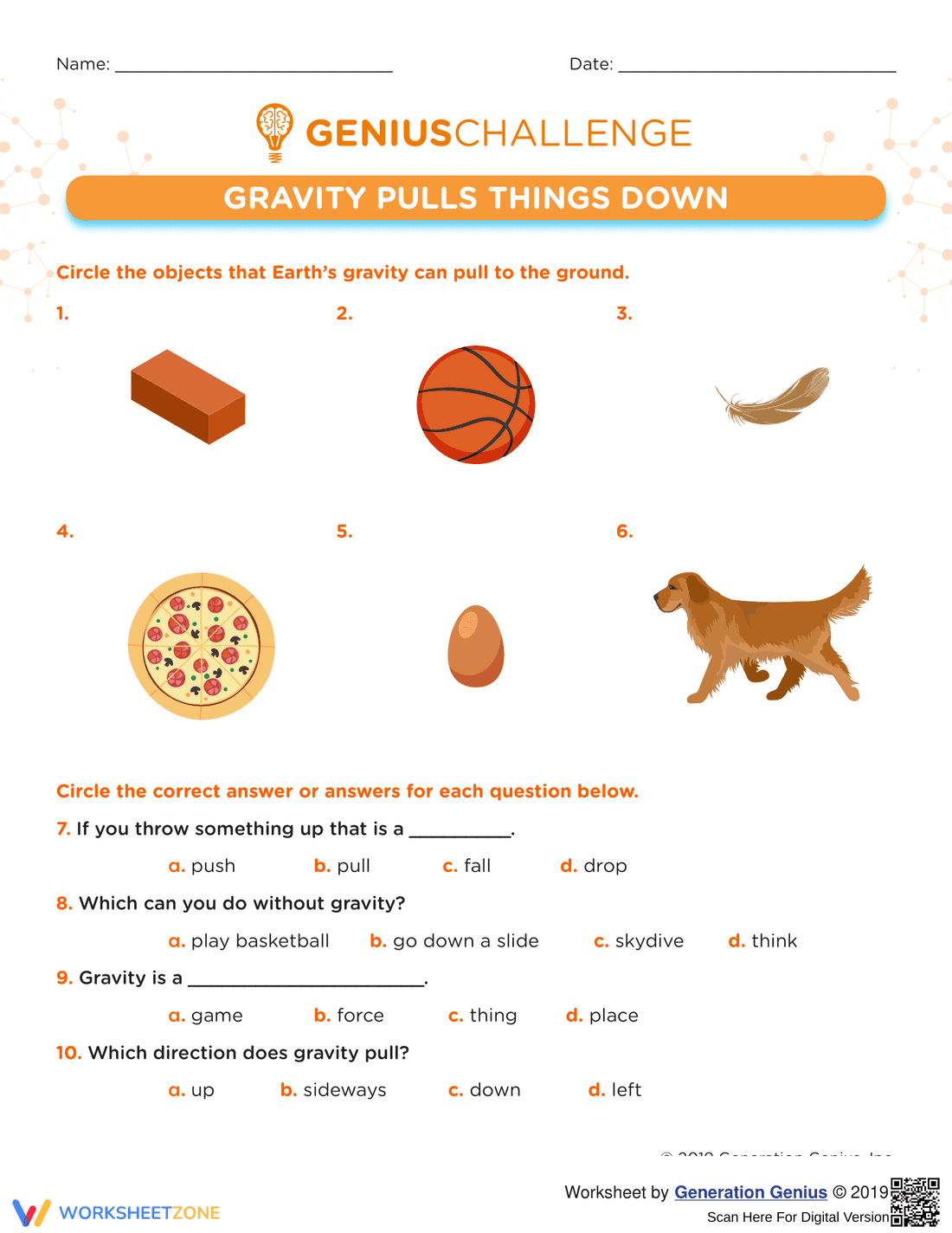
Gravity is the invisible force that keeps our world grounded. This worksheet helps students visualize how Earth's gravity acts on everyday objects, pulling them toward the center of the planet. By identifying which items are affected by gravity and answering conceptual questions, learners solidify their understanding of physical forces and motion.
At a Glance
- Grade: 5 · Subject: Science
- Standard:
5-PS2-1— Support an argument that the gravitational force exerted by Earth is directed down- Skill Focus: Gravity as a downward force
- Format: 1 page · 10 problems · Answer key included · PDF
- Best For: Quick formative assessment or science centers
- Time: 10–15 minutes
What's Inside
This single-page PDF contains 10 targeted tasks designed for immediate student engagement. The first 6 problems require students to visually identify and circle objects—ranging from bricks to feathers—that are subject to Earth's gravitational pull. The final 4 problems transition to multiple-choice questions that define gravity as a force and specify its constant downward direction. A clear, legible layout ensures accessibility for all learners.
Zero-Prep Workflow
This resource is designed for a zero-prep classroom workflow. Teachers can print the document in seconds. Distribution takes approximately 1 minute, and because the tasks are self-explanatory, students can begin working immediately. Reviewing the 10 answers as a whole class takes roughly 3 minutes, making the entire instructional cycle highly efficient for busy educators or substitute lesson plans.
Standards Alignment
This worksheet is directly aligned with `5-PS2-1`, which requires students to support the argument that the gravitational force exerted by Earth on objects is directed down. It also supports foundational concepts in 3-PS2-1 regarding balanced and unbalanced forces. Both standard codes can be copied directly into lesson plans, IEP goals, or district curriculum mapping tools.
How to Use It
Use this worksheet as a "check for understanding" immediately following a demonstration of falling objects. It serves as an excellent formative assessment tool; observe if students hesitate to circle the feather, which provides an opening to discuss air resistance versus gravity. The expected completion time is 10 to 15 minutes, fitting perfectly into a standard science block.
Who It's For
This resource is ideal for 5th-grade students beginning their physics unit, but its heavy visual scaffolding also makes it appropriate for 3rd-grade enrichment or English Language Learners (ELL) who need clear pictorial cues. It pairs with an anchor chart or video clip demonstrating gravity in a vacuum.
According to the RAND AIRS 2024 report on elementary science instruction, high-quality visual aids are essential for conceptualizing invisible forces like gravity. This worksheet addresses the 5-PS2-1 standard by requiring students to identify gravity as a constant downward force through 10 specific tasks. Research by Fisher & Frey (2014) emphasizes that the gradual release of responsibility—moving from visual identification to conceptual multiple-choice questions—supports long-term retention of physical science principles. By focusing on the student action of supporting an argument with evidence, this resource ensures that learners do more than memorize definitions; they apply the concept of gravitational pull to a variety of physical objects. This alignment with evidence-based pedagogical practices makes the worksheet a reliable tool for achieving mastery in elementary physics and meeting state-mandated science benchmarks.


