


























1 / 5
0
Views
0
Downloads


0.0
0
Save
0 Likes
Share
Gravity and Friction Review Worksheet for Physics
0 Views
0 Downloads
Paste this activity's link or code into your existing LMS (Google Classroom, Canvas, Teams, Schoology, Moodle, etc.).
Students can open and work on the activity right away, with no student login required.
You'll still be able to track student progress and results from your teacher account.
Information
Description
What It Is:
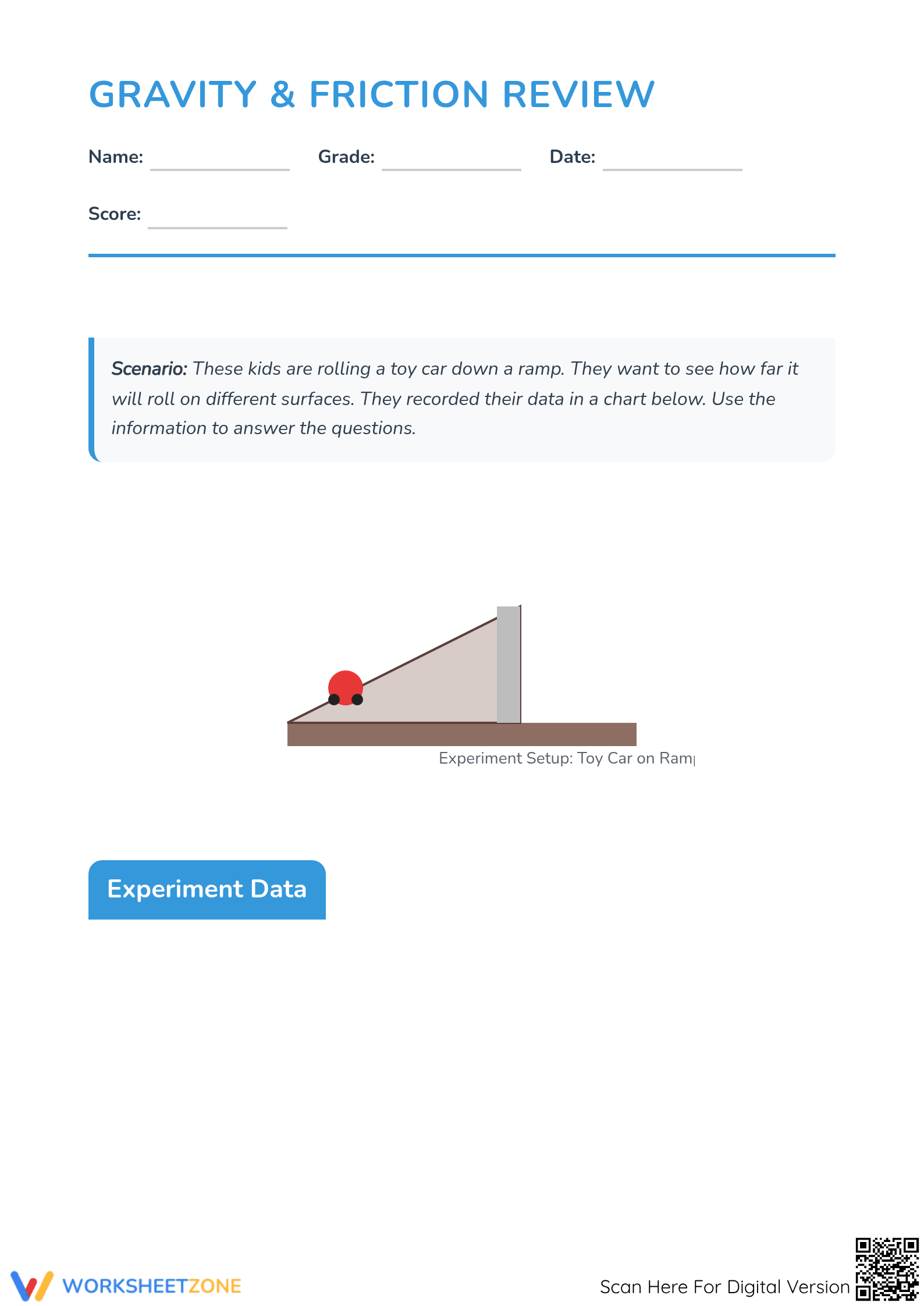
This is a science worksheet focusing on gravity and friction. It features a scenario where kids roll a toy car down a ramp on different surfaces (wood, carpet, tile, and grass) and record the distance. A table presents the surface and the corresponding distance the car rolled. The worksheet includes questions about the forces involved (gravity and friction), which surface has the most/least friction, and a question about which surface would allow the car to roll the longest.
Grade Level Suitability:
This worksheet is suitable for grades 2-4. The concepts of gravity and friction are introduced in elementary science, and the questions are designed to be accessible to students in these grade levels. The data interpretation from the table is also appropriate for this age group.
Why Use It:
This worksheet helps students understand the concepts of gravity and friction through a real-world example. It encourages critical thinking by asking students to analyze data and explain their reasoning. It also reinforces the relationship between surface type and the amount of friction generated.
How to Use It:
Students should first read the introductory paragraph to understand the scenario. Then, they should analyze the data table showing the distance the car rolled on each surface. Finally, they should answer the questions, circling the correct answers where indicated and providing written explanations for the remaining questions.
Target Users:
This worksheet is designed for elementary school students (grades 2-4) learning about gravity and friction. It can be used in a classroom setting or as a supplemental activity for science education at home. It's also beneficial for students who learn best through visual aids and hands-on examples.
This is a science worksheet focusing on gravity and friction. It features a scenario where kids roll a toy car down a ramp on different surfaces (wood, carpet, tile, and grass) and record the distance. A table presents the surface and the corresponding distance the car rolled. The worksheet includes questions about the forces involved (gravity and friction), which surface has the most/least friction, and a question about which surface would allow the car to roll the longest.
Grade Level Suitability:
This worksheet is suitable for grades 2-4. The concepts of gravity and friction are introduced in elementary science, and the questions are designed to be accessible to students in these grade levels. The data interpretation from the table is also appropriate for this age group.
Why Use It:
This worksheet helps students understand the concepts of gravity and friction through a real-world example. It encourages critical thinking by asking students to analyze data and explain their reasoning. It also reinforces the relationship between surface type and the amount of friction generated.
How to Use It:
Students should first read the introductory paragraph to understand the scenario. Then, they should analyze the data table showing the distance the car rolled on each surface. Finally, they should answer the questions, circling the correct answers where indicated and providing written explanations for the remaining questions.
Target Users:
This worksheet is designed for elementary school students (grades 2-4) learning about gravity and friction. It can be used in a classroom setting or as a supplemental activity for science education at home. It's also beneficial for students who learn best through visual aids and hands-on examples.


