


























Views
Downloads

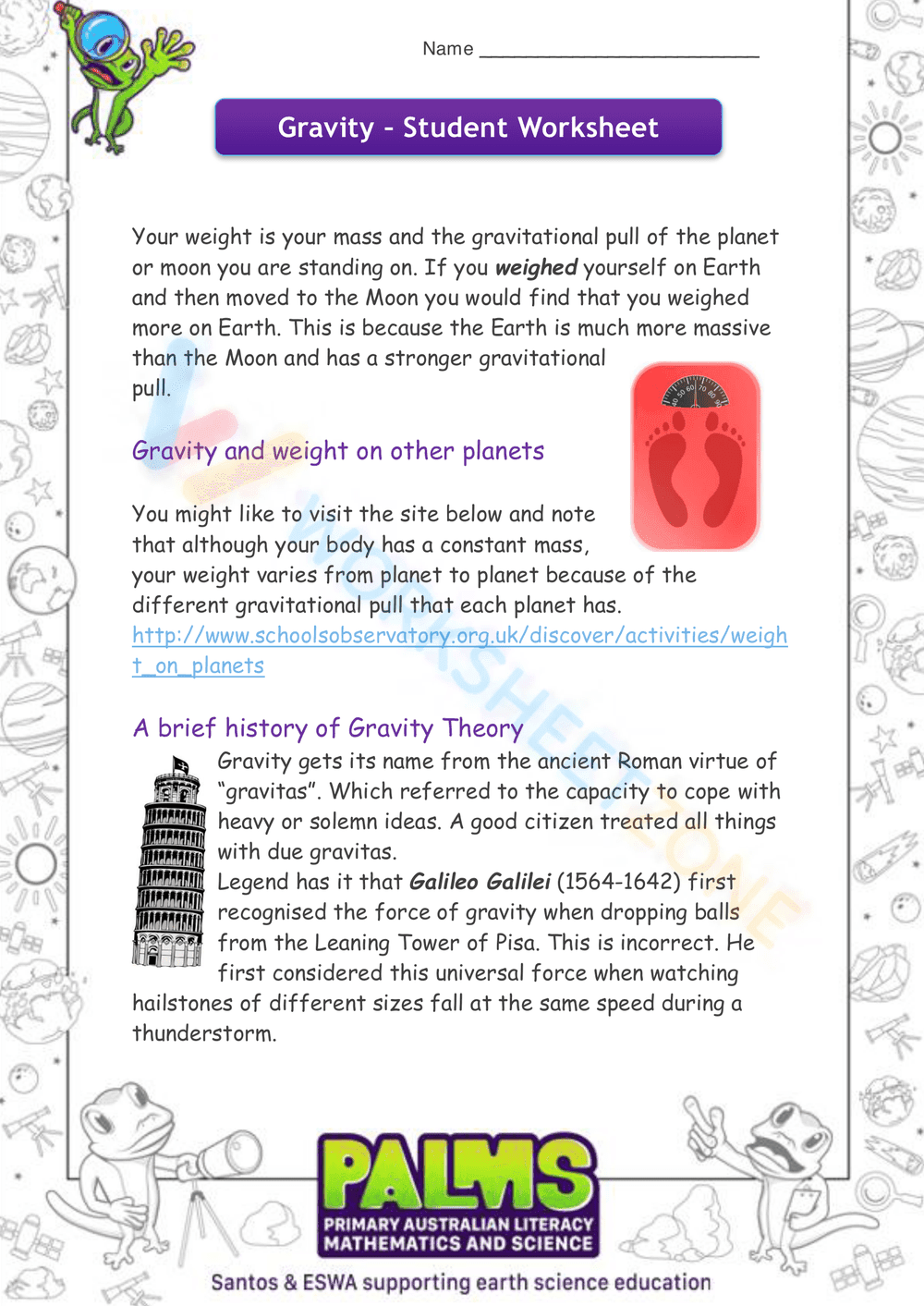


Gravity and Orbits Worksheet | Grade 6 Science Printable
Paste this activity's link or code into your existing LMS (Google Classroom, Canvas, Teams, Schoology, Moodle, etc.).
Students can open and work on the activity right away, with no student login required.
You'll still be able to track student progress and results from your teacher account.
This Grade 6 science worksheet helps students understand the fundamental principles of gravity and its role in the universe. By reading historical context and observing a teacher-led demonstration, students will analyze how mass affects gravitational pull and orbital motion, connecting theoretical physics to observable phenomena.
At a Glance
- Grade: 6 · Subject: Science
- Standard:
MS-ESS1-2— Describe the role of gravity in motions within the solar system- Skill Focus: Gravity and orbital motion
- Format: 4 pages · 4 problems · PDF
- Best For: Interactive science lessons
- Time: 30–45 minutes
Inside this four-page resource, educators will find a comprehensive reading guide paired with an interactive teacher demonstration. The text covers the formation of the solar system, the difference between mass and weight, and the historical theories of Galileo, Newton, and Einstein. The final pages feature a hands-on space-time continuum model using simple classroom materials, followed by four targeted observation questions that require students to synthesize what they have learned.
This resource follows a clear gradual-release approach to build student comprehension:
- Guided practice: Students begin by reading foundational text about gravity's role in the universe, answering an initial comprehension question to anchor their understanding.
- Supported practice: The class participates in a teacher-led demonstration modeling the space-time continuum, observing how a heavy object influences the path of a smaller marble.
- Independent practice: Students complete three analytical questions based on the demonstration, describing the orbit and the effects of mass and velocity on the system.
This structured progression ensures students move from basic recall to complex application of physics concepts.
This material is aligned to MS-ESS1-2, requiring students to develop and use a model to describe the role of gravity in the motions within galaxies and the solar system. It also touches upon foundational physical science concepts regarding forces and interactions. Both standard codes can be copied directly into lesson plans, IEP goals, or district curriculum mapping tools.
This worksheet is highly effective when used during direct instruction to introduce the concept of planetary orbits. Teachers can read the historical background together as a class, then transition into the physical demonstration using a bucket, plastic sheet, and marbles. As a formative assessment, teachers can observe students' written responses to the final three questions to gauge their understanding of how mass dictates gravitational pull. Expect the reading and demonstration to take approximately 30 to 45 minutes to complete.
This resource is designed for middle school science students, particularly those in sixth grade studying Earth and space systems. The combination of reading passages and a visual, hands-on model provides excellent differentiation for visual and kinesthetic learners. It pairs perfectly with a broader unit on the solar system or an anchor chart detailing the differences between mass and weight.
Integrating physical models into abstract astrophysics lessons significantly improves student comprehension and retention. According to a ScienceDirect TpT Analysis, instructional materials that combine historical context with hands-on demonstrations increase student engagement in middle school science classrooms. This resource directly supports MS-ESS1-2 by helping students describe the role of gravity in motions within the solar system. By observing a physical model of the space-time continuum, learners can visualize how massive objects influence the trajectory of smaller bodies. This concrete representation bridges the gap between theoretical physics and observable reality, ensuring that complex concepts like orbital mechanics become accessible. Utilizing structured observation questions alongside these models encourages critical thinking and allows educators to accurately measure student mastery of foundational physical science standards.


