


























Views
Downloads
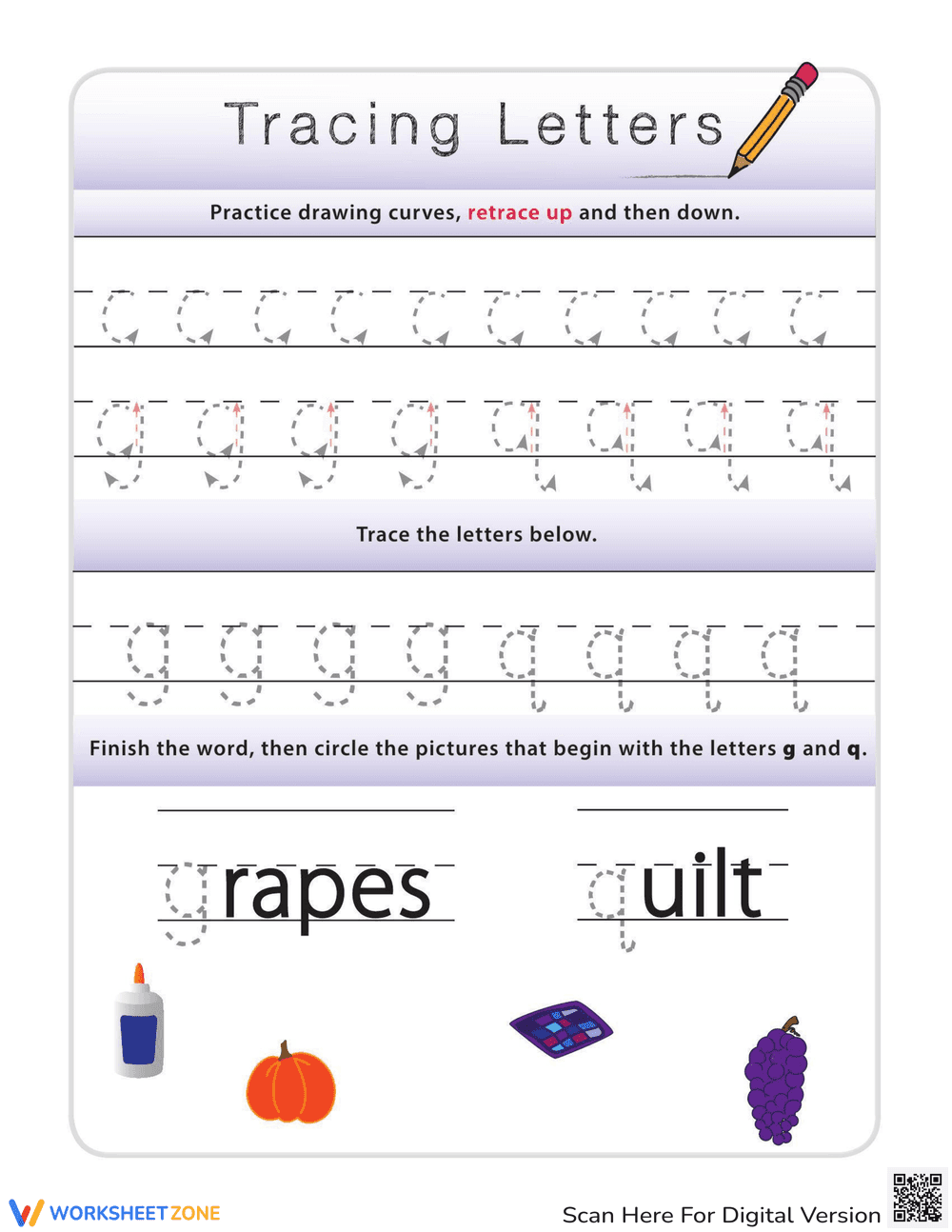

Letter G & Q Tracing Printable | Grade 1 Handwriting
Paste this activity's link or code into your existing LMS (Google Classroom, Canvas, Teams, Schoology, Moodle, etc.).
Students can open and work on the activity right away, with no student login required.
You'll still be able to track student progress and results from your teacher account.
This Grade 1 handwriting worksheet builds cursive letter formation for lowercase g and q through guided tracing lines and picture-matching cues, giving early writers a structured path from letter recognition to muscle memory in a single print-ready page.
At a Glance
- Grade: 1–2 · Subject: Handwriting / ELA
- Standard:
CCSS.ELA-LITERACY.L.1.1— Print all upper- and lowercase letters with correct formation- Skill Focus: Lowercase cursive letter tracing — g and q
- Format: 1 page · 2 letter tasks · Picture-matching cues · PDF
- Best For: Handwriting centers, morning warm-up
- Time: 10–15 minutes
Inside: two tracing sections, one per letter. Each section pairs a real-world image (grapes for g, quilt for q) with dotted cursive guidelines. Students trace multiple repetitions of each letter along the guide path, reinforcing correct stroke direction and letter shape. No word bank or sentence frames — format stays clean and distraction-free for early writers.
- Guided practice: Traced starter strokes with directional arrows show exact pencil path for each letter — students follow the model before attempting independent lines.
- Supported practice: Dotted guidelines continue across the row; picture anchor beside each letter keeps the sound-symbol link active during tracing.
- Independent practice: Final row on each letter section removes the dotted overlay, prompting students to form the letter from memory using only the baseline.
This gradual-release structure mirrors the I Do / We Do / You Do model: teacher models formation, students trace with support, then produce the letter independently — all within one compact page.
CCSS.ELA-LITERACY.L.1.1 requires students to print all upper- and lowercase letters with correct formation. This worksheet targets the lowercase cursive variants of g and q, two letters with descending strokes that early writers frequently reverse or misform. Supporting standard CCSS.ELA-LITERACY.RF.1.3 is addressed incidentally through the picture-to-letter matching cues that reinforce phoneme-grapheme correspondence. Both standard codes can be copied directly into lesson plans, IEP goals, or district curriculum mapping tools.
Use before direct instruction as a diagnostic: observe which students struggle with the descending loop on g or the tail stroke on q before modeling. Use after instruction as a quick formative check — collect pages and scan the final independent row for correct baseline placement and closed loops. Expected completion time: 10–15 minutes for most Grade 1 students; allow up to 20 minutes for students still developing pencil grip.
Primary audience: Grade 1 and Grade 2 students in early handwriting instruction, including those receiving occupational therapy support for fine motor development. Pairs naturally with a lowercase cursive alphabet anchor chart posted at eye level during seat work. Students who finish early can be prompted to write a word using each letter on the back of the sheet.
Research supports explicit, repeated letter-tracing practice as a foundation for writing fluency. Fisher & Frey (2014) identify structured guided practice with gradual release as essential for skill automaticity in early literacy. Worksheet targets CCSS.ELA-LITERACY.L.1.1 — correct formation of all lowercase letters — focusing on g and q, two high-confusion descender letters. Picture anchors (grapes, quilt) activate phoneme-grapheme mapping alongside motor practice. NAEP data consistently show that students with strong early handwriting automaticity allocate more cognitive resources to composition in later grades, making foundational tracing work a high-leverage investment in Grade 1 writing development.


