


























Views
Downloads


Essential Reflexive Pronouns Worksheet | Grade 2-5 English
Paste this activity's link or code into your existing LMS (Google Classroom, Canvas, Teams, Schoology, Moodle, etc.).
Students can open and work on the activity right away, with no student login required.
You'll still be able to track student progress and results from your teacher account.
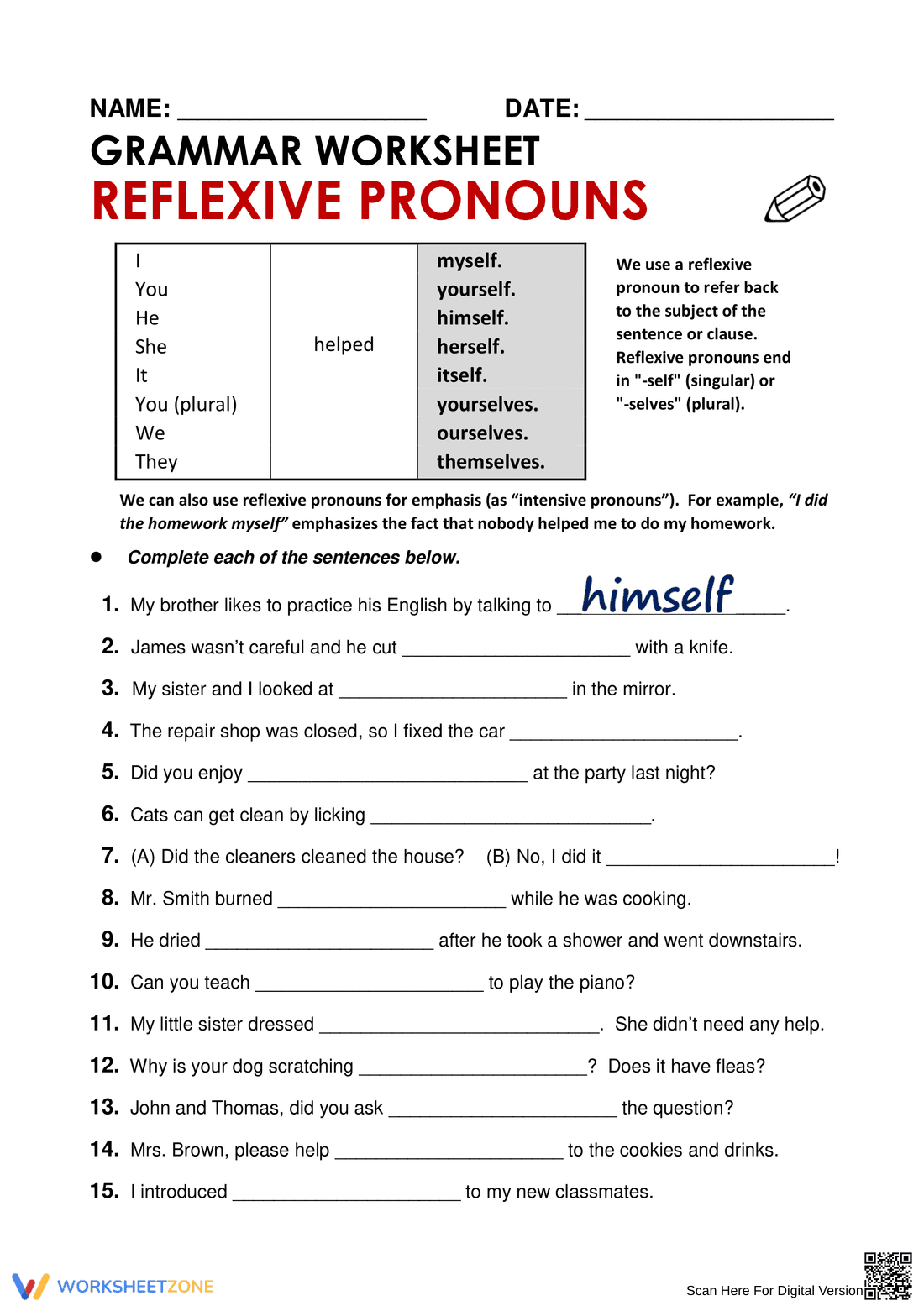
This essential reflexive pronouns worksheet provides elementary students with targeted grammar practice to master the use of "self" and "selves" suffixes. By completing contextual sentences, learners develop the ability to correctly refer back to the subject of a sentence, ensuring clear and grammatically accurate communication in both writing and speaking.
At a Glance
- Grade: 2–5 · Subject: English Language Arts
- Standard:
CCSS.ELA-LITERACY.L.2.1.C— Use reflexive pronouns such as myself, ourselves, and themselves correctly in sentences- Skill Focus: Reflexive and Intensive Pronouns
- Format: 1 page · 15 problems · Answer key included · PDF
- Best For: Independent practice or quick morning work
- Time: 15–20 minutes
The worksheet features a comprehensive reference header that maps personal pronouns to their reflexive counterparts, including both singular and plural forms. Below the instructional guide, students encounter 15 fill-in-the-blank sentences designed to test their understanding of subject-pronoun agreement. The single-page layout is clean and distraction-free, making it an ideal resource for quick assessment or reinforcement.
This resource is designed for a frictionless classroom experience. First, print the single-page PDF in under 30 seconds. Second, distribute the copies; the reference chart allows students to start immediately without a teacher introduction. Third, review the answers using the included key in less than two minutes. The self-explanatory tasks make it a reliable choice for emergency sub plans.
Aligned to CCSS.ELA-LITERACY.L.2.1.C: "Use reflexive pronouns." The worksheet also supports L.4.1 grammar standards by introducing intensive pronoun usage for emphasis. Both standard codes can be copied directly into lesson plans, IEP goals, or district curriculum mapping tools.
Use this worksheet during the "Independent Practice" phase of a grammar lesson after introducing the concept of reflexive pronouns. It also serves as an effective formative assessment tool; observe if students struggle with the plural "selves" forms to identify who needs additional small-group support. Most students will complete the 15 tasks within a 15-minute window.
Designed for general education students in grades 2 through 5, this resource is particularly helpful for English Language Learners (ELLs) who often struggle with pronoun-antecedent agreement. The provided reference chart acts as a scaffold for students with IEPs, while the intensive pronoun examples provide a challenge for advanced learners. Pair this with a short reading passage to find reflexive pronouns in the wild.
Grammar instruction is most effective when skills like CCSS.ELA-LITERACY.L.2.1.C are practiced within structured, contextualized sentence frames. This worksheet focuses on reflexive pronouns, requiring students to identify the subject and select the appropriate pronoun ending in "-self" or "-selves." According to Fisher & Frey (2014), the gradual release of responsibility is supported by providing clear models—like the header table included here—before moving to independent application. By completing 15 distinct tasks, students build the repetition necessary for linguistic internalization. Research from the NAEP indicates that strong foundational grammar skills are direct predictors of future writing proficiency. This resource provides the precise, low-stakes practice needed to move students toward mastery without overwhelming them with complex terminology. It serves as a reliable, research-backed bridge between direct instruction and creative writing, ensuring that students can accurately employ reflexive and intensive pronouns in various academic contexts.


