


























Views
Downloads


Grade 2-3 Grammar & Nouns — Essential Printable Worksheet
Paste this activity's link or code into your existing LMS (Google Classroom, Canvas, Teams, Schoology, Moodle, etc.).
Students can open and work on the activity right away, with no student login required.
You'll still be able to track student progress and results from your teacher account.
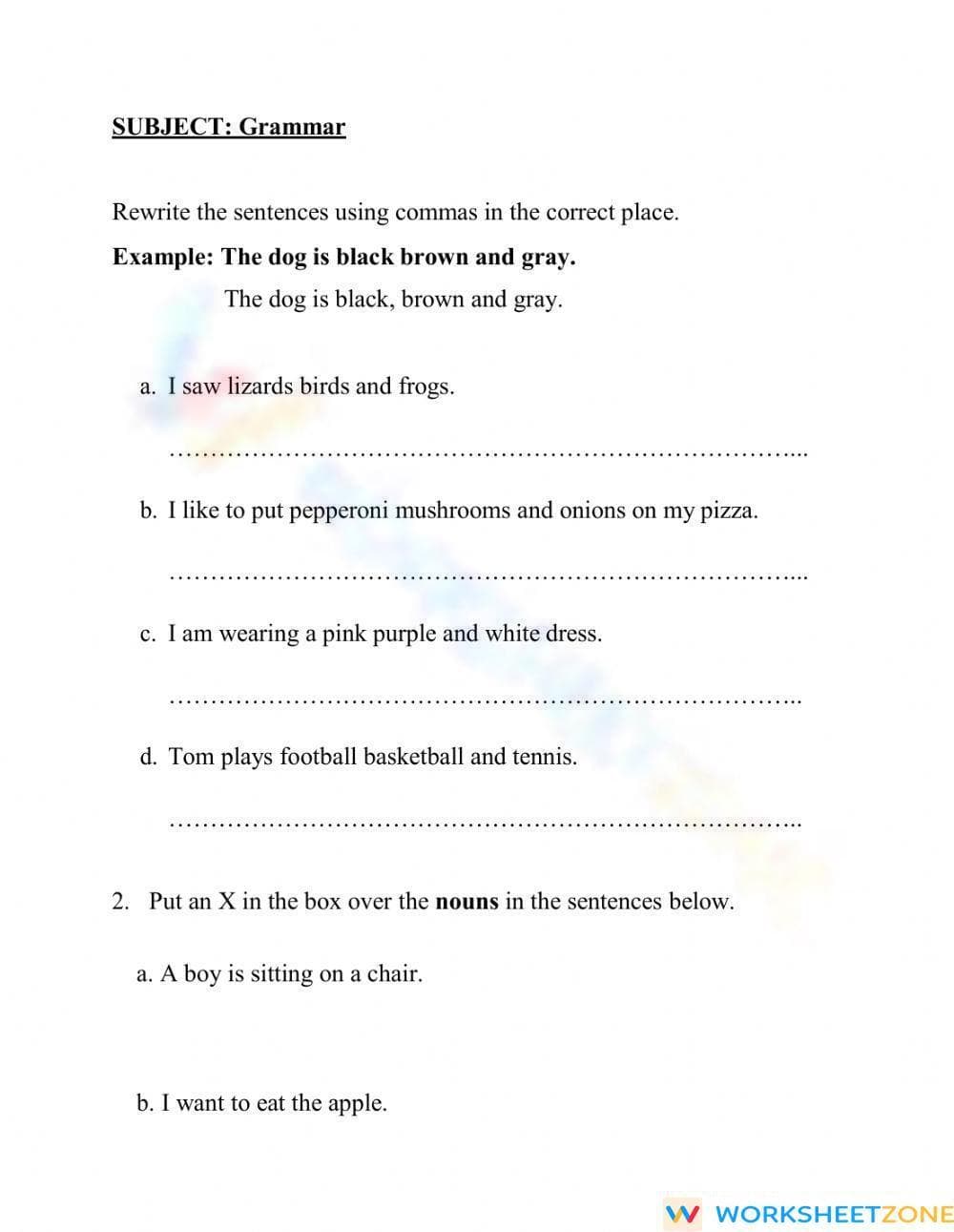
This Grade 2-3 grammar worksheet provides structured practice for students to master comma placement in a series, noun identification, and singular/plural noun agreement. By rewriting sentences and selecting correct word forms, learners build the mechanical precision necessary for clear writing. This resource ensures that foundational grammar rules are reinforced through direct application and repetitive practice, helping students gain confidence in their daily writing tasks.
At a Glance
- Grade: 2-3 · Subject: ELA Grammar
- Standard:
CCSS.ELA-LITERACY.L.2.2— Use punctuation to demonstrate command of standard English capitalization and mechanics- Skill Focus: Commas, Nouns, and Plurals
- Format: 2 pages · 12 problems · Answer key included · PDF
- Best For: Independent practice or morning bell work
- Time: 15–20 minutes
What's Inside
This two-page worksheet contains three distinct sections designed for comprehensive skill building. The first section asks students to rewrite four sentences by inserting commas in a series. The second section requires learners to identify and mark nouns within four specific sentences. Finally, the third section provides four multiple-choice tasks where students circle the correct singular or plural noun to complete a sentence. A comprehensive answer key is included for rapid grading and student self-correction.
Zero-Prep Workflow
This resource is designed for immediate classroom implementation with minimal teacher effort. First, print the two-page PDF for your class, which takes less than 30 seconds. Next, distribute the sheets to students; the self-explanatory instructions require zero teacher setup or complex explanation. Finally, review the completed tasks using the included answer key to identify common misconceptions or areas for review. The total teacher preparation time for this activity is under two minutes, making it ideal for sub plans.
Standards Alignment
The primary focus of this activity is CCSS.ELA-LITERACY.L.2.2, which requires students to demonstrate command of the conventions of standard English punctuation. Specifically, it addresses the use of commas in a series. Additionally, the worksheet supports CCSS.ELA-LITERACY.L.2.1.B by requiring students to form and use plural nouns correctly. Both standard codes can be copied directly into lesson plans, IEP goals, or district curriculum mapping tools to ensure instructional alignment.
How to Use It
Assign this worksheet as a formative assessment after a direct instruction lesson on parts of speech or punctuation. It also serves as an excellent morning work activity or exit ticket to gauge student understanding of noun plurals. Teachers should observe whether students can identify the "and" conjunction as a cue for comma placement. Most students will complete the 12 tasks within 15 to 20 minutes, allowing for a quick check for understanding during the instructional block.
Who It's For
This resource is specifically tailored for Grade 2 and Grade 3 students who are developing their writing mechanics and grammatical awareness. It provides scaffolding for English Language Learners (ELL) through the inclusion of clear sentence-level context clues. This worksheet pairs naturally with a mentor text or an anchor chart that visualizes the difference between singular and plural noun endings. Integrating punctuation mechanics with grammatical part-of-speech identification is critical for developing syntactic fluency in early elementary writers, and this worksheet addresses this need by combining comma usage with noun categorization and pluralization in a single, cohesive unit. The structured tasks provide necessary practice for students to achieve mastery in identifying nouns and applying punctuation rules within varied sentence structures.


