


























Views
Downloads


Grade 6 Vocabulary Practice | Essential ELA Worksheet
Paste this activity's link or code into your existing LMS (Google Classroom, Canvas, Teams, Schoology, Moodle, etc.).
Students can open and work on the activity right away, with no student login required.
You'll still be able to track student progress and results from your teacher account.
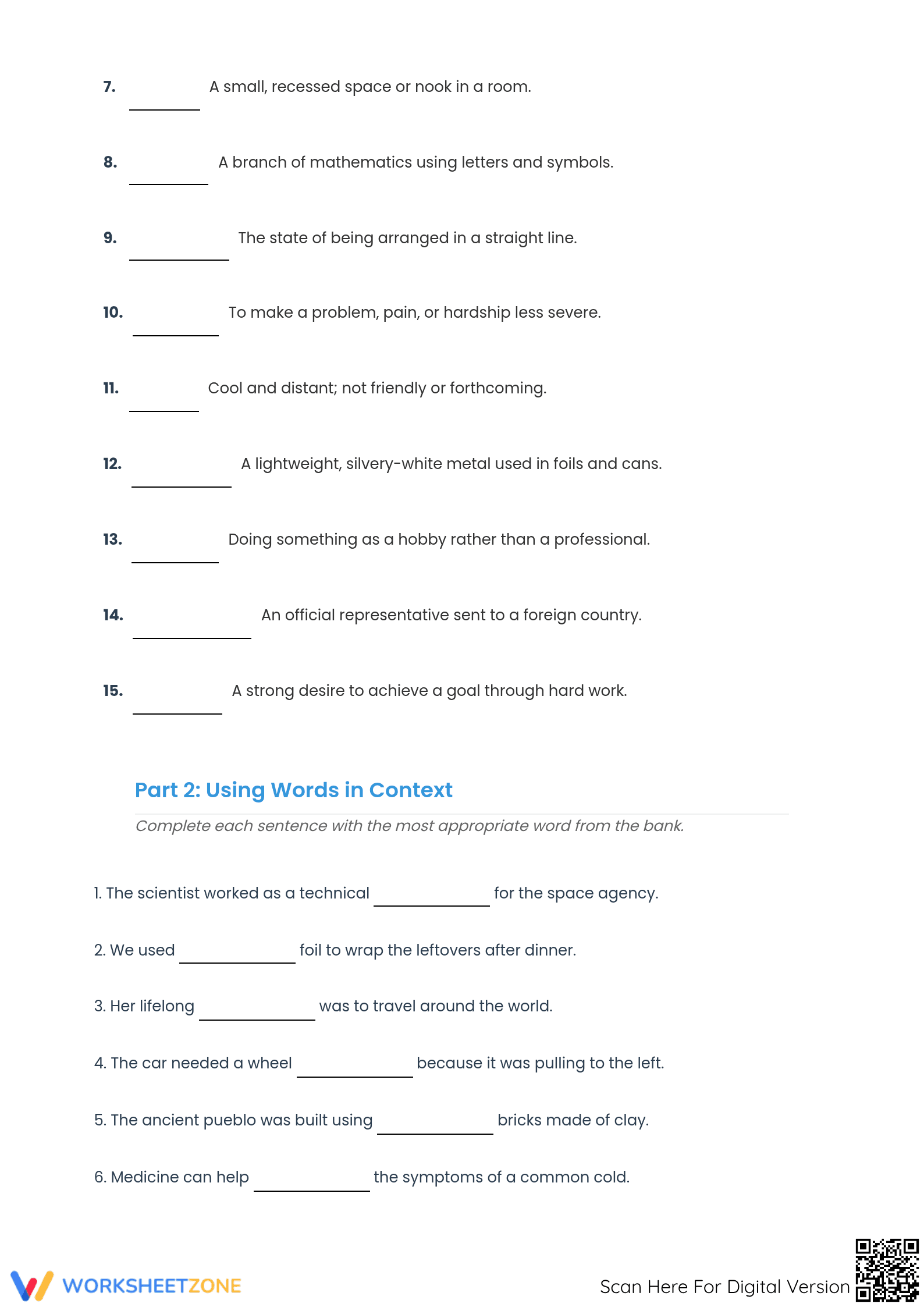
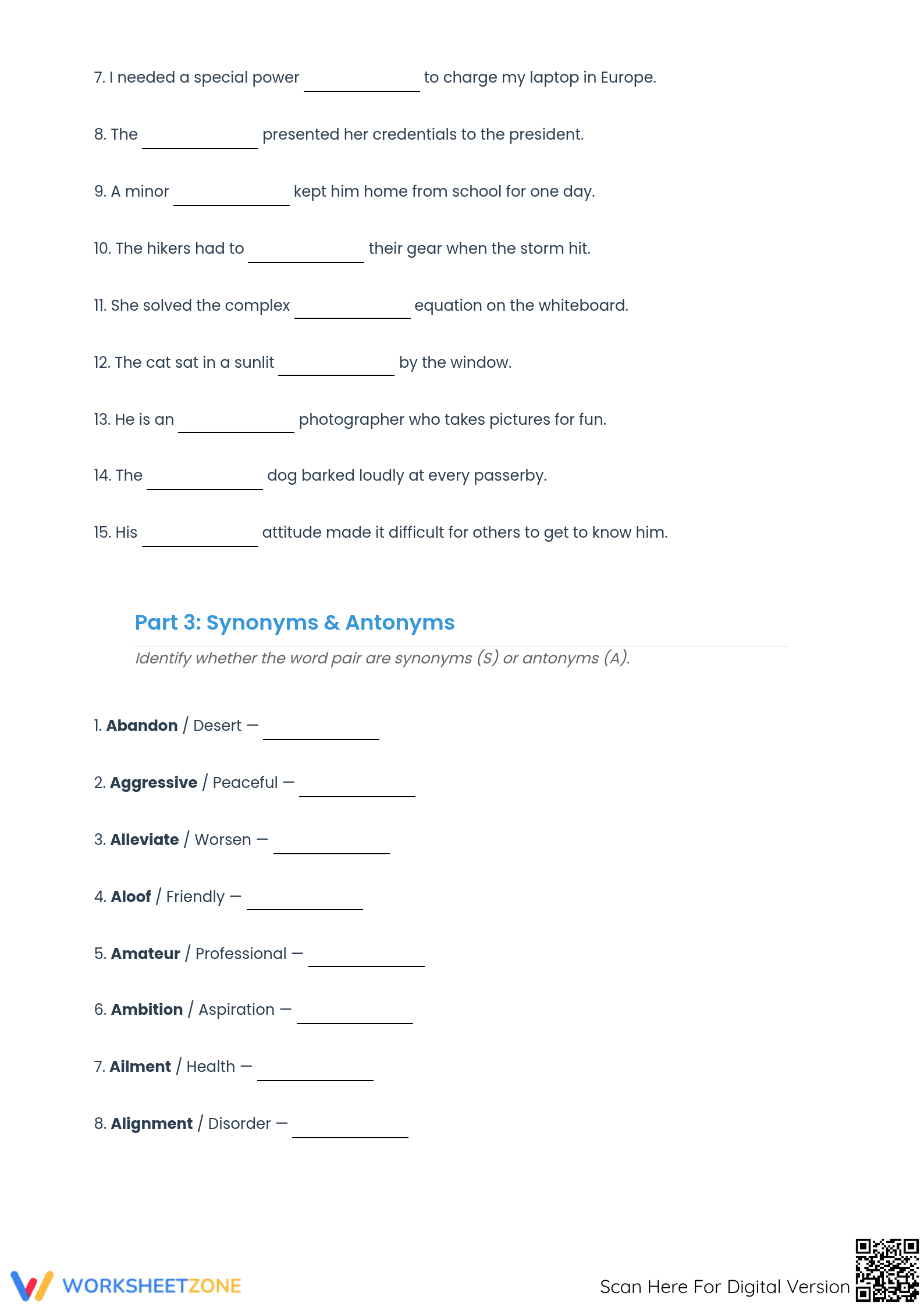
This Grade 6 vocabulary worksheet provides a comprehensive framework for students to acquire and apply 15 high-frequency academic words. By engaging with definitions, contextual application, and word relationships, learners build the linguistic precision necessary for middle school reading and writing success. It transforms abstract word lists into functional knowledge through varied practice.
At a Glance
- Grade: 6 · Subject: ELA
- Standard:
CCSS.ELA-LITERACY.L.6.6— Acquire and use accurately grade-appropriate general academic and domain-specific words- Skill Focus: Academic Vocabulary Mastery
- Format: 3 pages · 38 problems · Answer key included · PDF
- Best For: Weekly vocabulary routines and literacy centers
- Time: 30–45 minutes
The resource contains three distinct sections across three printable pages. It begins with a clear word bank featuring 15 terms ranging from "alleviate" to "ambassador." Students navigate through 15 definition-matching exercises, 15 sentence-completion tasks, and 8 synonym/antonym identification problems. A full answer key is provided for rapid grading or student self-correction.
Skill Progression
- Guided Practice: Students match 15 target words to their dictionary definitions, establishing a foundational understanding with the support of a provided word bank.
- Supported Practice: Learners apply their knowledge by completing 15 sentences, using context clues to determine which academic term fits the specific scenario.
- Independent Practice: The final 8 tasks challenge students to identify synonyms and antonyms, requiring a deeper relational understanding of the word list.
This structure follows a gradual-release model, moving from simple recognition to complex application and analysis.
Standards Alignment
This resource is primarily aligned with `CCSS.ELA-LITERACY.L.6.6`, focusing on the acquisition of general academic words. It also supports `CCSS.ELA-LITERACY.L.6.4.C` by requiring students to consult reference materials to determine precise meanings. Both standard codes can be copied directly into lesson plans, IEP goals, or district curriculum mapping tools.
How to Use It
Use this worksheet as a mid-week formative assessment after introducing the word list on Monday. During the "Using Words in Context" section, walk around to observe if students are using context clues or simply guessing. The 38 tasks typically require 35 minutes for completion, making it an ideal anchor activity for literacy rotations.
Who It's For
This is designed for general education sixth graders, but the clear word bank and structured definitions make it an excellent scaffold for English Language Learners (ELLs) or students with IEPs. It pairs naturally with a weekly reading passage or a Greek and Latin roots anchor chart.
Research from Fisher & Frey (2014) emphasizes that vocabulary instruction must move beyond simple memorization toward generative word knowledge. This Grade 6 resource addresses this by requiring students to interact with 15 target words across three cognitive domains: recognition, application, and relational analysis. By providing 38 distinct opportunities for engagement, the worksheet aligns with the "distributed practice" model, which has been shown to increase long-term retention of academic language compared to isolated drill-and-kill methods. The inclusion of CCSS.ELA-LITERACY.L.6.6 ensures that the selected words, such as "alignment" and "alleviate," are high-utility terms that appear frequently in complex middle-school texts. Educators can use this tool to provide the multiple exposures necessary for students to move words from receptive to productive vocabularies, a critical component of closing the literacy achievement gap in diverse classroom settings.


