




























Views
Downloads

Grade 6 Connotation Worksheet | Essential ELA Practice

Paste this activity's link or code into your existing LMS (Google Classroom, Canvas, Teams, Schoology, Moodle, etc.).
Students can open and work on the activity right away, with no student login required.
You'll still be able to track student progress and results from your teacher account.
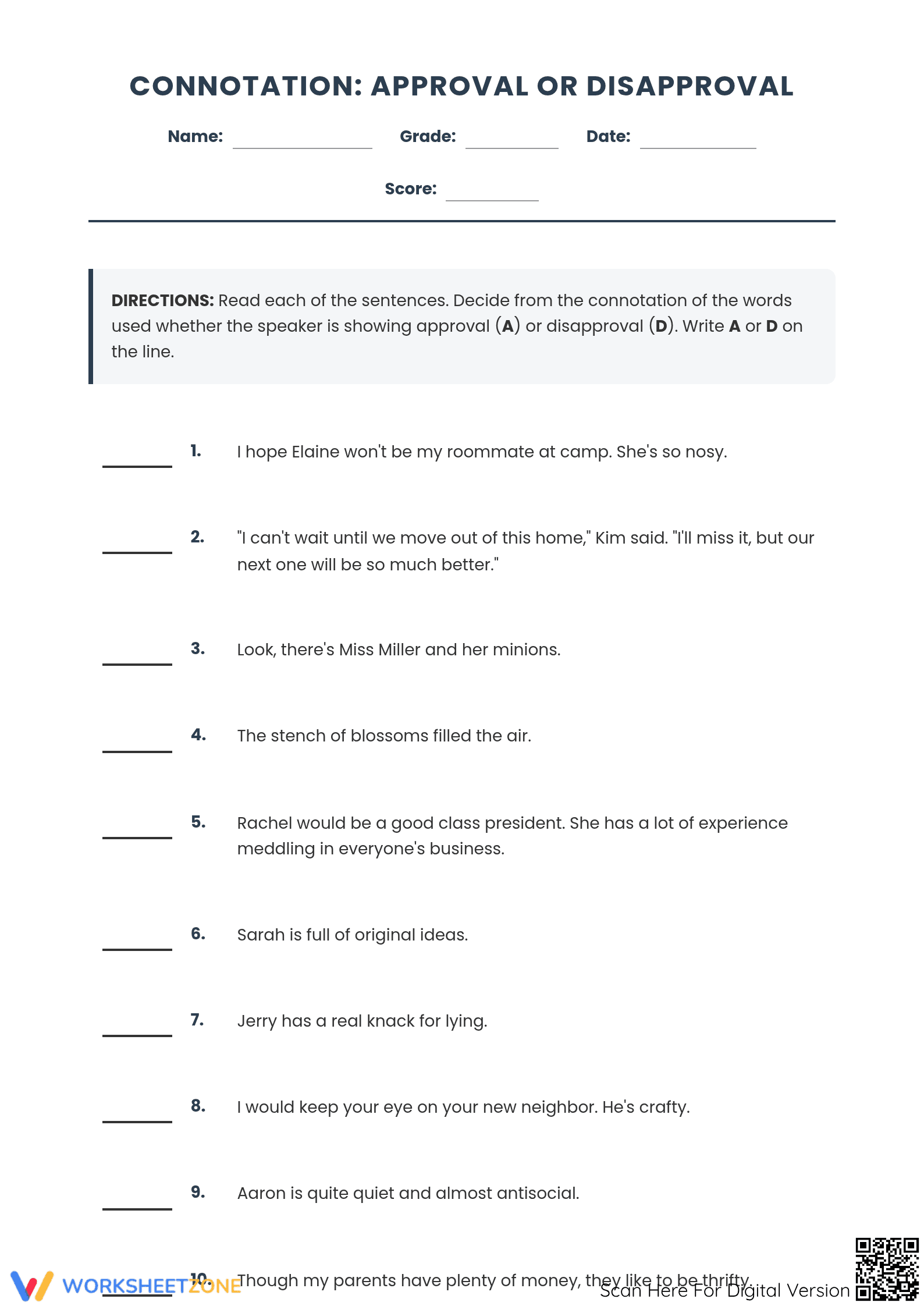
This Grade 6 ELA worksheet helps students master the nuances of word choice by identifying positive and negative connotations. By analyzing 10 specific sentences, learners determine if the speaker expresses approval or disapproval through their vocabulary. This exercise builds critical reading skills and improves student writing by highlighting how specific words influence tone and meaning.
At a Glance
- Grade: 6 · Subject: English Language Arts
- Standard:
CCSS.ELA-LITERACY.L.6.5.C— Distinguish among the connotations of words with similar denotations to understand meaning.- Skill Focus: Connotation and Tone Analysis
- Format: 1 page · 10 problems · Answer key included · PDF
- Best For: Quick formative assessment or bell-ringer activity
- Time: 10–15 minutes
This single-page PDF features 10 carefully crafted sentences that utilize words with strong emotional charges, such as "nosy," "minions," and "thrifty." Students are tasked with reading each sentence and writing "A" for approval or "D" for disapproval on the provided lines. The layout is clean and distraction-free, including a dedicated header for student names, dates, and scores. A full answer key is provided for rapid grading.
Zero-Prep Workflow
- Print: Generate the single-page PDF in under 30 seconds.
- Distribute: Hand out the sheets as a warm-up or exit ticket (1 minute).
- Review: Use the included answer key to review responses as a whole class or for individual grading (under 2 minutes).
This streamlined process makes it an ideal choice for emergency sub plans or busy instructional blocks where teacher prep time is limited.
Standards Alignment
This resource is directly aligned with `CCSS.ELA-LITERACY.L.6.5.C`, which requires students to distinguish among the connotations of words with similar denotations. By evaluating how words like "meddling" versus "involved" change a sentence's intent, students demonstrate a sophisticated understanding of language. This standard code can be copied directly into lesson plans, IEP goals, or district curriculum mapping tools.
How to Use It
Use this worksheet as a formative assessment after a direct instruction lesson on denotation and connotation. It works exceptionally well as a "silent starter" to settle the class while you take attendance. For a deeper dive, have students pair up after completion to discuss why specific words like "stench" or "crafty" imply disapproval. Expect students to complete the 10 items in approximately 12 minutes.
Who It's For
This worksheet is designed for Grade 6 students but is also appropriate for Grade 5 enrichment or Grade 7 review. It provides excellent support for English Language Learners (ELLs) who are working to understand the subtle emotional weight of English vocabulary. Pair this resource with a connotation anchor chart or a short literary passage to reinforce tone analysis in context.
According to the RAND AIRS 2024 report, explicit instruction in word nuances is a critical component of middle school literacy development. This worksheet addresses CCSS.ELA-LITERACY.L.6.5.C by challenging students to identify the "approval or disapproval" inherent in specific word choices. Research by Fisher & Frey (2014) suggests that brief, focused practice sessions on vocabulary connotation significantly improve a student's ability to interpret authorial intent and tone. By engaging with these 10 targeted problems, Grade 6 learners move beyond literal definitions to recognize the emotional impact of language. This resource provides the structured repetition necessary for students to internalize how synonyms can carry vastly different social meanings. The inclusion of an answer key ensures that feedback is immediate, a practice shown to enhance retention in language arts instruction.


