




























Views
Downloads
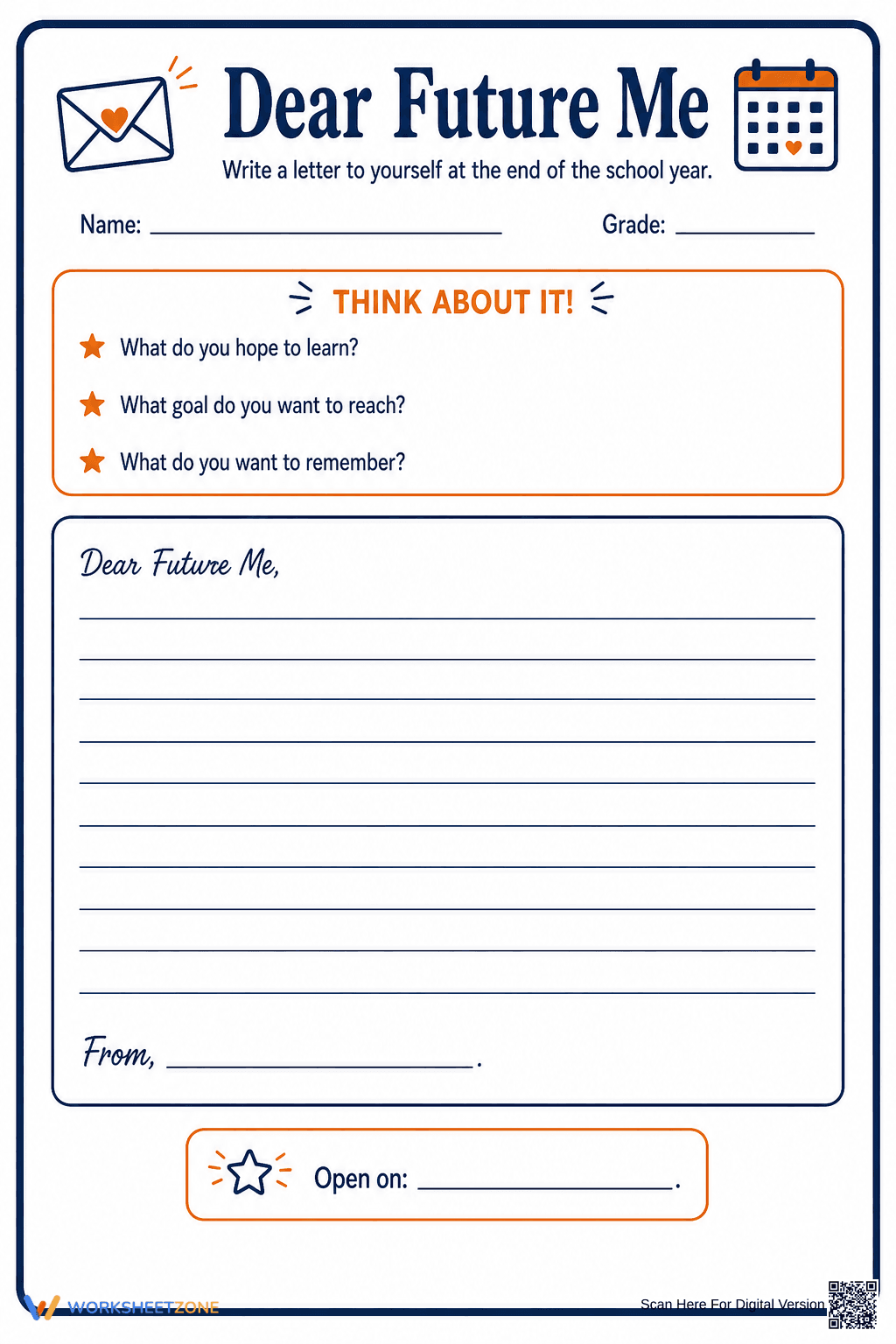

Grade 5 Future Me Letter — Printable No-Prep Worksheet

Paste this activity's link or code into your existing LMS (Google Classroom, Canvas, Teams, Schoology, Moodle, etc.).
Students can open and work on the activity right away, with no student login required.
You'll still be able to track student progress and results from your teacher account.
This reflective letter-writing worksheet prompts students to articulate their academic and personal goals for the upcoming school year. By writing a letter to their future selves, learners practice organizing their thoughts, setting measurable objectives, and producing clear, coherent writing tailored to a specific purpose and audience.
At a Glance
- Grade: 5 · Subject: ELA
- Standard:
CCSS.ELA-LITERACY.W.5.4— Produce clear writing appropriate to task and purpose- Skill Focus: Reflective writing and goal setting
- Format: 1 page · 1 writing task · Open-ended · PDF
- Best For: Back-to-school goal setting
- Time: 20–30 minutes
This single-page resource features a clean, engaging layout designed to guide student reflection. It includes a "Think About It!" brainstorming box with three specific guiding questions focused on learning hopes, goal achievement, and memory preservation. Below the prompts, students will find a structured letter format with elegant writing lines, a formal salutation, a closing, and a designated space to record the future opening date.
- Print (1 minute): Simply download the PDF and print a class set. The black-and-white friendly design with minimal color accents ensures crisp copies.
- Distribute (1 minute): Hand out the worksheet during a morning meeting, advisory period, or dedicated writing block. No additional materials or teacher setup are required.
- Review (15 minutes): Allow students time to read the guiding questions and draft their letters independently. Total teacher prep time is under two minutes, making this an excellent option for a quick sub plan or first-week activity.
This activity aligns with CCSS.ELA-LITERACY.W.5.4: Produce clear and coherent writing in which the development and organization are appropriate to task, purpose, and audience. It also supports broader social-emotional learning objectives related to self-awareness and self-management. Both standard codes can be copied directly into lesson plans, IEP goals, or district curriculum mapping tools.
Use this worksheet as a back-to-school activity before beginning heavy academic content, allowing students to establish a baseline for their aspirations. Alternatively, assign it at the start of a new semester or grading period to reset expectations. As students write, circulate the room to observe their sentence structure and ability to address the specific prompts—a quick formative assessment of their baseline writing skills. Expected completion time is 20 to 30 minutes.
This resource is primarily designed for fifth-grade students, though the open-ended nature makes it highly adaptable for grades four through eight. For students needing differentiation, teachers can provide sentence starters or allow them to dictate their goals before writing. It pairs perfectly with a beginning-of-the-year anchor chart on growth mindset or a direct instruction lesson on setting SMART goals.
Aligning instruction with CCSS.ELA-LITERACY.W.5.4 to produce clear writing appropriate to task and purpose is critical for developing effective communicators. According to a recent EdReports 2024 analysis, integrating reflective writing tasks into the curriculum significantly boosts student engagement and ownership of learning outcomes. When students articulate their personal and academic goals through structured activities like a future-self letter, they build essential self-regulation skills alongside their foundational writing abilities. This practice not only reinforces organizational writing structures but also fosters a growth mindset by requiring learners to visualize their future success. By providing targeted prompts that guide this reflection, educators can effectively bridge the gap between social-emotional development and rigorous academic standards, ensuring students are prepared for both classroom challenges and real-world communication demands.


