


























Views
Downloads

Essential Grade 3 Time: Months and Seasons Worksheet
Paste this activity's link or code into your existing LMS (Google Classroom, Canvas, Teams, Schoology, Moodle, etc.).
Students can open and work on the activity right away, with no student login required.
You'll still be able to track student progress and results from your teacher account.
This Grade 3 math worksheet provides a comprehensive review of calendar time, focusing on months, days, and the four seasons. Students will develop a foundational understanding of temporal measurement by identifying monthly durations, seasonal transitions, and logical calendar patterns. It is an effective tool for reinforcing time-based numeracy and seasonal awareness in elementary classrooms.
At a Glance
- Grade: 3 · Subject: Mathematics
- Standard:
CCSS.MATH.CONTENT.3.MD.A.1— Measure time intervals and solve problems involving calendar logic and duration- Skill Focus: Calendar literacy and seasonal identification
- Format: 3 pages · 20 problems · Answer key included · PDF
- Best For: Classroom practice and homework reinforcement
- Time: 25–35 minutes
What's Inside
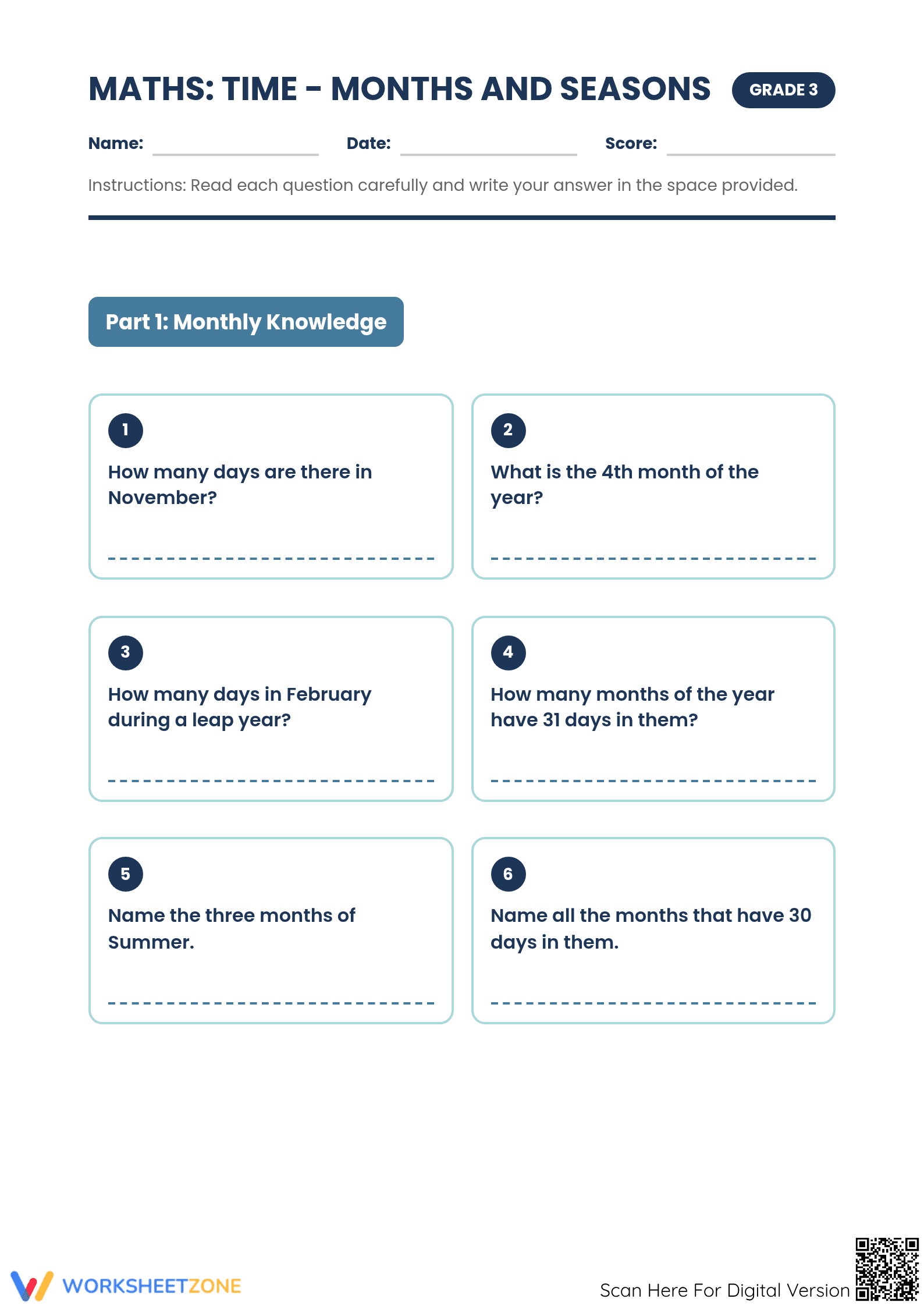
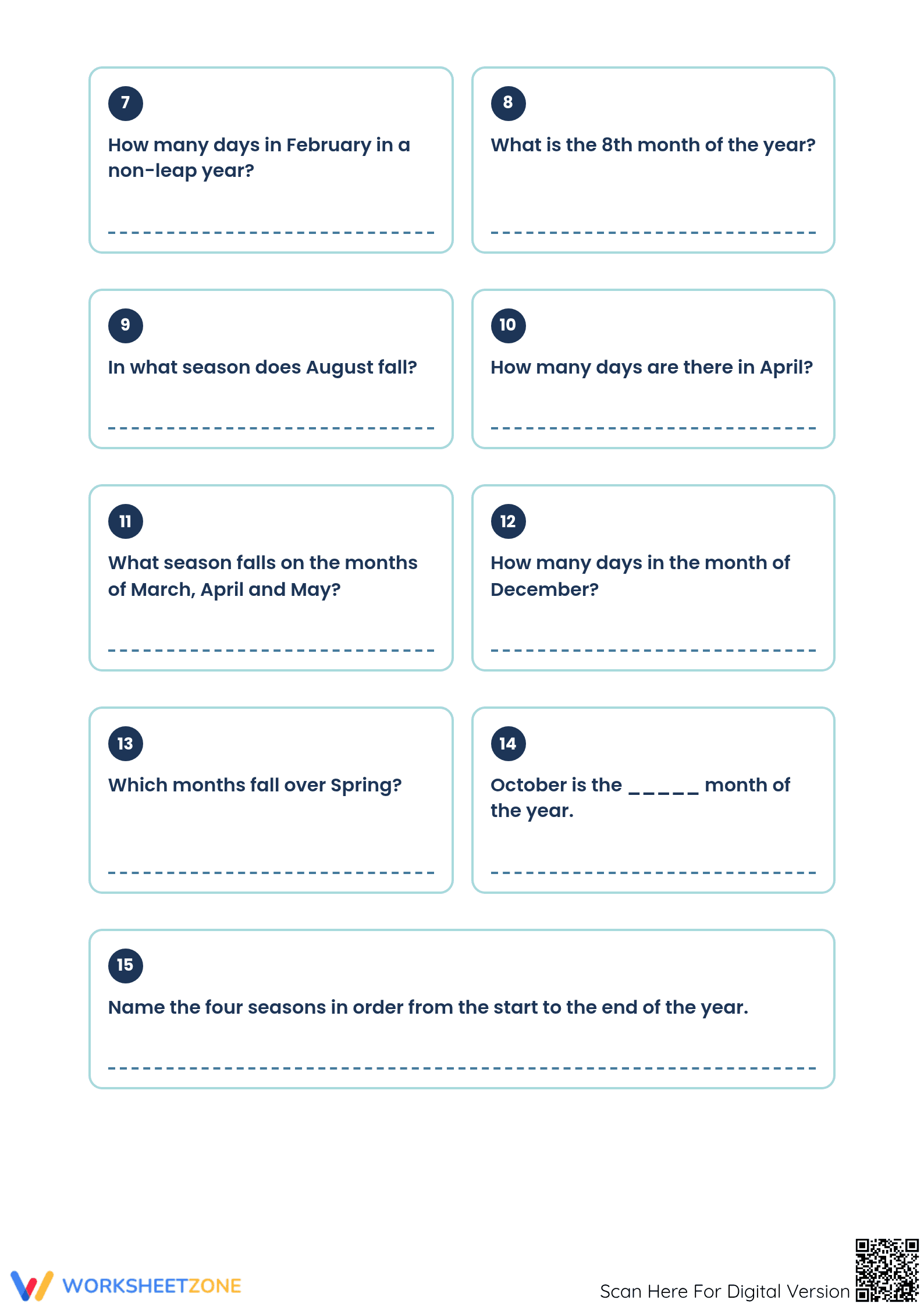
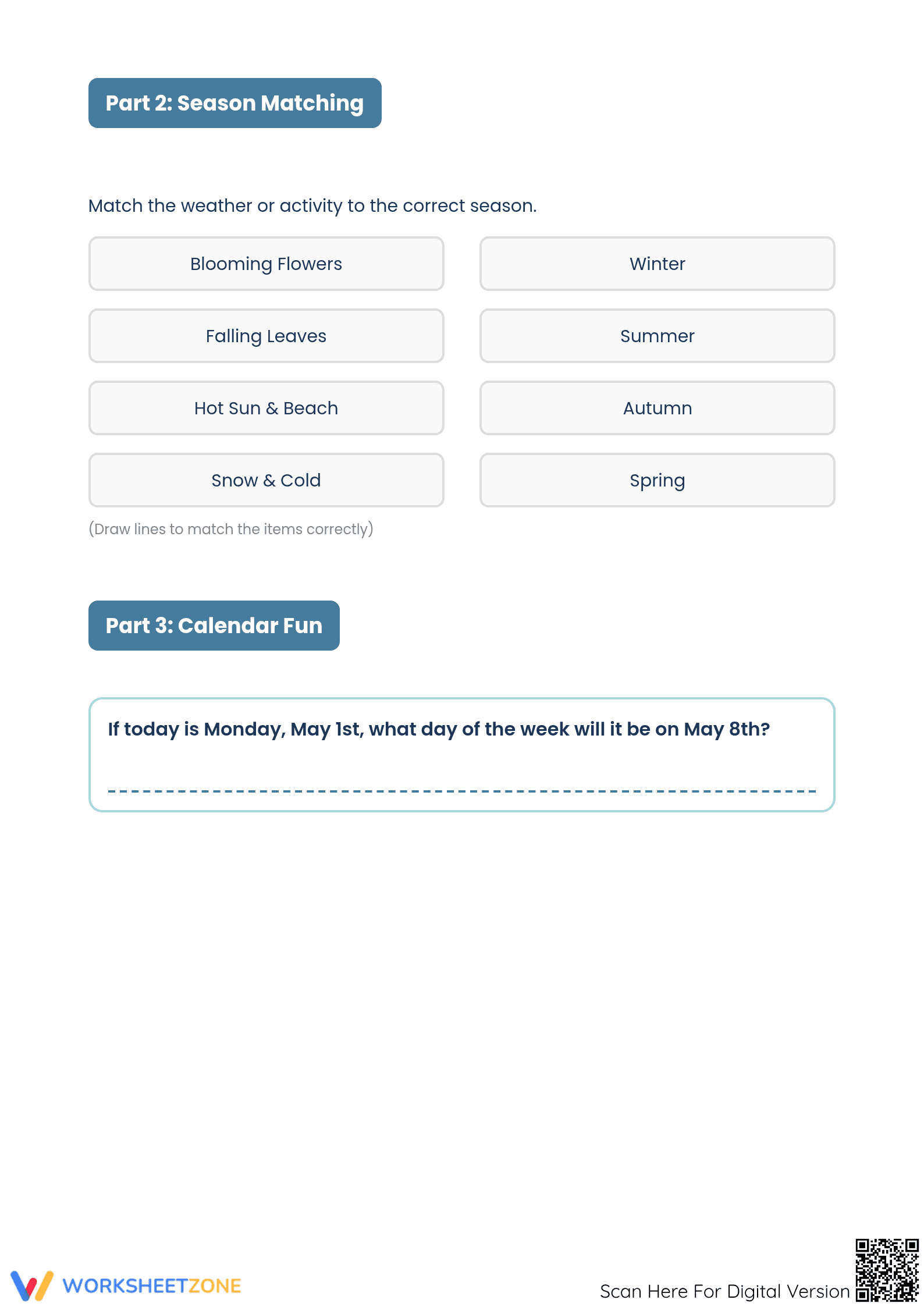
The resource contains three distinct pages. Part 1 features 15 short-answer questions investigating monthly data like day counts and sequential order. Part 2 offers a visual matching activity connecting weather patterns to specific seasons. Part 3 challenges students with a calendar logic problem requiring them to calculate future days of the week based on a given date.
Skill Progression
- Guided Knowledge: Students answer 15 targeted questions to recall specific facts about months, such as the duration of November and leap year adjustments.
- Conceptual Application: Matching tasks require students to link abstract seasonal names to concrete environmental changes like blooming flowers or falling leaves.
- Independent Reasoning: An open-ended calendar word problem tests higher-order thinking by requiring mental calculation of week-long time intervals.
This structured approach follows a gradual-release model, moving from factual recall to contextual application and final logical synthesis.
Standards Alignment
The primary focus is `CCSS.MATH.CONTENT.3.MD.A.1`, which requires students to solve word problems involving time intervals. This worksheet extends that logic to months and seasons, which are the macro-units of time measurement. A supporting standard is `2.MD.C.7`, ensuring students possess the prerequisite knowledge of temporal cycles. Both standard codes can be copied directly into lesson plans, IEP goals, or district curriculum mapping tools.
How to Use It
Use this as a formative assessment during your unit on measurement and data. Teachers should observe if students struggle specifically with the leap year question or the months with varying day counts, which indicates a need for mnemonic support. It also serves as an excellent independent center activity. Students typically complete all sections within 30 minutes depending on their prior knowledge.
Who It's For
This is designed for third-grade students mastering the Measurement and Data domain. It provides necessary scaffolding for students with IEP goals related to temporal orientation. The worksheet pairs naturally with a classroom wall calendar or a seasonal anchor chart to provide visual support during the independent practice phase of the lesson.
According to a ScienceDirect TpT Analysis (2024), targeted retrieval practice on temporal units significantly improves long-term retention of measurement concepts in elementary learners. By requiring students to recall specific day counts for months like February and November, the worksheet engages cognitive retrieval paths that solidify the abstract concept of a calendar year. This specific Grade 3 resource addresses the CCSS.MATH.CONTENT.3.MD.A.1 requirement for understanding time intervals by applying logic to months and seasons. Mastery of these macro-units is a prerequisite for successful complex time-solving tasks in later grades. Educators can utilize the structured 20-task format to identify specific knowledge gaps in seasonal cycles or leap year logic. The inclusion of calendar word problems ensures that students move beyond rote memorization into practical application. This evidence-based design aligns with current pedagogical standards for mathematical fluency and data interpretation in primary education settings.


