


























Views
Downloads
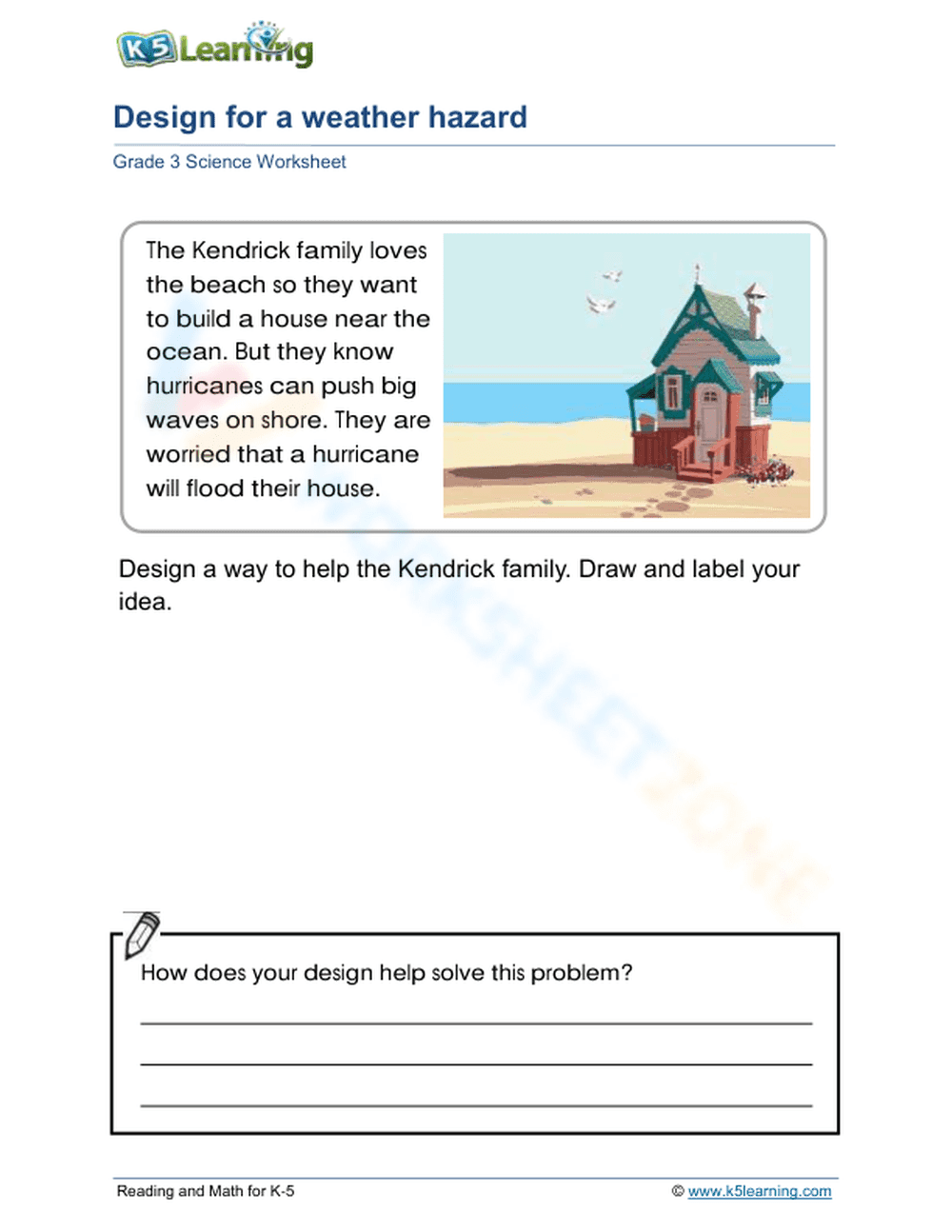

Grade 3 Weather Hazard Design — Essential Science Worksheet
Paste this activity's link or code into your existing LMS (Google Classroom, Canvas, Teams, Schoology, Moodle, etc.).
Students can open and work on the activity right away, with no student login required.
You'll still be able to track student progress and results from your teacher account.
Empower your third-grade students to think like engineers with this focused science worksheet. This activity requires students to evaluate a real-world scenario involving hurricane flooding and design a structural solution. By drawing, labeling, and justifying their ideas, learners demonstrate a deep understanding of how humans can reduce the impact of severe weather hazards.
At a Glance
- Grade: 3 · Subject: Science
- Standard:
3-ESS3-1— Make a claim about the merit of a design solution for weather hazards- Skill Focus: Weather Hazard Engineering
- Format: 1 page · 2 tasks · Answer key included · PDF
- Best For: Introduction to the engineering design cycle
- Time: 20–30 minutes
This single-page resource features a relatable case study about a family building a coastal home. The worksheet includes a dedicated space for students to sketch their engineering designs and add descriptive labels. A structured writing prompt follows the drawing task, asking students to explain the logic behind their solution and how it specifically addresses the threat of hurricane-driven waves and flooding.
The zero-prep workflow for this resource is designed for maximum teacher efficiency. First, print the single PDF page in under 15 seconds. Second, distribute the copies to students with no additional materials required beyond pencils and crayons for labeling. Finally, review the completed designs using the included answer key in about one minute. Total teacher preparation time is less than two minutes, making this an ideal choice for sub plans or quick formative checks.
This resource is strictly aligned to 3-ESS3-1: "Make a claim about the merit of a design solution that reduces the impacts of a weather-related hazard." It also supports the engineering standard 3-5-ETS1-1 by having students define a problem and propose a solution. Both standard codes can be copied directly into lesson plans, IEP goals, or district curriculum mapping tools.
Use this worksheet as a mid-lesson application activity after discussing different types of severe weather. It works exceptionally well as a formative assessment; as students draw, circulate the room to observe if they are incorporating specific features like stilts, sea walls, or drainage systems. Expected completion time is 25 minutes, providing enough depth for a meaningful science block while remaining concise enough for a warm-up.
This activity is designed for Grade 3 students but is easily adapted for Grade 2 enrichment or Grade 4 review. It pairs naturally with weather-themed reading passages or anchor charts describing different engineering solutions used in coastal communities. Differentiation is supported through the open-ended nature of the drawing task, allowing for both simple and complex engineering proposals.
According to Fisher & Frey (2014), the use of intentional design tasks in elementary science fosters the development of critical thinking by requiring students to move beyond recall into the application of scientific principles. This 3-ESS3-1 worksheet facilitates this transition by placing students in the role of problem-solvers who must mitigate the real-world effects of hurricane flooding. The integration of drawing and writing ensures that students with varying literacy levels can communicate their scientific reasoning effectively. Research from NAEP indicates that hands-on engineering scenarios significantly improve long-term retention of earth science concepts compared to passive reading alone. This resource provides a structured yet creative framework for students to engage with the engineering design process while meeting rigorous state and national standards for third-grade science. It serves as a vital component in a comprehensive weather and climate unit, bridging the gap between theoretical knowledge and practical application.


